Buying Groundnut and Cotton from Farmers in 2026: Cash Payment Rules, the Rs 2 Lakh Limit, RCM on Raw Cotton, TDS on Purchases and Cash Withdrawals
Traders buying groundnut and cotton from farmers can pay cash for the produce, but RCM on raw cotton and the Rs 2 lakh cash limit still catch many.
Jagdishbhai runs a groundnut and cotton trading firm in a Saurashtra marketing yard. In the season he buys from 40 farmers a day, pays most of them in cash, sells groundnut to oil mills and raw cotton to ginning factories, and withdraws close to Rs 2 crore in cash in two months. Last year one farmer was paid Rs 3.5 lakh in cash for a single tractor-load, the GST on raw cotton bought directly from farmers was never paid, and the bank cut TDS on his cash withdrawals.
With the kharif crop now reaching the yards, these questions come up in every trading office. The rules are clear, but they sit across income tax and GST. Here is how they work in the 2026 season.
Our team handles GST, TDS and income tax for traders, commission agents, oil mills and ginners. Call or WhatsApp +91 82005 28355, or see the details at the end of this guide.
Paying farmers in cash
- The buyer's side: cash payments above Rs 10,000 a day are normally disallowed as an expense, but payments to the cultivator, grower or producer of agricultural produce are an exception.
- Only the real farmer: the exception does not cover payments to middlemen or other traders. Keep the farmer's land record, ID and a signed receipt.
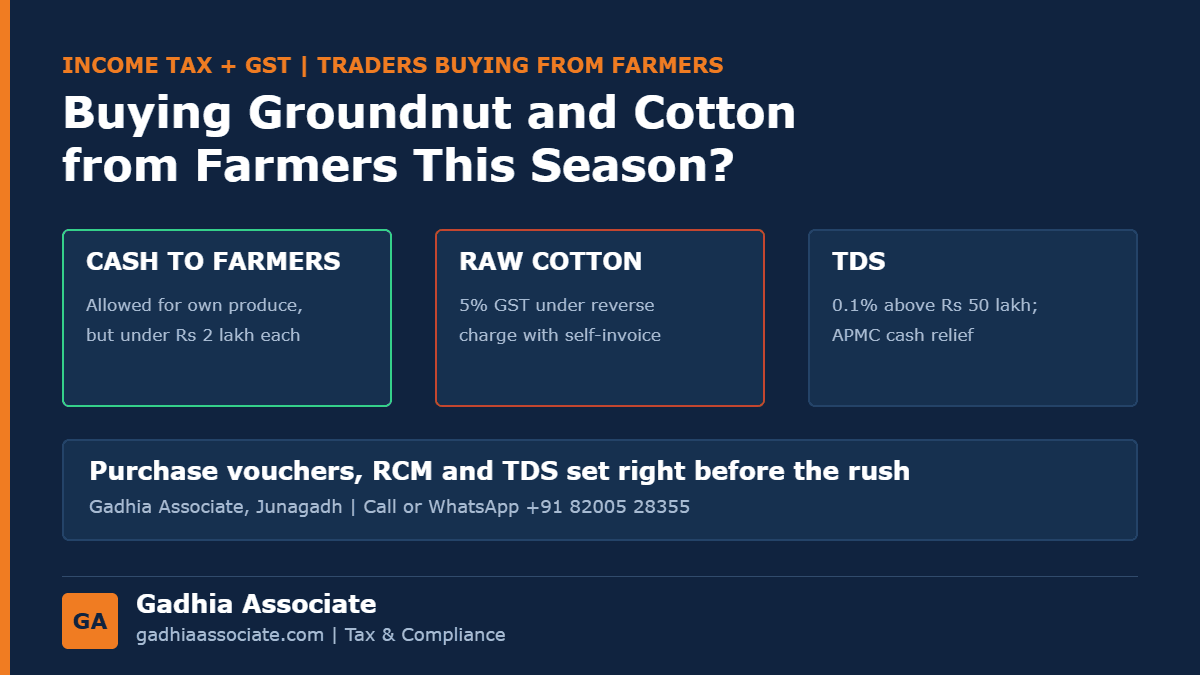
- The farmer's side: no one can receive Rs 2 lakh or more in cash from one person in a day, for one transaction or for one event. The penalty, equal to the amount, falls on the farmer.
- In practice: pay Rs 2 lakh or more by bank transfer or UPI, which also gives both sides a clean record. See cash transaction limits.
GST on what you buy and sell
- Farmers: an agriculturist selling his own produce does not need GST registration.
- Raw cotton: bought from an agriculturist, it attracts 5% GST under reverse charge, payable by the registered buyer. Issue a self-invoice and payment voucher, pay the tax in cash, then claim the credit.
- Groundnut: no reverse charge on purchases from farmers. Sales of groundnut by a registered trader carry 5%, while seed-quality groundnut for sowing is exempt.
- Exempt services: commission agents, loading, packing, warehousing and road transport of agricultural produce are exempt from GST.
- E-way bill: needed for taxable consignments above Rs 50,000.
- Coming soon: e-invoicing of reverse charge self-invoices for businesses with turnover of Rs 5 crore or more is in testing, with no start date yet.
TDS on purchases
- Who deducts: a buyer whose turnover crossed Rs 10 crore in the previous year.
- On what: 0.1% on purchases from one seller above Rs 50 lakh in the year, including large farmers.
- Without PAN: the rate jumps to 5%, so collect PAN from big suppliers early. See TDS on purchases.
TDS on cash withdrawals
- The rule: banks deduct 2% TDS on cash withdrawals above Rs 1 crore in a year, and from a lower limit if returns have not been filed.
- APMC relief: commission agents and traders registered under the APMC law, withdrawing cash to pay farmers for produce, can be exempted, after giving the bank the required details and certificate.
- Plan ahead: share the APMC licence and purchase records with your bank at the start of the season.
Farmers' own tax
- Exempt: income from selling your own crop is agricultural income, though it can raise the tax rate on other income. See agricultural income tax.
- Trading is different: a farmer who also buys and resells others' produce earns business income on that part.
- Cash deposits: keep yard receipts and sale bills to explain large cash deposits. See cash deposit rules.
Records that protect you
- Purchase vouchers with the farmer's name, village, land record number and quantity
- Bank or UPI payment for Rs 2 lakh and above to any one farmer
- Self-invoices and RCM payment for raw cotton, month by month
- APMC fee receipts and gate passes matched to stock
- A daily cash book that ties withdrawals to farmer payments
Back to Jagdishbhai. From this season, farmers owed Rs 2 lakh or more are paid by bank transfer, and smaller cash payments carry the farmer's land record and signature. His raw cotton purchases go through monthly self-invoices with 5% GST paid under reverse charge and taken back as credit, and last year's missed tax is paid with interest before a notice arrives. He gives his bank the APMC details needed to stop TDS on cash withdrawn for farmer payments, and collects PAN from the two large farmers who sell him more than Rs 50 lakh a year.
How we help
- GST registration, returns and RCM self-invoicing for traders
- Purchase voucher and cash book formats that stand scrutiny
- TDS on purchases and the cash withdrawal exemption for APMC traders
- Income tax returns and audits for traders, oil mills and ginners
- Replies to GST and income tax notices on farmer purchases
- Tax planning for farmers with large cash deposits
Gadhia Associate has been in practice since 2007 and has handled work for over 7,000 clients, with a 5.0 Google rating from more than 100 reviews. Traders, oil mills and ginning units from Junagadh, Rajkot, Gondal, Keshod and Amreli come to our Junagadh office, where same-day appointments are available. Work for clients elsewhere is handled online.
Buying from farmers this season? Get your cash payments, RCM and TDS set right before the rush. Call or WhatsApp +91 82005 28355, or message us on WhatsApp. The first consultation is free.
Frequently asked questions
Can a trader pay farmers in cash?
Yes, for the farmer's own produce, without losing the expense deduction. But a farmer cannot receive Rs 2 lakh or more in cash from one buyer in a day or for one sale.
Is GST payable on raw cotton bought from farmers?
Yes. 5% under reverse charge, paid by the registered buyer, who can then claim the credit.
Is GST payable on groundnut bought from farmers?
Not on the purchase. A registered trader charges 5% when selling it.
Does a farmer need GST registration to sell his crop?
No. An agriculturist selling produce from his own land does not need to register.
Is TDS deducted on purchases from farmers?
Yes, at 0.1%, if the buyer's turnover is above Rs 10 crore and purchases from that farmer cross Rs 50 lakh in the year.
Can APMC traders avoid TDS on large cash withdrawals?
Yes. Traders and commission agents registered under the APMC law can be exempted for cash withdrawn to pay farmers, after giving the bank the required details.
Position as of 29 October 2026, under the Income-tax Act, 2025 and the GST law in force. Rates and exemptions depend on the exact produce and your registration, so take advice on your own business.