Took a Loan in Your Company's Name? CHG-1 Charge Registration Within 30 Days, Late Fees, CHG-4 After Repayment and the Rs 5 Lakh Penalty
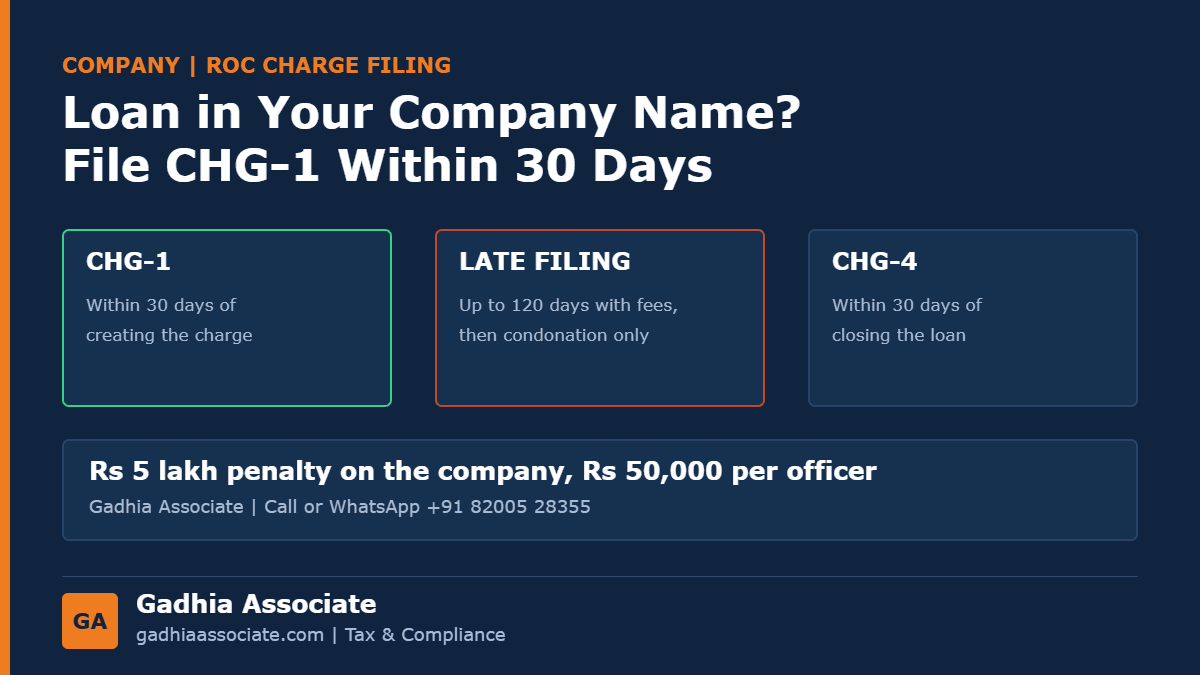
A private limited company that takes a secured loan must register the charge with the ROC in Form CHG-1 within 30 days, or pay heavy fees.
Mehulbhai's private limited company in Jamnagar makes brass parts. Last year it took a Rs 1.5 crore term loan and cash credit against its factory and stock, a car loan for his SUV, and it closed an old loan with another bank. Now a new bank offering a better rate has run an MCA search: the old loan still shows as an open charge, the car loan was never registered, and the bank wants both fixed before sanction.
Charge filings are among the most commonly missed ROC compliances, because the bank handles the loan papers and everyone assumes the ROC part is done. Here is how it works in 2026.
Our team files CHG-1, CHG-4 and condonation applications, and runs charge searches before you apply for a loan. Call or WhatsApp +91 82005 28355, or see the details at the end of this guide.
What counts as a charge
- Property: a mortgage of land, buildings or a factory.
- Movable assets: hypothecation of stock, debtors, machinery or vehicles, including car and commercial vehicle loans.
- Pledges: of shares, fixed deposits or other securities given for a loan.
- Changes: enhancement of limits, renewal with extra security or any change in terms is a modification, filed in CHG-1 within 30 days.
- Not a charge: unsecured loans with no security over the company's assets.
Filing CHG-1
- Deadline: within 30 days of the date the charge is created, usually the date of the loan or security documents.
- Signatures: digital signatures of a director and of the lender.
- Attachments: the deed or document creating the charge, such as the hypothecation agreement or mortgage deed.
- Fees: based on the company's authorised capital.
- If the company does not file: the lender can file it and recover the fees from the company.
Late filing
- Day 31 to 60: allowed with additional fees, a multiple of the normal fee.
- Day 61 to 120: allowed with an ad valorem fee based on the amount secured, subject to a cap.
- After 120 days: only after the Regional Director condones the delay, on an application in Form CHG-8 explaining the reason.
Closing the charge after repayment
- Form CHG-4: within 30 days of full repayment, with the lender's no-dues certificate and signatures of the company and the lender.
- Late CHG-4: can be filed with additional fees, but an open charge on the MCA record stays until it is filed.
- Why it matters: new lenders check the charge register, and an old open charge can hold up a sanction or a sale of the asset.
- Uncooperative lender: the Registrar can record satisfaction on evidence of repayment, after giving the lender notice.
Penalties and risks
- Penalty: Rs 5 lakh on the company and Rs 50,000 on each officer in default.
- Weak security: an unregistered charge is not counted against a liquidator or other creditors, so lenders insist on it and may hold back funds until it is filed.
- Loan stays valid: the company still owes the money; only the security is affected.
- Annual filings: charges also appear in the company's yearly MCA filings. See private limited company annual compliance.
LLPs, firms and proprietors
- LLPs: no CHG forms; charges are reported in the yearly Form 8.
- Proprietors and partnership firms: no ROC filing at all. The bank registers its security with CERSAI instead.
A simple checklist
- Note the 30-day deadline on the day any loan, renewal or top-up is signed.
- Register vehicle loans as soon as the car or truck is hypothecated.
- Collect the no-dues certificate and file CHG-4 in the same month a loan is closed.
- Run an MCA charge search before applying for a new loan. See business loans for private limited companies.
- Keep directors' digital signatures and KYC current, so filings are not stuck. See DIR-3 KYC.
Back to Mehulbhai. The old bank's no-dues letter is collected and CHG-4 is filed with additional fees, closing the open charge. The car loan charge, now more than 120 days old, needs a CHG-8 application to the Regional Director explaining the oversight, followed by CHG-1 once the delay is condoned. The new bank's sanction goes ahead with its CHG-1 diarised for filing within 30 days of signing, and the company now keeps a charge register that is reviewed at every board meeting.
How we help
- CHG-1 for new loans, renewals and modifications
- CHG-4 on repayment, and follow-up with lenders
- CHG-8 condonation applications to the Regional Director
- Charge searches and clean-up before a new loan
- Annual ROC filings, board minutes and registers
- Project reports and CA certificates for bank loans
Gadhia Associate has been in practice since 2007 and has handled work for over 7,000 clients, with a 5.0 Google rating from more than 100 reviews. Companies from Junagadh, Rajkot, Jamnagar, Morbi and Gondal come to our Junagadh office, where same-day appointments are available. ROC work for companies elsewhere in India is handled online.
Took a loan or closed one, and not sure the ROC filing was done? Get your charge record checked this week. Call or WhatsApp +91 82005 28355, or message us on WhatsApp. The first consultation is free.
Frequently asked questions
What is the time limit for filing CHG-1?
30 days from the creation of the charge, extendable to 60 days with additional fees and to 120 days with an ad valorem fee.
Is charge registration needed for a car loan in a company's name?
Yes. Hypothecation of the car is a charge on the company's asset and must be registered in CHG-1.
What happens if a company does not register a charge?
The charge does not count against a liquidator or other creditors, and the company faces a Rs 5 lakh penalty, with Rs 50,000 for each officer in default.
When is Form CHG-4 filed?
Within 30 days of full repayment, with the lender's no-dues certificate.
Can a charge be registered after 120 days?
Only after the Regional Director condones the delay on an application in Form CHG-8.
Do LLPs file CHG-1?
No. LLPs report their charges in the yearly Form 8.
Position as of 27 October 2026, under the Companies Act, 2013 and the Companies (Registration of Charges) Rules, 2014. Fees follow the MCA portal, so check the current fee before filing.