Joint Development Agreement for Land in Gujarat 2026: When the Landowner Pays Tax, 10% TDS on Cash, GST on Flats and RERA Duties
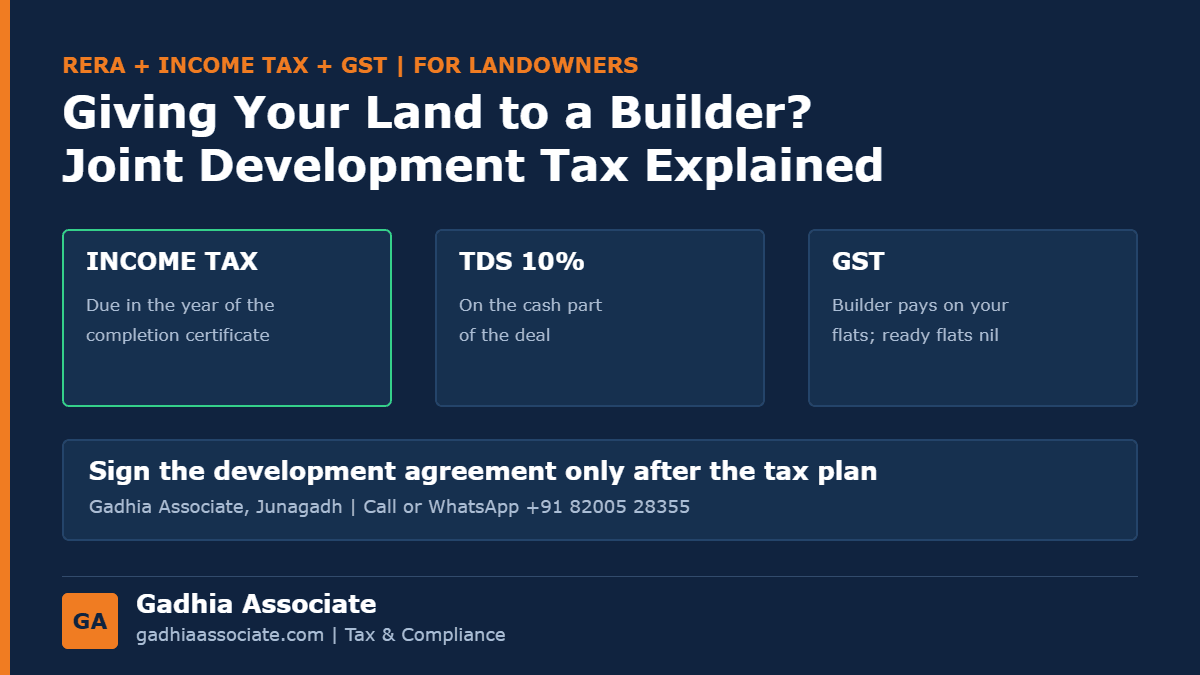
Under a registered joint development agreement, a landowner pays capital gains tax only when the project's completion certificate is issued.
Three Patel brothers own a 3,000 square metre plot on the edge of Rajkot that they inherited from their father. A builder has offered a joint development deal: he will build 60 flats at his own cost and give the family 24 of them, plus Rs 50 lakh in cash on signing. The brothers want to know when they pay tax, whether GST applies to them, and what happens when they sell their flats.
Joint development deals are now common across Gujarat because they let landowners share in the value of a project without selling the land outright. The tax rules are friendly, but only if the agreement is drafted and registered correctly. Here is how it works in 2026.
Our team reviews the agreement before you sign, plans the tax year by year and handles TDS, GST and the returns. Call or WhatsApp +91 82005 28355, or see the details at the end of this guide.
How a joint development deal works
- The landowner: gives the land and the right to develop it, without selling it outright.
- The builder: gets the approvals, registers the project with GujRERA and builds at his own cost.
- The landowner's share: an agreed number of flats, shops or plots, sometimes with cash as well.
- The agreement: registered, with stamp duty paid. Registration also decides the tax treatment.
When the landowner pays income tax
- The special rule: for individuals and HUFs with a registered agreement, the capital gain arises in the year the completion certificate for the whole or part of the project is issued.
- The value taxed: the stamp duty value of your share of flats on the date of that certificate, plus any cash received.
- The rate: land held for more than 24 months gives a long-term gain taxed at 12.5%. For land bought before 23 July 2024, resident individuals and HUFs can choose 20% with indexation if that works out lower.
- Your cost: what you paid for the land, or for inherited land, the previous owner's cost, with the option of its value on 1 April 2001 if it was bought earlier.
- Outside the rule: firms, LLPs and companies, agreements that are not registered, and landowners who sell their share before completion. For them the normal rules apply, and tax can arise in the year possession is handed over or the share is sold.
- Reducing the tax: exemptions for buying a house or investing in specified bonds can apply if the conditions and timing fit. See saving capital gains tax.
TDS on the cash part
- 10% TDS: the builder deducts tax at 10% on any cash paid to the landowner under the agreement, and it is credited to your PAN.
- No TDS on flats: the flats you receive do not carry TDS.
GST in a joint development
- Land: no GST on land itself.
- Development rights for residential flats: exempt since April 2019. If flats remain unbooked when the completion certificate is issued, the builder pays GST on a proportionate part under reverse charge.
- Commercial portion: GST on development rights for shops and offices is paid by the builder under reverse charge.
- Flats given to the landowner: the builder pays GST on their construction at 1% for affordable housing or 5% otherwise, valued at the price of similar flats, when the completion certificate is issued or the flats are first occupied.
- Landowner selling before completion: you charge GST to your buyers, with credit for the GST the builder charged you on those flats.
- After completion: sale of a ready flat carries no GST.
RERA and the landowner
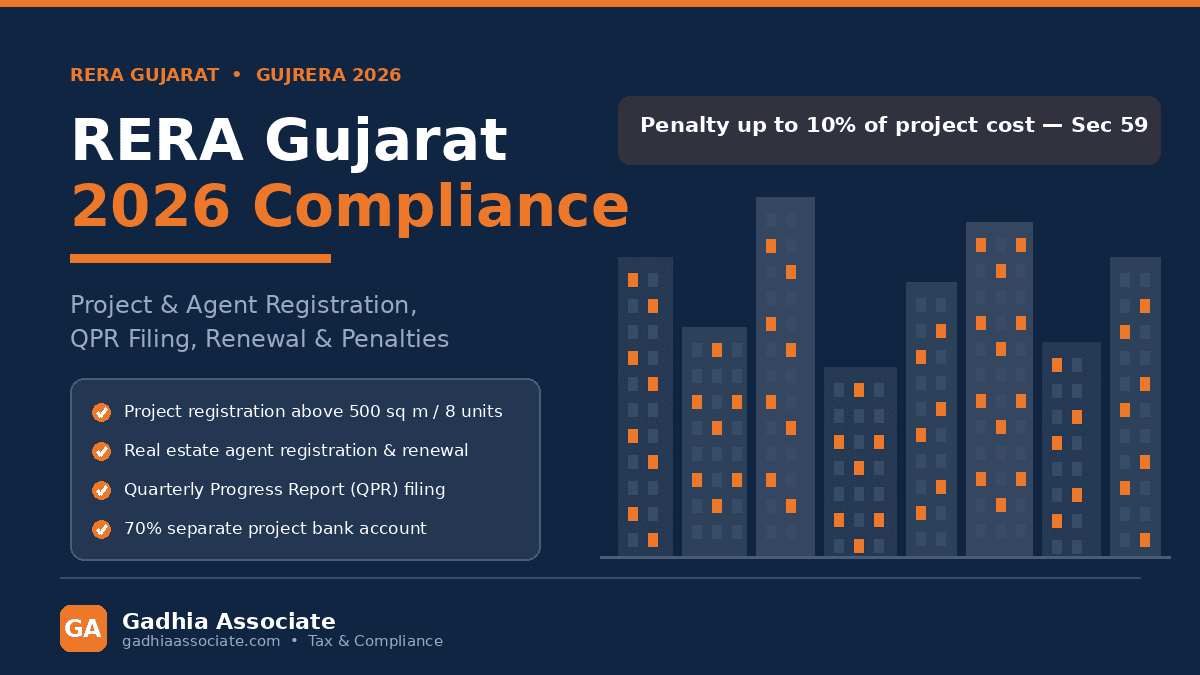
- Registration first: the builder must register the project with GujRERA before advertising or booking, with the agreement and land title as part of the file. See RERA Gujarat registration and filings.
- You can be a promoter: if you sell your share of flats, you are treated as a promoter for those sales, and RERA rules on agreements, carpet area and advance payments apply to you.
- Protect yourself: the agreement should fix the completion date, the specification of your flats, and compensation if the builder delays.
Selling your flats later
- Your cost: the value on which you paid tax in the completion year becomes the cost of your flats.
- Short or long term: counted from when the flats are received. A flat sold within 24 months gives a short-term gain taxed at your slab rate; after that, it is long-term at 12.5%.
- Buyer's TDS: a buyer of a flat above Rs 50 lakh deducts 1% TDS. See TDS mistakes in property deals.
Back to the Patel brothers. The agreement is registered in the names of all three, so the special rule applies to each of them as individuals. The builder deducts Rs 5 lakh of TDS on the Rs 50 lakh cash, which the brothers claim against their tax. Nothing is taxed on signing; the gain falls due in the year the completion certificate is issued, on the stamp duty value of their 24 flats plus the cash, with the 20% indexed option compared against 12.5%. They plan to sell eight flats after completion, free of GST, to pay that tax, and keep the rest for rent, with each flat's cost already fixed by the value taxed.
How we help
- Reviewing the development agreement for tax before you sign
- Working out capital gains for each co-owner, year by year
- TDS on the cash part and credit in your returns
- GST for landowners selling flats before completion
- RERA compliance for landowners and builders
- Planning exemptions and the sale of your share of flats
Gadhia Associate has been in practice since 2007 and has handled work for over 7,000 clients, with a 5.0 Google rating from more than 100 reviews. Landowners and builders from Junagadh, Rajkot, Jamnagar, Gondal and Porbandar come to our Junagadh office, where same-day appointments are available. Work for clients elsewhere is handled online.
Got a joint development offer for your land? Get the tax worked out before you sign. Call or WhatsApp +91 82005 28355, or message us on WhatsApp. The first consultation is free.
Frequently asked questions
When does a landowner pay tax under a joint development agreement?
In the year the completion certificate is issued, for individuals and HUFs with a registered agreement.
Is TDS deducted in a joint development agreement?
Yes, 10% on any cash paid to the landowner. There is no TDS on the flats received.
Does the landowner pay GST in a joint development?
Not on the land or on residential development rights. Only if the landowner sells flats before completion, with credit for the GST charged by the builder.
What is the cost of flats received under a joint development agreement?
The value on which capital gains tax was paid in the year of the completion certificate.
Does the special rule apply to firms and companies?
No. It applies only to individuals and HUFs with a registered agreement.
Does a joint development project need RERA registration?
Yes. The builder must register it with GujRERA before any booking or advertising.
Position as of 27 October 2026. The joint development rules are described as carried into the Income-tax Act, 2025, where section numbers have changed, and GST is as notified for real estate from 1 April 2019. Every agreement is different, so take advice before you sign.