
RERA Gujarat 2026: Project and Agent Registration, QPR Filing, Renewal and Penalties Explained
RERA Gujarat 2026: Project Registration, Agent Registration and QPR Filing Explained
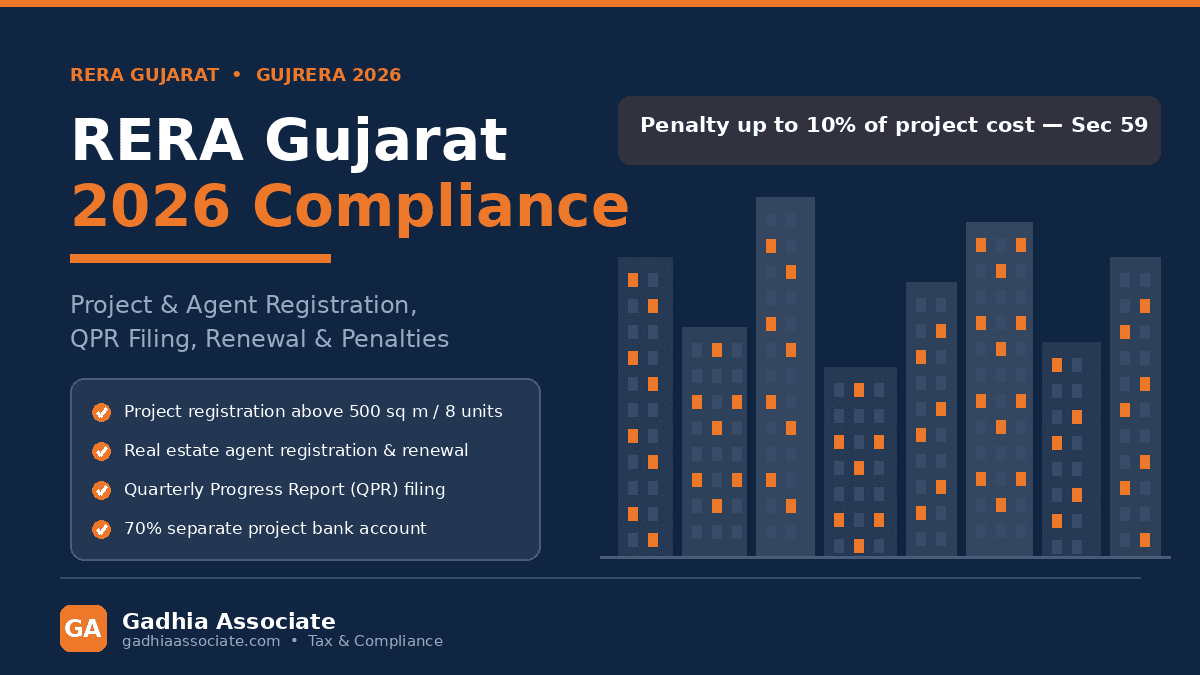
RERA Gujarat, administered by GUJRERA, requires every promoter to register a real estate project before advertising, marketing, booking or selling any unit in it, where the land proposed to be developed exceeds 500 square metres or the project has more than eight apartments. Every real estate agent dealing in a registered project must hold a separate agent registration. Promoters must also file a Quarterly Progress Report and route 70% of buyer collections through a separate account.
Whether you are a developer in Junagadh, a broker in Rajkot or a builder launching in Ahmedabad, the compliance calendar is the same. This guide sets out who must register, how agents register, what a QPR is, what happens if you skip registration, and how extensions work.
Which projects need RERA registration in Gujarat?
Registration under section 3 of the Real Estate (Regulation and Development) Act, 2016 is mandatory for a promoter where either threshold is crossed, that is the area of land proposed to be developed exceeds 500 square metres, or the number of apartments proposed to be developed exceeds eight, inclusive of all phases. Both residential and commercial projects are covered.
Two points trip up promoters. First, each phase is treated as a standalone project and registered separately. Second, registration must be in place before any advertisement, marketing, booking, selling or offer for sale. Putting a hoarding on the Junagadh to Rajkot highway or a listing on a portal before the GUJRERA number is issued is itself a contravention, even if no booking is taken.
Limited exemptions exist, for example projects below the thresholds, and renovation or repair work that does not involve marketing or fresh allotment. These exemptions are read narrowly, so take a written view before relying on one.
What does a promoter need to register a project with GUJRERA?
- Promoter PAN, constitution documents, and the authorised signatory's details
- Clear title report and land ownership or development rights documents
- Sanctioned plans, layout, and commencement certificate from the local authority
- Project details such as proposed completion date, unit configuration, common areas and amenities
- Details of the separate bank account to hold 70% of collections
- Audited details of the promoter's past projects and any pending litigation
- Declaration in the prescribed form and payment of the applicable registration fee
GUJRERA fees are prescribed per square metre of the proposed area and differ between residential, commercial and mixed-use projects, so confirm the current schedule on the GUJRERA portal before budgeting.
What is the 70% escrow rule?
Seventy per cent of the amounts realised from allottees for a project must be deposited in a separate account maintained in a scheduled bank, to be used only for that project's land and construction cost. Withdrawals are permitted in proportion to the percentage of completion, and must be certified by an engineer, an architect and a chartered accountant in practice. This is the single most examined item in a GUJRERA inspection and the most common cause of enforcement action against otherwise compliant builders.
How do I register as a real estate agent in Gujarat?
Any person who negotiates or acts on behalf of another in the sale or purchase of a unit in a registered project, whether called a broker, dealer or middleman, must obtain a real estate agent registration from GUJRERA. The application is made online with PAN, address proof, photographs, business constitution documents, income tax returns, and details of any registration held in other states, along with the prescribed fee. Registration is granted for a fixed validity, commonly five years, and must be renewed before it lapses.
A registered agent must quote the registration number in every advertisement, may not facilitate the sale of an unregistered project, must maintain books and records of transactions, and must give the allottee access to the project information the promoter is required to publish.
Promoter obligations versus agent obligations, what is the difference?
The two roles carry very different burdens, and confusing them is expensive. A promoter carries the heavy, continuing compliance: project registration per phase, quarterly progress reporting, the 70% separate account with tripartite certification, adherence to the sanctioned plan, the model agreement for sale, delivery by the declared completion date, and a five-year structural defect liability. A promoter's default can attract a penalty of up to 10% of the estimated project cost.
An agent, by contrast, is registered as a person rather than per project, files no QPR, and holds no buyer money in escrow. The agent's duties are disclosure-based: register, renew on time, quote the number, deal only in registered projects, keep records, and avoid misleading representations. The exposure is a daily penalty for continuing default rather than a percentage of project cost. In short, the promoter is accountable for the building and the agent is accountable for the representation.
What is a QPR and how often must it be filed?
A Quarterly Progress Report is the promoter's periodic update to GUJRERA on the status of a registered project, covering physical construction progress, unit-wise booking and sale status, money received and deployed, and any change in approvals or project details. It is filed online in the prescribed form for every quarter of the financial year, for the whole period until the project receives its completion or occupancy certificate.
The filing window after each quarter closes is short, and GUJRERA has moved to a stricter regime that includes fees and daily charges for delayed submissions, with the portal locking a missed quarter until the delay is regularised. Practically, this means QPR should be a diarised quarterly task handled alongside your GST returns, not something remembered at year end. Our RERA Compliance service page covers end-to-end QPR preparation for Saurashtra and Gujarat projects.
What is the penalty for selling without RERA registration?
Under section 59 of the RERA Act, 2016, a promoter who fails to register a project as required by section 3 is liable to a penalty of up to ten per cent of the estimated cost of the project. If the promoter continues to violate the requirement after that, the law provides for imprisonment of up to three years, or a further fine, or both. Section 60 deals with providing false information at registration and section 61 with other contraventions of the Act, each carrying its own penalty ceiling. Real estate agents who contravene section 9 or section 10 face penalty under section 62, computed on a daily basis for the period the default continues, subject to a cap.
Beyond the money, an unregistered project cannot be advertised, cannot be lawfully sold, and gives every allottee a strong footing in any complaint before the Authority.
Can a RERA project be extended?
Yes. A promoter may apply to GUJRERA for an extension of the registration where completion is delayed, supported by reasons, the applicable fee and the current project status. Extension is not automatic, it is granted at the Authority's discretion, generally for reasons genuinely beyond the promoter's control such as force majeure or delayed statutory approvals, and typically for a limited additional period. A clean QPR record substantially improves the chance of an extension being allowed, which is one more reason not to let quarters lapse.
Getting RERA right alongside your other filings
Real estate compliance rarely sits alone. Development agreements, joint ventures and unit sales all carry GST implications, and our GST Calculator helps with quick working, while land or unit transfers raise capital gains questions our Capital Gain Tax Calculator can model. Promoters structuring a new venture as a company or LLP should look at our Company Registration service page before the first approval is applied for.
How Gadhia Associate Can Help
Gadhia Associate, based in Junagadh, works with promoters, developers and agents across Gujarat, including Junagadh, Rajkot, Ahmedabad and the wider Saurashtra region, on GUJRERA project registration, agent registration and renewal, quarterly QPR filing, extension applications, escrow certification support and replies to GUJRERA notices, together with the related GST, income tax and ROC work. Contact us for a free consultation on your project's RERA position.
Position as of August 2026. RERA thresholds, fees, timelines and penalty provisions change through GUJRERA notifications, orders and circulars, and tax positions through CBDT and CBIC. Please confirm the current requirements with a qualified professional before acting on this article.