Appointing or Removing a Director in a Private Limited Company in 2026: DIN, DIR-12 Within 30 Days, Resignation and Removal
Appointing or removing a director in a private limited company needs a board or shareholder decision and Form DIR-12 at the ROC within 30 days.
Pravinbhai, 68, wants to step down as a director of his family's oil mill company in Junagadh and bring in his daughter-in-law, an engineer who already runs the plant. The company has only two directors, Pravinbhai and his son. The family assumed a letter and a board meeting would do, until the bank asked for the updated ROC record before changing the signatories.
Director changes are among the most common company law events in family businesses, and they are easy to get wrong in sequence. Here is how appointment, resignation and removal work in 2026.
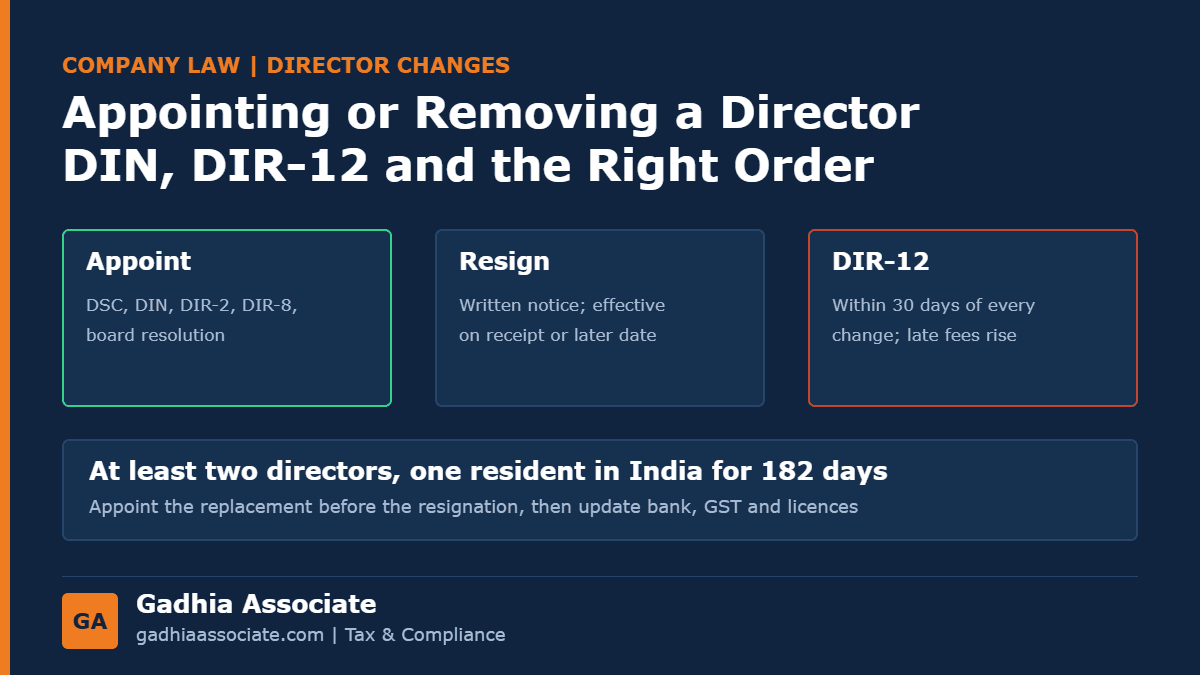
In short: A private company needs at least two directors, and at least one must have stayed in India for 182 days or more in the previous calendar year. A new director needs a DIN and a digital signature, gives consent in Form DIR-2 and a declaration in Form DIR-8, and is usually appointed by the board as an additional director until the next AGM, where shareholders confirm the appointment. A director resigns by written notice, and the resignation takes effect when the company receives it or from a later date given in the notice. Removal needs an ordinary resolution of shareholders after special notice. In every case, the company files Form DIR-12 within 30 days, and late filing costs rise with the delay. Bank mandates, GST registration and other licences must be updated too.
Our company law team handles DIN and DSC, resolutions, DIR-12 and the updates that follow. The details are at the end of this guide.
Who can be a director?
- Numbers: a private company needs at least two directors, a one person company one, and any company can have up to 15 without a special resolution.
- Resident director: at least one director must have stayed in India for 182 days or more in the previous calendar year. See our guide on NRIs and private companies.
- Not disqualified: a person who was a director of a company that failed to file its financial statements or annual returns for three years in a row is disqualified for five years. See company struck off or director disqualified.
- Active DIN: a DIN is deactivated if the yearly KYC is not filed. See DIR-3 KYC.
Appointing a new director, step by step
- Digital signature and DIN: the new director needs a DSC and, if not already held, a DIN.
- Consent and declaration: Form DIR-2 consenting to act, and Form DIR-8 confirming the person is not disqualified.
- Board resolution: if the Articles allow, the board appoints the person as an additional director, who holds office until the next AGM.
- Interest disclosure: the director discloses other directorships and interests in Form MBP-1 at the first board meeting.
- File DIR-12: within 30 days of the appointment, with the consent and the resolution.
- Confirm at the AGM: shareholders regularise the appointment by ordinary resolution.
- Update the rest: register of directors, bank mandate, GST registration within 15 days of the change, and licences such as IEC or FSSAI where directors are named.
Resignation
- Notice: the director gives written notice to the company.
- Effective date: the date the company receives it, or a later date given in the notice.
- Company's filing: DIR-12 within 30 days of receiving the notice.
- Director's own filing: the director may also send the resignation to the ROC in Form DIR-11 within 30 days.
- Minimum numbers: if a resignation would leave fewer than two directors, appoint the new director first.
- Past liability: a director who resigns remains liable for offences that took place during the tenure.
Removal by shareholders
- Special notice: members give the company special notice of the resolution at least 14 days before the meeting.
- Right to be heard: the director can make a written representation and be heard at the meeting.
- Ordinary resolution: a simple majority of shareholders removes the director, and DIR-12 follows within 30 days.
When a director's office falls vacant automatically
- Disqualification under the Companies Act
- Absence from all board meetings held over 12 months, with or without leave
- Death, for which DIR-12 is filed with the death certificate
What late or wrong filing costs
- Additional fees: DIR-12 filed late attracts additional fees that rise with the delay, from two to twelve times the normal fee.
- Stuck records: banks, GST officers and lenders rely on the MCA record, so an unfiled change blocks signatory and loan updates.
- Wrong sequence: a resignation filed before a replacement is appointed can leave the company below the minimum number of directors.
Back to Pravinbhai. First, his daughter-in-law gets a DSC and DIN and signs DIR-2 and DIR-8. The board appoints her as an additional director, and DIR-12 is filed. Only then does Pravinbhai resign, with a second DIR-12 within 30 days, so the company never falls below two directors. The bank mandate and GST registration are updated, and the AGM confirms her appointment. Our guide to private limited company annual compliance covers the AGM and yearly filings.
How we help
- DSC and DIN for new directors, and DIR-3 KYC
- Board and shareholder resolutions in the right order
- DIR-12 and DIR-11 filings, and AGM regularisation
- Removal of a director, including special notice
- Updates to bank mandates, GST registration and licences
- Restoring disqualified directors and deactivated DINs
Gadhia Associate has been in practice since 2007 and has handled work for over 7,000 clients, with a 5.0 Google rating from more than 100 reviews. Family companies from Junagadh, Rajkot, Jamnagar, Gondal and Morbi come to our Junagadh office, where same-day appointments are available. Company work for clients elsewhere in India is handled online.
Adding, replacing or removing a director? Get the sequence and filings right the first time. Call or WhatsApp +91 82005 28355, or message us on WhatsApp. The first consultation is free.
Frequently asked questions
What is the time limit to file DIR-12?
30 days from the appointment, resignation or removal of a director.
Who can appoint an additional director?
The board, if the Articles allow it. The additional director holds office until the next AGM, where shareholders can confirm the appointment.
When does a director's resignation take effect?
From the date the company receives the notice, or a later date given in it.
Can a director resign if only two directors remain?
The company must not fall below two directors, so a replacement should be appointed before the resignation takes effect.
How can shareholders remove a director?
By ordinary resolution at a general meeting, after special notice and giving the director a chance to be heard.
Does a private company need a resident director?
Yes. At least one director must have stayed in India for 182 days or more in the previous calendar year.
Position as of 22 October 2026, under the Companies Act, 2013 and the rules on appointment of directors. Articles of association can add conditions, so take advice on your own company.