Diwali to Diwali Books in 2026: Can Gujarati Traders Keep a Vikram Samvat Year? What Income Tax, GST, Companies and Banks Require
Diwali to Diwali books are a Gujarati trading tradition, but income tax, GST and company law all work on an April to March year.
Navinbhai's family has run a grain and oilseed trading firm in Junagadh for three generations. Every Labh Pancham the new chopda is opened, stock is counted after Diwali and the partners settle accounts for the Samvat year. Every year, his accountant then rebuilds the figures from April to March for the tax return and the bank, recounting stock that was last counted in November.
The new Samvat year begins with Diwali in November 2026. Here is what the law requires, and how to keep the tradition without doing the accounts twice.
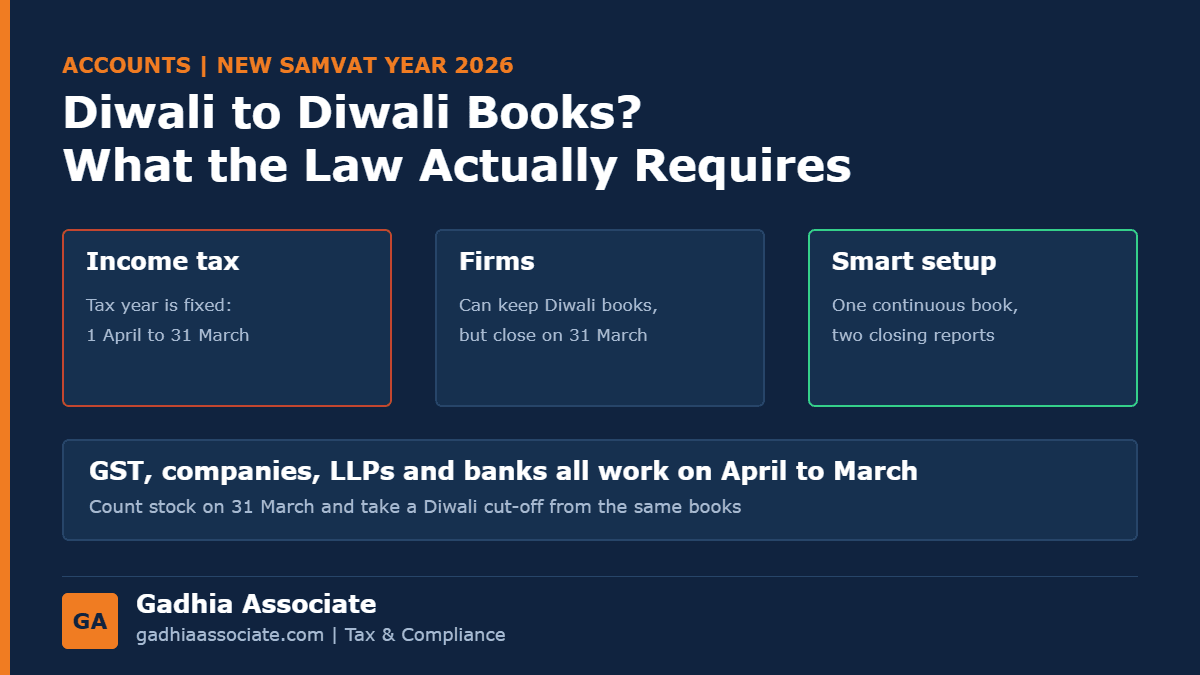
In short: The income tax year is fixed at 1 April to 31 March for everyone, so income must be worked out for that period whatever year your books follow. GST returns are monthly or quarterly and the annual return covers April to March. Companies and LLPs must use the April to March financial year. A proprietor or partnership firm can still keep internal books on the Diwali year, but needs a proper closing on 31 March, including stock, for tax, the tax audit and the bank. The simplest way is to keep continuous books, close on 31 March for the law and take a Diwali cut-off for the partners and the family.
Our team handles accounting, tax audits and bank papers for traders, with books set up to serve both years. The details are at the end of this guide.
What the law requires
- Income tax: income is computed for the tax year from 1 April to 31 March. A Diwali year is not accepted for the return.
- GST: returns follow calendar months or quarters, and the annual return, input tax credit time limits and turnover limits run on April to March.
- Companies: the financial year must end on 31 March, with limited exceptions approved by the tribunal.
- LLPs: also follow an April to March financial year.
- Proprietors and firms: are free to keep internal accounts on any year, but every legal filing uses April to March.
What a 31 March closing needs
- Stock: a count or a reliable working of stock on 31 March, valued on a consistent method. A November count cannot simply be carried to March.
- Cut-off: sales, purchases and expenses booked in the right year, especially around the March year end.
- Depreciation: worked out for April to March.
- Tax audit: where turnover crosses the audit limit, the auditor reports on the April to March accounts. See tax audit.
- Presumptive tax: the 6% and 8% presumptive scheme also uses April to March turnover. See presumptive taxation.
Partnership firms on a Samvat year
- Profit sharing: partners can still settle among themselves on the Diwali year, if the deed says so.
- Tax: the firm's taxable profit, partners' salary and interest limits, and the partners' shares for their own returns are all worked out for April to March.
- The deed: make sure it explains how the two years are reconciled, so remuneration claims hold up. See what a partnership deed must say.
Banks and lenders
- Loan renewals: banks want audited April to March accounts and projections for the next financial year.
- Stock statements: monthly or quarterly stock statements must match your books and GST returns.
- Mismatches: a Diwali-year balance sheet that does not tie to the tax return raises questions in credit reviews.
How to keep both years without double work
- Keep one set of continuous books in accounting software, month by month.
- Close the books legally on 31 March, with stock, depreciation and adjustments.
- Take a Diwali cut-off report from the same books for the chopda, the partners and the family.
- File GST every month from the same books, so the annual return reconciles itself.
Back to Navinbhai. His firm now keeps one set of books in accounting software. The legal closing happens on 31 March with a stock count, and the tax audit and bank papers come from it. At Diwali, the same books give a Samvat-year report for the chopda pujan and the partners' settlement, without a second stock count. The partnership deed is updated to say how profits for the two years are reconciled. Our monthly accounting retainer covers exactly this.
How we help
- Set up books that serve both the Diwali year and April to March
- Year-end closing with stock, depreciation and cut-off
- Tax audit and income tax returns for traders
- GST returns and the annual return from the same books
- Partnership deed updates for profit sharing
- Bank stock statements, CMA data and loan papers
Gadhia Associate has been in practice since 2007 and has handled work for over 7,000 clients, with a 5.0 Google rating from more than 100 reviews. Traders and family firms from Junagadh, Rajkot, Gondal, Jamnagar and Morbi come to our Junagadh office, where same-day appointments are available. Accounting for businesses elsewhere is handled online.
Opening new books this Labh Pancham? Set them up once so the Diwali year and the tax year both work. Call or WhatsApp +91 82005 28355, or message us on WhatsApp. The first consultation is free.
Frequently asked questions
Can a business keep books from Diwali to Diwali?
A proprietor or partnership firm can keep internal books on the Diwali year, but income tax, GST and bank filings all use April to March.
Can a company follow the Vikram Samvat year?
No. A company's financial year must end on 31 March, with only limited exceptions approved by the tribunal.
Is a stock count needed on 31 March?
Yes, or a reliable working of stock on that date, because the tax year closes on 31 March.
Which year is used for the tax audit?
April to March. The auditor reports on accounts for that period.
How do partners share profit if the firm follows the Diwali year?
They can settle on the Diwali year if the deed provides for it, but taxable profit and partners' shares for returns are worked out for April to March.
Does GST allow a Diwali year?
No. GST returns are monthly or quarterly, and the annual return covers April to March.
Position as of 22 October 2026. The tax year under the Income-tax Act, 2025 runs from 1 April to 31 March. Accounting methods should be applied consistently, so take advice before you change your books.