Tax Audit Under Section 44AB for AY 2026-27: Do You Need One, the 30 September Deadline and the Penalty for Missing It
Do I need a tax audit under Section 44AB for AY 2026-27?
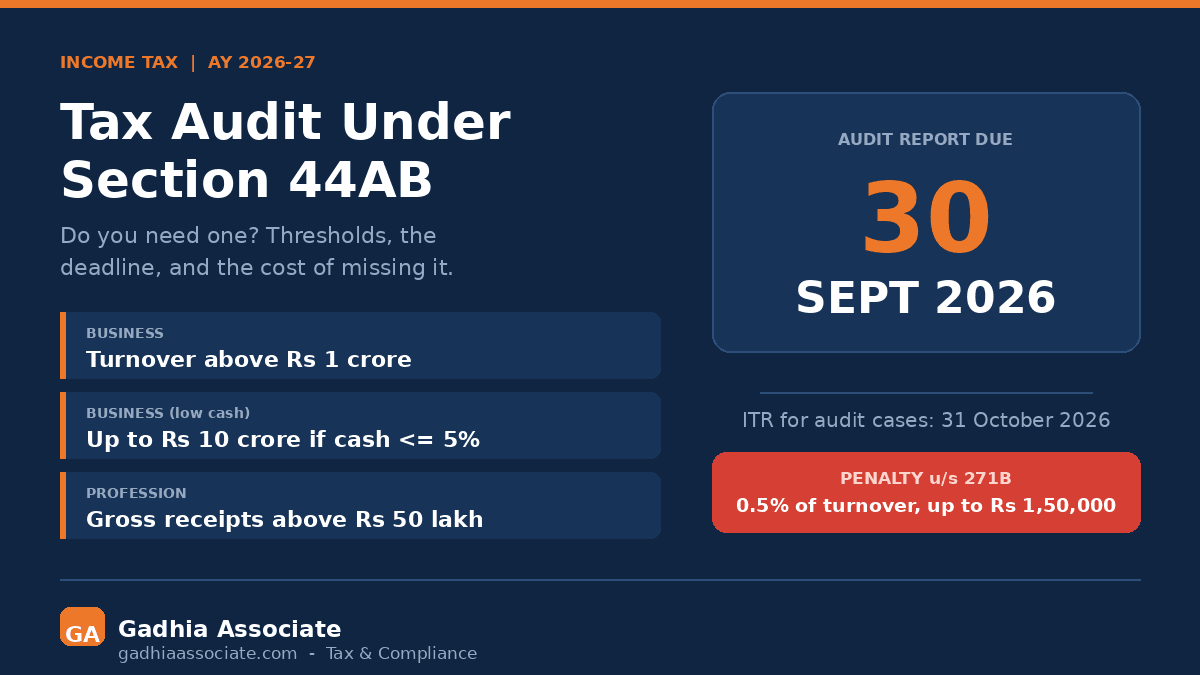
If your business turnover for the year ended 31 March 2026 crossed Rs 1 crore, or your professional gross receipts crossed Rs 50 lakh, a tax audit under Section 44AB almost certainly applies to you and your audit report is due by 30 September 2026. If you are a trader running mostly banked transactions, your threshold may stretch to Rs 10 crore. And if you filed under presumptive taxation last year but want to declare a lower profit this year, you may need an audit even at a turnover of Rs 30 lakh. Read the next section before you assume you are safe.
This applies to proprietors, partnership firms, LLPs and companies alike, including the many trading, ceramic, oil-mill, engineering and commission businesses we see across Junagadh and Saurashtra.
What is the tax audit due date for AY 2026-27, and what happens if you miss it?
For AY 2026-27 (financial year 2025-26), the audit report in Form 3CA or 3CB along with Form 3CD is due by 30 September 2026, and the income tax return for audit cases by 31 October 2026. We have not been able to confirm any notified extension for AY 2026-27 as at the date of this article; plan for the original dates and do not build your year around a rumour of an extension.
Now the part that costs money. Section 271B provides a penalty of 0.5% of turnover, gross receipts or total sales, capped at Rs 1,50,000, where a required audit is not obtained or furnished in time.
Illustrative example. A Junagadh trading firm with a turnover of Rs 4 crore misses the audit deadline. 0.5% of Rs 4 crore is Rs 2,00,000, so the penalty is restricted to the cap of Rs 1,50,000. At a turnover of Rs 1.2 crore, 0.5% is Rs 60,000 and the full Rs 60,000 can be levied. These are illustrative figures to show the mechanics, not a quotation of your case.
The penalty is rarely the worst of it. A late audit usually drags the return late too, and that means:
- Interest under Sections 234A, 234B and 234C on unpaid and deferred tax, which keeps accruing.
- Loss of the right to carry forward business losses and speculation losses if the return itself is filed after the due date.
- Disallowance of expenses where TDS or reporting defaults surface late, which raises your taxable income.
- Banks and buyers asking for audited financials you cannot produce during a limit renewal or a tender.
Section 273B does allow relief where you can show reasonable cause, for example a genuine illness, a seizure of records or a bereavement. Reasonable cause is decided case by case and is not a plan; it is a defence you hope you never need.
If your turnover is anywhere near these limits and nobody has told you clearly whether an audit applies, get it settled this week rather than in the last week of September. Gadhia Associate offers a free first consultation to check your applicability and give you a fixed-fee quote before any work starts. Call or WhatsApp +91 82005 28355 and we will tell you in one conversation whether Section 44AB applies to you.
What is the turnover limit for tax audit, and where do people get it wrong?
The tests, simply put:
- Business, basic threshold: total sales, turnover or gross receipts above Rs 1 crore in the previous year.
- Business, enhanced threshold: the limit is raised to Rs 10 crore where cash receipts do not exceed 5% of total receipts and cash payments do not exceed 5% of total payments. Both conditions must be satisfied. This is where mistakes happen: a few large cash payments to suppliers or labour can break the 5% test and pull you back to the Rs 1 crore threshold.
- Profession: gross receipts above Rs 50 lakh. Doctors, architects, lawyers, engineers, consultants and other specified professionals.
The presumptive scheme trap
This is the single most common reason a small business is caught unprepared. If you are eligible for presumptive taxation under Section 44AD (business) or 44ADA (profession) but declare profit lower than the deemed rate, and your total income exceeds the basic exemption limit, a tax audit is triggered even though your turnover is well below Rs 1 crore. Section 44AD also carries a five-year consequence: once you opt out after having opted in, you are locked out of the scheme for the following five assessment years, and in those years, if your income exceeds the exemption limit, you must maintain books and get them audited.
In plain terms, a Rs 60 lakh turnover business that reports a 3% margin instead of the deemed rate has bought itself an audit obligation, and possibly five more. If you are weighing this decision, read our article on presumptive taxation under Sections 44AD and 44ADA before you file.
Does a loss-making business need an audit?
Often, yes. Turnover, not profit, drives the basic test, so a loss-making business above the threshold still needs an audit. Separately, a loss-making business that had opted into 44AD is in exactly the low-profit scenario described above. And there is a practical reason to comply: you can only carry forward that loss to set off against future profits if the return is filed by the due date. Missing the deadline can convert a recoverable loss into a permanently wasted one.
One more point of context. The Income-tax Act, 2025 came into force on 1 April 2026 and has renumbered and reorganised these provisions, consolidating several presumptive provisions. The thresholds and the substance discussed here continue to apply for AY 2026-27, but section numbers you have used for years may be quoted differently in notices and forms. If you cannot match a section number on a communication you receive, do not panic and do not ignore it; see our article on handling income tax notices.
What documents does the auditor need?
Keep this checklist ready and your audit gets done in days, not weeks:
- Final trial balance, profit and loss account and balance sheet for FY 2025-26, with the previous year comparatives.
- Complete tally or accounting backup, plus bank statements for every account for the full year.
- Sales and purchase registers, and GST returns (GSTR-1, GSTR-3B and the annual return) reconciled to your books.
- Stock and inventory statement as at 31 March 2026, including valuation basis.
- TDS and TCS returns, challans and Form 26AS / AIS / TIS downloads.
- Loan sanction letters, interest certificates and details of related party and cash transactions.
- Fixed asset register with additions, deletions and depreciation working.
- Partnership deed or LLP agreement, MOA and AOA, PAN, and last year audited accounts and ITR.
Your chartered accountant then issues Form 3CA (where accounts are already audited under another law, such as the Companies Act) or Form 3CB (where they are not), with Form 3CD attached, and files it with a valid UDIN. A report without a UDIN is not a completed job.
Common mistakes we see every September
- Assuming the Rs 10 crore limit applies without actually testing the 5% cash conditions on both receipts and payments.
- Treating GST turnover and income tax turnover as identical when they differ on exports, schemes and other adjustments.
- Leaving GST-to-books reconciliation to the auditor in the last fortnight, which is when errors become expensive.
- Filing the audit report but forgetting to accept it on the income tax portal, so it stays incomplete.
- Missing the 31 October return date after finishing the audit on time, and losing loss carry-forward anyway.
Where a professional earns their fee is in the judgement calls: turnover computation for derivatives and commission agents, the cash-percentage test, Clause 44 GST expenditure reporting, disallowances under Section 40A(3) and 43B, and the presumptive opt-out decision. These are not tasks a spreadsheet settles.
When should you call a professional?
Call now if your turnover is between Rs 90 lakh and Rs 1.1 crore, if you deal in significant cash, if you are thinking of declaring less than the presumptive rate, if last year books were never properly closed, or if you have received a notice. Gadhia Associate has been in practice since 2007, over 18 years, and serves more than 7,000 clients across Saurashtra and Gujarat, with a 5.0 Google rating from 100+ reviews. You can meet us at our Junagadh office, usually with a same-day appointment, or work entirely digitally from anywhere in India.
You get a fixed fee agreed upfront with monthly payment options, and a dedicated client manager who chases the documents so you do not have to. Book your free first consultation on +91 82005 28355 by call or WhatsApp, tell us your turnover and your line of business, and we will map out exactly what has to be filed by 30 September and 31 October, and what it will cost. Every week you wait in September costs you options, not just time.
FAQ
How much does a tax audit cost?
Fees depend on turnover, the number of transactions, the state of your books and whether GST reconciliation is needed. We quote a fixed fee after a short review of your trial balance, so there are no surprises, and monthly payment options are available.
How long does a tax audit take?
With clean books and complete documents, typically one to two weeks. Where accounts are incomplete or GST reconciliation is pending, allow three to four weeks. Starting in September rather than late September is the single biggest factor.
What if my books are not ready yet?
That is a common starting point, not a disqualification. We can complete or rebuild the accounts for FY 2025-26 and then carry out the audit. It takes longer, so tell us early.
Can the penalty under Section 271B be avoided?
Section 273B allows relief where reasonable cause is established, and it is judged on facts. It is a defence, not a strategy. Filing on time is far cheaper than arguing about it later.
Position as of September 2026. Thresholds, forms and due dates change through CBDT notifications and circulars, and figures here are indicative and vary by case. Please confirm your specific position with a qualified professional before acting.