Selling on Instagram or WhatsApp in 2026: When GST Registration Is Compulsory, the Inter-State Trap, Income Tax and FSSAI for Home Businesses
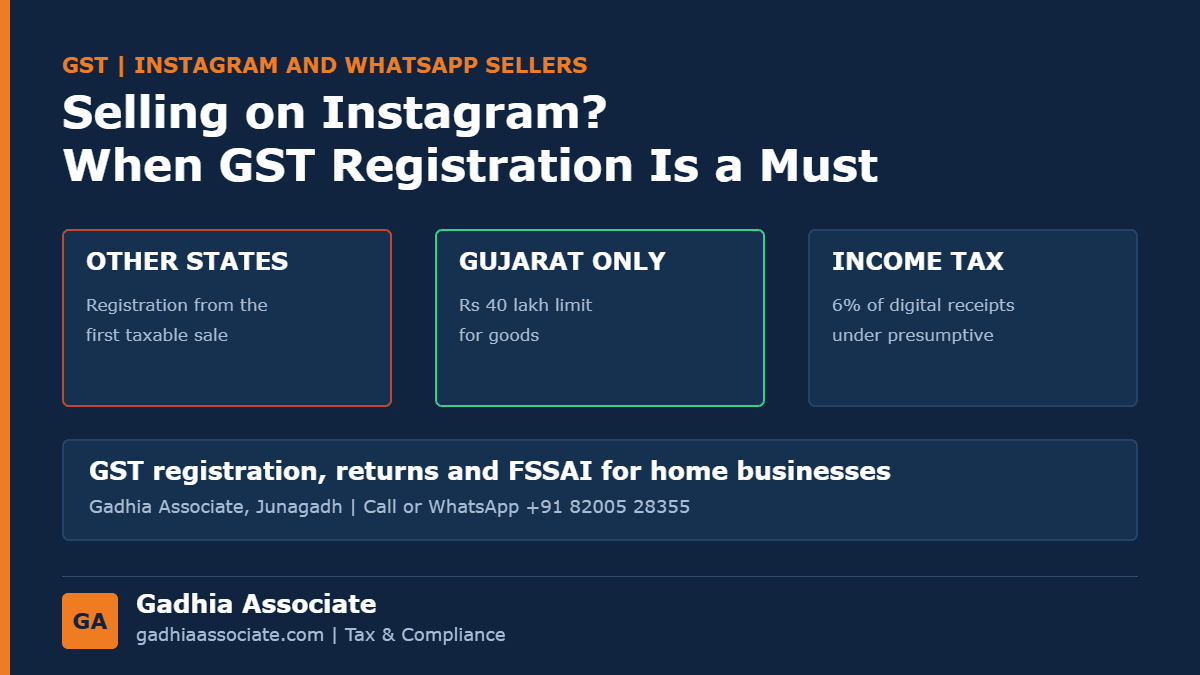
Selling taxable goods on Instagram or WhatsApp to buyers in other states needs GST registration from the first sale, whatever your turnover.
Riya runs a home business in Junagadh selling Diwali gift hampers and printed kurtis on Instagram. Orders come from Mumbai, Bengaluru and Delhi, paid by UPI and payment links, and go out by courier. Her sales this year will cross Rs 12 lakh, and she assumed GST starts only at Rs 40 lakh. Now a courier company has asked for her GSTIN before it takes a bulk corporate hamper order.
Instagram and WhatsApp have turned thousands of homes in Gujarat into small online stores, especially in the festive season. Most of these sellers are unaware of one GST rule that applies from the very first parcel to another state. Here is how GST and income tax work for social media sellers in 2026.
Short Answer: If you sell taxable goods on Instagram, WhatsApp or your own website, GST registration is compulsory from your first sale to a buyer in another state, whatever your turnover. Sellers who sell only within Gujarat get the Rs 40 lakh limit for goods, and service providers get a Rs 20 lakh limit even for clients in other states. Inter-state sellers of goods cannot use the composition scheme, so they charge IGST and file regular returns. For income tax, the sales are business income, and small sellers can declare 6% of digital receipts as profit. Food sellers also need FSSAI registration, even from a home kitchen.
Our team handles GST registration, invoicing, returns and income tax for online sellers. Call or WhatsApp +91 82005 28355, or see the details at the end of this guide.
When GST registration becomes compulsory
- Buyers in other states: registration is needed from the first taxable sale of goods to another state. There is no turnover limit for this.
- Buyers only in Gujarat: registration is needed once turnover crosses Rs 40 lakh a year for goods, or Rs 20 lakh if you also supply services.
- Services: online classes, design or consulting sold to other states get the Rs 20 lakh limit.
- Exempt goods only: sellers of exempt items, such as fresh fruit and vegetables, do not need to register.
- Handicrafts: makers of specified handicraft goods can sell to other states without registration up to the turnover limit, with conditions.
Why Instagram is different from Amazon
- Marketplaces: on platforms such as Amazon, Flipkart or Meesho, small sellers selling within their own state can sell without registration up to the limit, and the platform collects TCS. See GST for e-commerce sellers.
- Social media: when the buyer pays you directly, Instagram or WhatsApp is not collecting tax for you, so the normal rules apply, including registration for inter-state sales.
- Proposed changes: the 57th GST Council recommended easier registration for small sellers on e-commerce platforms, but these are not yet law. See 57th GST Council highlights.
After you register
- Tax on invoices: IGST on sales to other states, and CGST plus SGST within Gujarat, with your GSTIN, the buyer's state and the HSN code.
- Shipping charges: part of the sale value, taxed at the product's rate.
- Hampers: a hamper of different items sold for one price is taxed at the rate of its highest-taxed item, so price items separately where that saves tax.
- Returns: GSTR-1 and GSTR-3B monthly, or quarterly for smaller sellers. See our GST return calendar.
- Credit: claim GST paid on stock bought from registered suppliers, packaging, courier and online advertising.
- Returns from buyers: issue credit notes so that the tax is reduced.
- E-way bill: needed for consignments above Rs 50,000.
Income tax for online sellers
- Business income: the profit is taxed at your slab rate, in ITR-3 or ITR-4.
- Presumptive scheme: small sellers can declare 6% of digital receipts and 8% of cash receipts as profit, within the limits. See presumptive taxation.
- Your receipts are visible: bank and payment gateway data reach the department through your annual information statement.
- Advance tax: under the presumptive scheme, pay it in one instalment by 15 March.
Other registrations
- FSSAI: for sweets, snacks, dry fruits and other food, even from a home kitchen. See FSSAI registration.
- Udyam: free MSME registration that helps with loans and schemes. See Udyam registration.
- Bank account: a separate current account for the business keeps records clean.
Back to Riya. Because her hampers go to other states, she registers for GST as a regular taxpayer. Her invoices now show IGST on outside orders, her courier charges are billed with the products, and the candles and dry fruits in her hampers are priced separately. She files quarterly returns, claims credit for GST on packaging and courier, and declares 6% of her digital receipts as profit. An FSSAI registration covers the food items, and her sales to other states made before registration are reviewed, with any tax due paid with interest instead of waiting for a notice.
How we help
- GST registration for home and online businesses
- Invoice formats, HSN codes and tax rates for your products
- Monthly or quarterly GST returns and input tax credit
- Income tax returns, presumptive or with books
- FSSAI and Udyam registrations
- Reviewing past sales and fixing missed GST
Gadhia Associate has been in practice since 2007 and has handled work for over 7,000 clients, with a 5.0 Google rating from more than 100 reviews. Online sellers and small businesses from Junagadh, Rajkot, Jamnagar, Porbandar and Veraval come to our Junagadh office, where same-day appointments are available. Registrations and returns for sellers anywhere in India are handled online.
Selling on Instagram or WhatsApp to other states? Get registered before a buyer or courier asks for your GSTIN. Call or WhatsApp +91 82005 28355, or message us on WhatsApp. The first consultation is free.
Frequently asked questions
Do I need GST registration to sell on Instagram?
Yes, from the first sale if you sell taxable goods to other states. If you sell only within Gujarat, from Rs 40 lakh of turnover.
Is the Rs 40 lakh GST limit available for online sales to other states?
No, not for goods. Inter-state sales of taxable goods need registration whatever the turnover.
Can an Instagram seller opt for the composition scheme?
Not if they sell goods to buyers in other states.
Is GST charged on shipping charges?
Yes. Shipping charged to the buyer is part of the sale value, taxed at the product's rate.
How is income from Instagram sales taxed?
As business income. Small sellers can declare 6% of digital receipts as profit under the presumptive scheme.
Do home food sellers need FSSAI registration?
Yes. A basic FSSAI registration is needed even when you cook at home.
Position as of 27 October 2026, under the GST law and notifications in force and the income tax rules under the Income-tax Act, 2025. The 57th GST Council's proposals for small sellers are not yet law, so check before you rely on them.