GST Return Filing in 2026: GSTR-1, GSTR-3B and QRMP Due Dates, the Locked GSTR-3B Rule and a Monthly Checklist
GST return filing in 2026 comes down to a fixed order: GSTR-1 first, then IMS and GSTR-2B, then GSTR-3B by the 20th, or the 22nd under QRMP.
For years, many small businesses filed GST the other way round. The accountant filed GSTR-3B first to pay the tax, and uploaded the sales invoices in GSTR-1 later, correcting the numbers as he went. That habit is now expensive. The tax liability in GSTR-3B is picked up from GSTR-1 and can no longer be edited in GSTR-3B, the input tax credit you can claim is decided by what you accept in IMS, and a return that is three years overdue cannot be filed at all.
This article explains which returns you file, the 2026 due dates, the new rules, and a simple monthly routine that keeps you out of trouble.
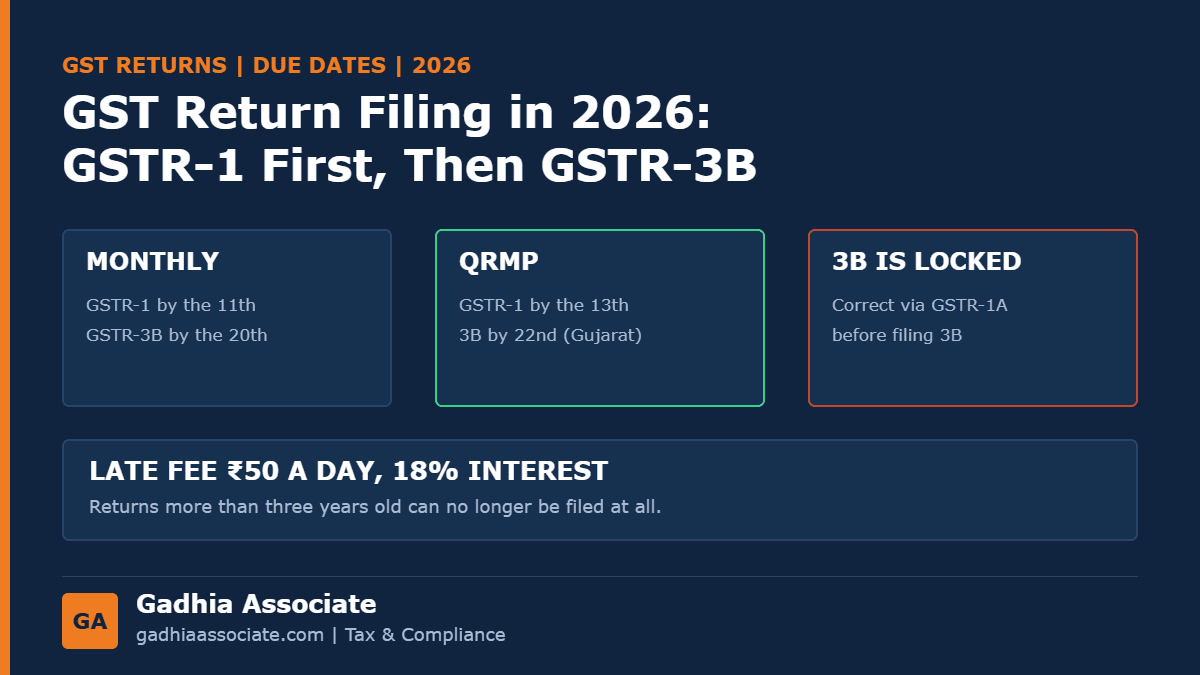
Short answer: A regular taxpayer files GSTR-1 (sales) and GSTR-3B (summary and tax payment). Monthly filers file GSTR-1 by the 11th and GSTR-3B by the 20th of the next month. Businesses with turnover up to Rs 5 crore can opt for QRMP, filing GSTR-1 by the 13th and GSTR-3B by the 22nd (for Gujarat) of the month after the quarter, while paying tax monthly by the 25th. Since the July 2025 period, the liability auto-filled in GSTR-3B from GSTR-1 is locked, so corrections must be made in GSTR-1A before GSTR-3B is filed. Late filing costs Rs 50 a day (Rs 20 for nil returns) plus 18% interest on late tax.
Which GST returns do you have to file?
- GSTR-1: details of outward supplies, invoice by invoice for business customers
- GSTR-3B: monthly or quarterly summary of sales, input tax credit and tax paid
- GSTR-9 and GSTR-9C: annual return and reconciliation, based on turnover (see our guide to GSTR-9 and GSTR-9C)
- Composition dealers: CMP-08 every quarter and GSTR-4 once a year
- Special cases: GSTR-7 for government TDS deductors, GSTR-8 for e-commerce operators, and a few others
GST return due dates in 2026
Monthly filers:
- GSTR-1 by the 11th of the following month
- GSTR-3B by the 20th of the following month
QRMP scheme (turnover up to Rs 5 crore):
- For the first two months of the quarter, pay tax by the 25th of the next month through PMT-06, and optionally upload B2B invoices in IFF by the 13th so that your customers get credit
- GSTR-1 for the quarter by the 13th of the month after the quarter
- GSTR-3B for the quarter by the 22nd of the month after the quarter for Gujarat and other states in that group (the 24th for the rest)
An example: a Junagadh trader under QRMP for July to September 2026 pays July's tax by 25 August and August's tax by 25 September, files GSTR-1 for the quarter by 13 October, and GSTR-3B by 22 October.
What changed in 2024-25 and 2025-26?
- GSTR-1A: an optional form to add or correct invoices in GSTR-1 for the same period, before GSTR-3B is filed.
- Locked liability in GSTR-3B: from the July 2025 tax period, the tax liability auto-filled in GSTR-3B from GSTR-1, IFF and GSTR-1A cannot be edited. If GSTR-1 is wrong, correct it through GSTR-1A before you file GSTR-3B.
- IMS: purchase invoices uploaded by your suppliers appear in the Invoice Management System, where you accept, reject or keep them pending. Your GSTR-2B, and so your input tax credit, is built from this. Read more in our note on IMS.
- Three-year bar: the portal now blocks the filing of returns more than three years after their due date. Old pending returns must be filed before that window closes, as we explained in GST returns pending for months.
A monthly GST routine that works
- Close sales for the month: check every invoice, credit note and e-invoice, and match them with e-way bills.
- File GSTR-1 (or IFF) on time, so that your customers see the invoices in their GSTR-2B.
- Review IMS: accept correct purchase invoices, reject wrong ones, and keep doubtful ones pending, before the GSTR-2B is generated.
- Reconcile GSTR-2B with your purchase register: claim credit only on invoices in GSTR-2B, leave out blocked credits, and reverse credit on bills unpaid for 180 days. Our guide to input tax credit rules covers the details.
- Work out reverse charge on legal fees, GTA, rent from unregistered persons and similar payments.
- File GSTR-3B and pay the tax, using credit first and cash for the balance.
- Keep the working for every month. It is the first thing an officer asks for when a notice comes.
What does filing late cost?
- Late fee: Rs 50 per day of delay for each return (Rs 20 per day for nil returns), subject to a maximum that depends on turnover.
- Interest: 18% a year on tax paid late, calculated on the cash portion.
- Blocked filing: GSTR-1 cannot be filed while GSTR-3B for earlier periods is pending, and e-way bills get blocked if returns stay unfiled.
- Lost credit: credit for a year cannot be claimed after 30 November of the next year or the filing of the annual return, whichever is earlier.
- Notices and cancellation: mismatches trigger intimations, and continued non-filing can lead to cancellation of registration.
The detailed caps are in our note on GST late fee and interest. And if your GSTR-1 and GSTR-3B do not match, see DRC-01B intimations.
Monthly or QRMP: which should you choose?
- QRMP suits small traders and service providers who sell mainly to consumers, or whose business customers do not mind receiving credit quarterly.
- Monthly filing suits businesses that sell to other registered businesses, which want invoices reflected every month, and those claiming refunds.
Under QRMP, tax is still paid every month. The saving is in the number of returns, not in the payments.
Common mistakes
- Filing GSTR-3B first and correcting GSTR-1 later, which no longer works because the liability is locked.
- Ignoring IMS, so wrong or duplicate supplier invoices flow into GSTR-2B.
- Claiming credit on invoices that are not in GSTR-2B.
- Not filing nil returns in months with no business.
- Paying tax under the wrong head, such as IGST instead of CGST and SGST.
- Letting returns pile up past the three-year limit.
What we do for you
- File your GSTR-1, IFF, GSTR-1A and GSTR-3B every month or quarter, on time
- Review IMS and reconcile GSTR-2B with your purchase register before every return
- Advise on monthly filing or QRMP based on your customers and cash flow
- Clear pending returns and old defaults before they cross the three-year limit
- Prepare GSTR-9 and GSTR-9C, and reply to GST notices and mismatch intimations
- Keep month-wise working files ready for any audit or notice
Gadhia Associate has been in practice since 2007 and has handled work for over 7,000 clients across Saurashtra and Gujarat, with a 5.0 Google rating from more than 100 reviews. Traders, manufacturers, service providers and e-commerce sellers from Junagadh, Rajkot, Jetpur, Veraval, Porbandar and Amreli come to our Junagadh office, where same-day appointments are available. Monthly GST filing can equally be handled online for businesses anywhere in India. Fixed-fee and monthly plans are available.
Want your GST returns handled every month without missing a date? Call or WhatsApp +91 82005 28355 for a monthly plan. The first consultation is free.
Frequently asked questions
What is the due date for GSTR-3B?
The 20th of the following month for monthly filers. Under QRMP, the 22nd of the month after the quarter for Gujarat and states in the same group, and the 24th for the others.
What is the due date for GSTR-1?
The 11th of the following month for monthly filers, and the 13th of the month after the quarter under QRMP.
Can I edit the tax liability in GSTR-3B?
Not the part auto-filled from GSTR-1, IFF and GSTR-1A, from the July 2025 tax period. Correct GSTR-1 through GSTR-1A before filing GSTR-3B.
Who can opt for the QRMP scheme?
Registered persons with aggregate turnover up to Rs 5 crore in the previous financial year, who file GSTR-3B.
What is the late fee for GST returns?
Rs 50 per day per return, or Rs 20 per day for nil returns, subject to a turnover-based maximum, plus 18% interest on tax paid late.
Can I file a GST return that is more than three years old?
No. The portal now blocks returns filed more than three years after their due date, so old defaults must be cleared before then.
Position as of 26 September 2026. GST due dates are often extended by notification, and portal rules on IMS, GSTR-1A and locking continue to evolve. Check the current dates on the GST portal before you file.