GST Input Tax Credit in 2026: Section 16(4) Deadline, GSTR-2B Matching, Blocked Credits under Section 17(5) and the 180-Day Payment Rule
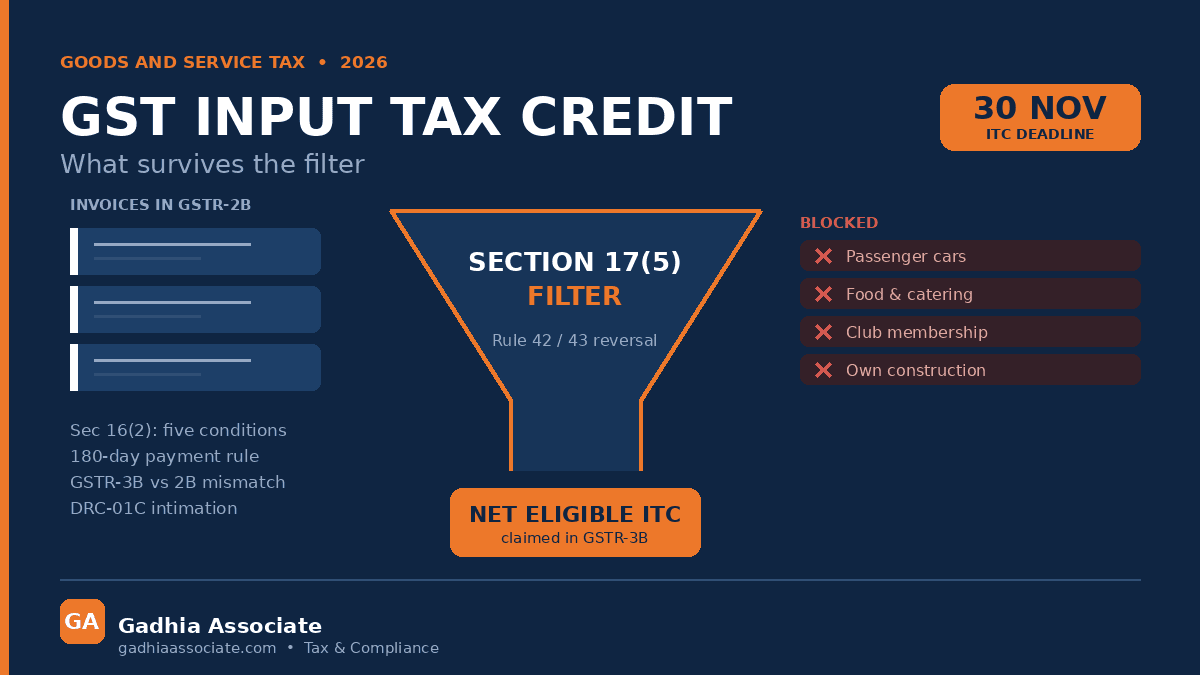
GST input tax credit in 2026 is no longer something you claim from your purchase register — it is something the system allows you, invoice by invoice. Credit for a financial year must generally be taken by 30 November of the following year or the date of filing the annual return, whichever is earlier; the invoice must appear in your GSTR-2B; the supplier must have actually paid the tax; and the item must not fall in the blocked list under Section 17(5). Miss any one of these and the credit is gone, usually with interest and penalty attached.
What are the conditions for claiming GST input tax credit?
Section 16(2) sets five cumulative conditions. All of them must be satisfied:
- You hold a valid tax invoice or debit note from a registered supplier.
- You have actually received the goods or services (including the "bill to ship to" deemed receipt).
- The supplier has paid the tax to the government — Section 16(2)(c).
- The invoice is communicated to you in GSTR-2B and is not restricted — Sections 16(2)(aa) and (ba).
- You have furnished the return in which the credit is claimed.
Two of the five conditions are outside your control: your credit depends on the supplier filing correctly and paying. Vendor discipline is now a finance function, not an accounts-payable afterthought.
What is the last date to claim ITC?
Under Section 16(4), credit for an invoice or debit note of a financial year must be taken in a GSTR-3B filed by the 30 November following the end of that financial year, or the date of furnishing the annual return in Form GSTR-9 for that year, whichever is earlier. For FY 2025-26, that outer date is broadly 30 November 2026, unless you file GSTR-9 sooner — filing the annual return early actually shortens your own window, a trap many businesses walk into.
There is limited relief for the past. Sections 16(5) and 16(6), inserted retrospectively from 1 July 2017 by the Finance (No. 2) Act, 2024, relax the time bar. Section 16(5) allows credit for FY 2017-18 to FY 2020-21 where the return was filed up to 30 November 2021, even though Section 16(4) had earlier disallowed it. Section 16(6) protects taxpayers whose registration was cancelled and later revoked, giving a fresh window tied to the revocation order. If you have an old demand purely on 16(4) grounds, it is worth revisiting under these provisions.
Why is my ITC not showing in GSTR-2B?
Usually one of four reasons: the supplier has not filed GSTR-1 or IFF; the supplier filed late, so it lands in the next month's 2B; your GSTIN was entered wrongly; or the supply was reported as B2C. Sometimes the entry appears but is flagged ineligible because the place of supply is another state. The fix is the same — reconcile monthly, not annually, and chase suppliers while their money is still unpaid.
What happens if I do not pay my supplier within 180 days?
The second proviso to Section 16(2), read with Rule 37, requires you to reverse the credit with interest if you have not paid the supplier the value of supply plus tax within 180 days from the invoice date. The reversal is made in your GSTR-3B, and interest runs from the date the credit was availed. The credit is not lost forever — you can re-avail it in the month you actually make the payment, and that re-availment is not subject to the Section 16(4) time limit. Note the rule does not apply to reverse charge supplies or to supplies deemed made without consideration.
A monthly ageing report of unpaid vendor invoices crossing 150 days prevents almost every 180-day problem.
Which GST input tax credit is blocked under Section 17(5)?
Section 17(5) lists credits that are simply not available, however clearly they relate to business:
- Motor vehicles for transport of persons with approved seating capacity of up to 13 persons — unless used for further supply of such vehicles, passenger transport, or driving training. Related insurance, servicing and repairs follow the same fate.
- Food and beverages, outdoor catering, beauty treatment, health services, cosmetic surgery — unless used to make an outward supply of the same category or where provision is obligatory under a law.
- Club, health and fitness centre memberships.
- Life and health insurance, except where obligatory for an employer under law.
- Works contract services for construction of immovable property, and goods or services used for construction of immovable property on one's own account, other than plant and machinery.
- Goods lost, stolen, destroyed, written off or disposed of by way of gift or free samples.
- Goods or services used for CSR obligations, and tax paid under Sections 74, 129 and 130.
Can I claim ITC on a car?
Generally no, if it seats up to 13 persons and carries people. A car bought by a trading company for its directors is blocked; the same car bought by a driving school, cab operator or vehicle dealer is eligible. Goods transport vehicles and buses seating more than 13 remain outside the restriction.
Can I claim ITC on office construction?
Credit on constructing your own building is blocked. The nuance comes from the Supreme Court's Safari Retreats ruling, which applied a functionality test: where a building is not merely a setting for business but is itself the apparatus through which the taxable supply is made — for example a mall constructed for letting out — it may qualify as "plant" and fall outside the blockage. This is a fact-specific test, not a blanket permission, and the legislative response to it must be checked for your period. We cover it in detail in our article on landmark GST judgments.
Eligible versus blocked: a quick comparison
Eligible credit typically includes raw materials, trading stock, packing material, freight inward, goods transport vehicles, plant and machinery and its erection, professional and audit fees, rent on business premises, software subscriptions, and advertising. Blocked credit includes passenger cars and their running costs, staff meals and canteen expenses beyond statutory obligation, gym and club memberships, gifts and free samples, goods written off, CSR spend and construction of your own immovable property. A third bucket sits between them: credit that is eligible but must be proportionately reversed under Rules 42 and 43 where inputs, input services or capital goods are used partly for exempt supplies or non-business purposes. Rule 42 handles inputs and input services monthly with an annual true-up; Rule 43 spreads capital goods credit over 60 months.
An illustrative worked example
Illustrative only. A trading firm in Junagadh, Gujarat sees Rs 6,00,000 of ITC in its GSTR-2B for a month. Of this, Rs 60,000 relates to a passenger car purchased for the proprietor and Rs 20,000 to a staff Diwali gift — both blocked under Section 17(5), so Rs 80,000 is removed. A further Rs 30,000 is reversed under Rule 42 because 5% of turnover is exempt. The firm therefore claims a net credit of Rs 4,90,000 in Table 4(A) of GSTR-3B and reports the blocked and reversed amounts correctly in Table 4(B).
What if I get a notice for GSTR-3B versus GSTR-2B mismatch?
The portal generates an automated intimation in Form DRC-01C where credit claimed in GSTR-3B exceeds credit available in GSTR-2B beyond the prescribed tolerance. Reply in Part B — either pay the difference with interest through DRC-03, or explain the reason, such as earlier-period credit claimed now, an amendment or an import IGST entry. Ignoring it can block your next GSTR-1. Our article on replying to GST notices sets out the drafting approach.
Monthly ITC checklist
- Download GSTR-2B on generation and reconcile it against the purchase register.
- Tag every invoice as eligible, blocked or common credit.
- Compute Rule 42 and 43 reversals where you have exempt turnover.
- Run an ageing report for vendor invoices approaching 180 days.
- Track pending FY 2025-26 credit against the 30 November 2026 cut-off.
- Keep invoices, e-way bills, transport and payment proof for every claim.
- Respond to DRC-01C within the time allowed.
How Gadhia Associate can help
We handle monthly 2B reconciliation, ITC eligibility reviews, Rule 42/43 workings, DRC-01C and departmental replies, and GST audits for businesses across Gujarat and India from our Junagadh office. Use our GST Calculator for quick computations, explore our GST Services, and book a free consultation if you have a mismatch notice or a large blocked-credit exposure. Our Income Tax services and Capital Gain Tax Calculator are on the same site.
Disclaimer: This article reflects the position as of August 2026. GST law changes frequently through CBIC notifications, circulars and Council decisions. Please confirm the current position with a qualified professional before acting.