GST Returns Pending for Months? Late Fees, ITC Lost Forever, Suspension and the Three-Year Deadline You Cannot Miss
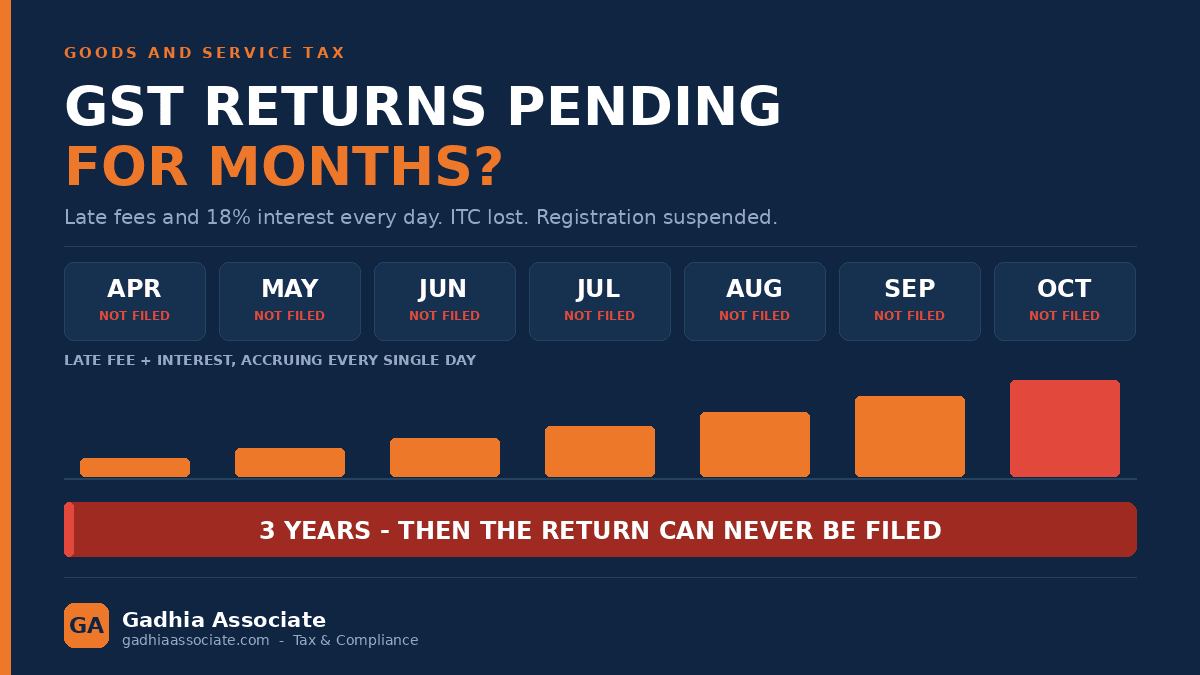
You have GST returns pending — maybe three months, maybe eighteen, maybe since the accountant stopped answering calls. The business is still running and sales are still happening, but GSTR-1 and GSTR-3B have not been filed since one month of tight cash flow quietly became many. If that is your situation, give this article ten minutes. A meter is running while you read it, and one of the three losses below becomes permanent once the window shuts.
What happens if I do not file GST returns?
Three things start from the day after the due date and run in parallel. A late fee under Section 47 of the CGST Act accrues every day, per return. Interest under Section 50 runs at 18% per annum on the tax payable in cash until you actually pay it, with no cap. And the portal blocks you: under the sequential filing restriction, GSTR-1 cannot be filed if the previous period's GSTR-3B is pending. That is not a technical error — it is the law working as designed.
How much is the late fee for GSTR-3B?
For a normal return the late fee is Rs 50 per day (Rs 25 CGST plus Rs 25 SGST); for a nil return, Rs 20 per day. The maximum per return is capped by turnover slab — Rs 2,000 up to Rs 1.5 crore turnover, Rs 5,000 between Rs 1.5 crore and Rs 5 crore, Rs 10,000 above Rs 5 crore, and Rs 500 for a nil return. The cap applies per return, not per year: nine pending months means eighteen returns, each with its own cap. And it does nothing for the interest, which is the part that actually hurts.
The three real losses when your GST returns are pending
Will I lose my input tax credit?
Yes — and for most businesses this is the largest loss by far. Section 16(4) sets an outer deadline for claiming input tax credit: broadly the 30th of November following the end of the relevant financial year, or the date of filing the annual return, whichever is earlier. Credit is claimed through GSTR-3B, so if the 3B is not filed before that deadline, the credit for that year lapses.
In cash terms: your suppliers charged you GST, you paid it, it sits in your GSTR-2B and it was meant to reduce your own tax. Once 16(4) closes it is gone permanently, while your output liability stays exactly where it was — payable in cash, in full, with 18% interest on top. A trader with Rs 6 lakh of unclaimed credit for a lapsed year has lost Rs 6 lakh of real money. Our article on GST input tax credit covers the eligibility conditions in depth.
Can I still file a return from three years ago?
This is the change most business owners in Junagadh have still not heard about. The Finance Act, 2023 inserted a time bar into Sections 37, 39, 44 and 52 of the CGST Act: a return cannot be furnished after three years from its due date. It covers GSTR-1, GSTR-3B, GSTR-9, GSTR-9C and GSTR-8, and GSTN implemented it on the portal in phases through 2025. The system now hard-blocks barred periods.
No late fee reopens it. The filing window simply closes — but the department's power to demand tax, interest and penalty for that period through assessment and recovery does not. You end up in the worst position available: unable to file, unable to claim the credit, still liable for the tax. If any period is approaching that mark, that is the deadline to work backwards from.
Can my GST registration be cancelled for not filing?
Yes. Under Section 29(2) read with Rule 21A, registration can be suspended and then cancelled for non-furnishing of returns for a continuous prescribed period — broadly six consecutive months for a regular monthly filer, two consecutive quarters for a QRMP filer, and for a composition taxpayer where the annual return is not furnished beyond three months from its due date. Suspension is largely automatic and system-driven.
Commercially, suspension is worse than the tax: you cannot issue a taxable invoice, buyers cannot take credit on you, and tenders requiring an active GSTIN fall away. Before cancellation the department normally issues Form GSTR-3A giving 15 days to file. Ignore it and the officer can proceed to a best judgment assessment under Section 62, estimating your liability from e-way bills and your suppliers' GSTR-1 — almost always higher than the real figure. Our articles on GST notice replies and on GST cancellation and revocation cover both stages.
An illustrative computation: nine pending months
Illustrative only. Assume a Junagadh trader with turnover around Rs 1.2 crore, nine months of GSTR-1 and GSTR-3B pending, and average net cash liability of Rs 40,000 a month.
- Late fee: 18 returns capped at Rs 2,000 each at that slab — roughly Rs 36,000.
- Interest at 18% on Rs 3.6 lakh of cash liability, averaging six months of delay — roughly Rs 32,000.
- Input tax credit for the oldest year, say Rs 5,00,000, at risk of lapsing under Section 16(4).
Late fee and interest total about Rs 68,000. The ITC exposure alone is Rs 5,00,000. That ratio is why we tell clients to stop worrying about the late fee and start worrying about the calendar.
Not sure which periods are still inside the window? Call or WhatsApp +91 82005 28355 for a free first consultation. We will pull your filing status GSTIN by GSTIN and tell you which periods are safe, which are near the three-year bar and what the exposure is, before you commit to anything. Gadhia Associate has been practising since 2007 — 18+ years — handling catch-up filings across Saurashtra and Gujarat.
How to clear GST returns pending for several months
- Get the exact position. Download return status for every GSTIN and period, and measure the oldest against the three-year bar.
- Reconcile before you file. Match GSTR-2B to purchase records and the sales register to e-way bills. A wrong 3B filed to "get it done" becomes a mismatch notice later.
- File strictly oldest first, prioritising years where the Section 16(4) deadline is still open.
- Arrange the cash first. A 3B will not submit without the tax being paid, so fund the cash ledger period by period.
- File the annual returns. GSTR-9 and, where applicable, GSTR-9C carry their own late fees and three-year bar.
What if a Section 62 best-judgment order has already been passed?
Do not treat it as final, and do not ignore it. Where a valid return is furnished within the prescribed period after service of the order — extended by the Finance Act, 2023 from 30 days to 60 days, with a further 60 days on payment of an additional daily late fee — the order is deemed withdrawn, though interest and late fee still stand. Once that window closes, the only route is appeal.
How do I restore a suspended GSTIN?
Where suspension was triggered by non-filing, filing all pending returns with tax, interest and late fee usually allows drop proceedings on the portal. Where cancellation has already been ordered, you need a revocation application within the prescribed time with proof of filing and payment. The order is not interchangeable — returns first, revocation after.
What not to do
- Do not wait for an amnesty. Schemes are announced by notification for specific periods on specific terms, and there is no guarantee one will cover your years. Waiting for one that never comes is how businesses walk into the three-year bar.
- Do not file the latest return first. Besides the sequential restriction, it leaves the most at-risk periods for last.
- Do not ignore the GSTR-3A notice. Fifteen days is short, and what follows is an assessment with a number you did not choose.
Start with the periods closest to expiring. Call or WhatsApp +91 82005 28355 for your free first consultation. We work on fixed-fee and monthly plans so you know the cost before we begin, every client gets a dedicated client manager, and the service is fully digital across India — or visit our Junagadh office, where same-day appointments are usually available. We serve 7000+ clients across Saurashtra and Gujarat with a 5.0 Google rating from 100+ reviews.
Frequently asked questions
How much will it cost to get all my pending returns filed?
It depends on the number of periods, the number of GSTINs and the state of your records — not on your turnover. We quote a fixed fee after looking at your portal status, and show late fee and interest separately so you can see what is our fee and what is government dues.
How far back can pending GST returns be fixed?
Up to three years from each return's due date. Beyond that the portal blocks filing. Periods inside the window can almost always be regularised; for barred periods the work shifts to managing the demand rather than filing.
What documents do you need to start?
Your GST portal login, sales and purchase registers for the pending periods, bank statements, and any notices received. If records are incomplete, much can be reconstructed from GSTR-2B, e-way bill data and bank entries.
Can the late fee and penalty be avoided?
The late fee under Section 47 is statutory and only reduces where the government notifies a waiver; interest under Section 50 is likewise not discretionary. What can be reduced is the damage — protecting ITC still within its deadline, getting a Section 62 order deemed withdrawn in time, and avoiding cancellation.
This article reflects the position as of September 2026. GST law changes frequently through CBIC notifications, circulars and GST Council decisions, and outcomes depend on the specific facts of each case. Please confirm the current position with a qualified professional before acting on anything stated here.