GSTR-9 and GSTR-9C in 2026: Who Must File the GST Annual Return, Turnover Limits, Due Date, Reconciliation and Late Fees
GSTR-9 and GSTR-9C in 2026: the short answer
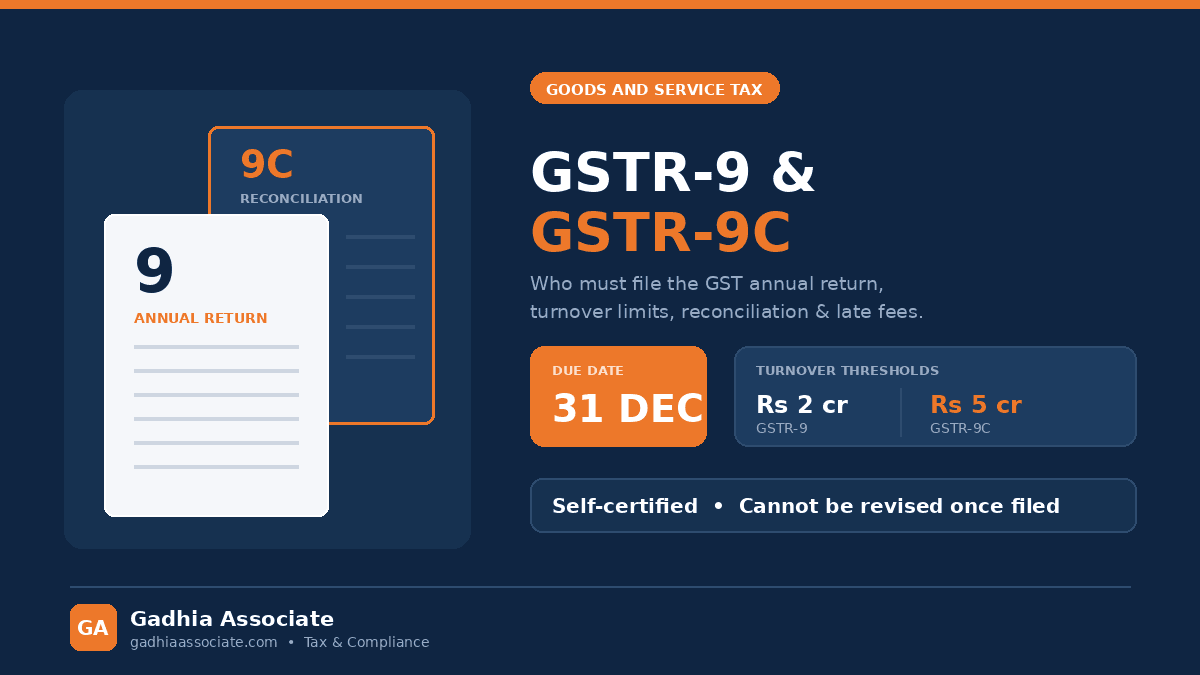
GSTR-9 is the GST annual return that consolidates a financial year's outward supplies, inward supplies, tax paid and input tax credit into one filing. It is mandatory for regular registered taxpayers whose aggregate turnover exceeds Rs 2 crore, and optional below that. GSTR-9C is the self-certified reconciliation statement between the annual return and the audited books, required where aggregate turnover exceeds Rs 5 crore. Both are due by 31 December following the end of the financial year, unless CBIC extends the date.
That is the headline. The detail is where businesses in Junagadh and across Gujarat lose money, because GSTR-9 cannot be revised once filed and the late fee runs per day until it is.
Who has to file GSTR-9?
Every person registered as a regular taxpayer under GST for any part of the financial year is within the scope of the annual return, subject to the turnover exemption. The test is aggregate turnover computed on an all-India PAN basis: taxable supplies, exempt supplies, exports and inter-state supplies of persons on the same PAN, excluding GST itself. Once that figure crosses the threshold, filing is required GSTIN-wise, so a group with registrations in Gujarat and Maharashtra files a separate GSTR-9 for each.
Some categories are outside GSTR-9 entirely:
- Composition taxpayers, who file GSTR-9A where notified, having filed GSTR-4 for the year
- Casual taxable persons
- Non-resident taxable persons
- Input Service Distributors
- Persons deducting TDS under Section 51 or collecting TCS under Section 52
A registration surrendered mid-year does not remove the obligation for the period the registration was live. Nil-turnover GSTINs above the threshold still file a nil annual return, and this is one of the most common oversights among dormant registrations.
Is GSTR-9 mandatory below Rs 2 crore?
No. Taxpayers with aggregate turnover up to Rs 2 crore have been exempted from filing GSTR-9, and the exemption has been extended year after year by CBIC notification. Filing remains optional. Two points worth weighing before you skip it. If you choose to file, the return is treated as furnished and the usual finality applies. And where your books show credits or liabilities that were never reconciled during the year, a voluntary annual return is often the cleanest way to surface them before a departmental query does. Check the notification for the relevant year, because the exemption is granted annually and is not permanent in the statute.
What is the difference between GSTR-9 and GSTR-9C?
Set them side by side. GSTR-9 is a return; GSTR-9C is a reconciliation statement. GSTR-9 is a consolidation of what you already reported in GSTR-1 and GSTR-3B through the year, with some additional disclosures. GSTR-9C compares that consolidated annual return against your audited annual financial statements and requires you to explain, line by line, why turnover per books differs from turnover per returns and why tax paid per books differs from tax paid per returns.
The applicability threshold differs: GSTR-9 above Rs 2 crore, GSTR-9C above Rs 5 crore. So a taxpayer between Rs 2 crore and Rs 5 crore files GSTR-9 alone, while a taxpayer above Rs 5 crore files both. The certification differs too. GSTR-9C originally required certification by a Chartered Accountant or Cost Accountant; that requirement was removed and the form is now self-certified by the taxpayer. The compliance burden did not disappear with the certificate. It shifted onto the taxpayer, and an unexplained reconciliation difference in a self-certified statement is your exposure, not your auditor's.
Illustrative worked example
Illustrative, with round numbers. A trading firm in Junagadh has an aggregate turnover of Rs 6.5 crore for the financial year across two GSTINs, Rs 4 crore in Gujarat and Rs 2.5 crore in Rajasthan. Because aggregate turnover on the PAN exceeds Rs 5 crore, both GSTINs file GSTR-9 and GSTR-9C, even though the Rajasthan registration on its own is below Rs 5 crore. Contrast a single-state manufacturer with Rs 3.2 crore turnover: GSTR-9 is mandatory, GSTR-9C is not. And a small retailer at Rs 1.4 crore: neither is mandatory, though GSTR-9 may be filed voluntarily. The trap is treating the threshold as GSTIN-wise when it is PAN-wise.
What is the due date for the GST annual return?
The standard due date for both GSTR-9 and GSTR-9C is 31 December following the close of the financial year. For FY 2024-25 that date was 31 December 2025. For FY 2025-26 the corresponding date is 31 December 2026, unless CBIC issues an extension, which it has done in several past years, usually announced close to the deadline. Do not plan around an extension. The reconciliation work is the slow part, and firms that begin in November routinely find mismatches they cannot resolve in four weeks.
What is the late fee for GSTR-9?
Late fee for the annual return is charged per day of delay under CGST and an equal amount under SGST, with a cap expressed as a percentage of turnover in the state or union territory. Since FY 2022-23 the structure has been slab-based by aggregate turnover, following CBIC Notification No. 07/2023 - Central Tax:
- Turnover up to Rs 5 crore: Rs 50 per day (Rs 25 CGST plus Rs 25 SGST), capped at 0.04 per cent of turnover in the state or UT (0.02 per cent under each Act)
- Turnover above Rs 5 crore and up to Rs 20 crore: Rs 100 per day (Rs 50 CGST plus Rs 50 SGST), capped at 0.04 per cent of turnover in the state or UT
- Turnover above Rs 20 crore: Rs 200 per day (Rs 100 CGST plus Rs 100 SGST), capped at 0.25 per cent of turnover in the state or UT
Separately, failure to furnish GSTR-9C where it applies can attract the general penalty provisions of the CGST Act. Interest on any additional tax paid through the annual return runs independently of late fee. Amnesty windows waiving or reducing annual-return late fee for earlier years have been notified from time to time; check whether one is open before paying an old liability in full. Our GST Calculator is useful for working out interest and tax on the differences you find, and our GST Services team handles the filing end to end.
Can GSTR-9 be revised?
No. GSTR-9 cannot be revised once filed. There is no rectification facility and no revised return. Whatever you submit becomes the final annual position for that year, and any error must be corrected in the returns of the following period, subject to the statutory time limits for amendments and for claiming credit. This is the single strongest argument for completing the reconciliation properly before you hit submit, rather than filing something approximate to beat the due date and fixing it later. There is no later.
Reconciliation: where the real work sits
The annual return is mostly a reporting exercise. The reconciliation behind it is where discrepancies emerge. Work through these areas before you touch the form:
- GSTR-1 versus GSTR-3B versus books: outward supply values and tax, invoice by invoice for large customers
- ITC as per GSTR-2B versus ITC claimed in GSTR-3B versus purchase register: the most frequent source of notices
- Amendments made in the following year that relate to the year under report, including credit notes and debit notes issued after March
- Reversals under Rule 42 and 43 for exempt and non-business use, and reversal for non-payment to suppliers within 180 days
- RCM liability discharged and the corresponding credit taken
- Turnover per audited financial statements versus turnover per returns, including unbilled revenue, discounts, and non-GST income
- Tax paid in cash versus credit, and any DRC-03 payments made during or after the year
Table-level reporting requirements in GSTR-9 have been refined over successive years, with the GSTN adding and revising ITC disclosure tables, including a further split of ITC reported through the Invoice Management System. Before you begin, download the current offline utility and read the table instructions for that year rather than working from last year's template, because the disclosure format changes more often than the law does.
A practical filing checklist
- Confirm aggregate turnover on a PAN basis, then decide GSTR-9 and GSTR-9C applicability per GSTIN
- Download the system-generated GSTR-9 and compare it with your books before editing anything
- Reconcile GSTR-2B for the full year against the purchase register and identify vendor non-filers
- Trace all next-year amendments back to the year under report
- Compute additional liability and pay through DRC-03 where required
- Prepare the GSTR-9C reconciliation with a written explanation for every unreconciled difference
- Review once, then file, remembering that no revision is possible
How Gadhia Associate Can Help
We prepare and file GSTR-9 and GSTR-9C for traders, manufacturers, service providers and exporters in Junagadh and across Gujarat, including full-year GSTR-2B reconciliation, notice handling and DRC-03 computation. If your books and returns have drifted apart, the annual return is the moment to fix it properly. Book a free consultation with Gadhia Associate and we will scope the reconciliation before the December rush.
This article reflects the position as of August 2026. Thresholds, due dates, late fees and table-level reporting requirements change through CBIC notifications and GSTN advisories. Please confirm your specific position with a qualified professional before filing.