Income Tax Appeal in 2026: How to Challenge an Assessment Order, the 30-Day Limit, Form 99, Fees and Paying 20% for a Stay
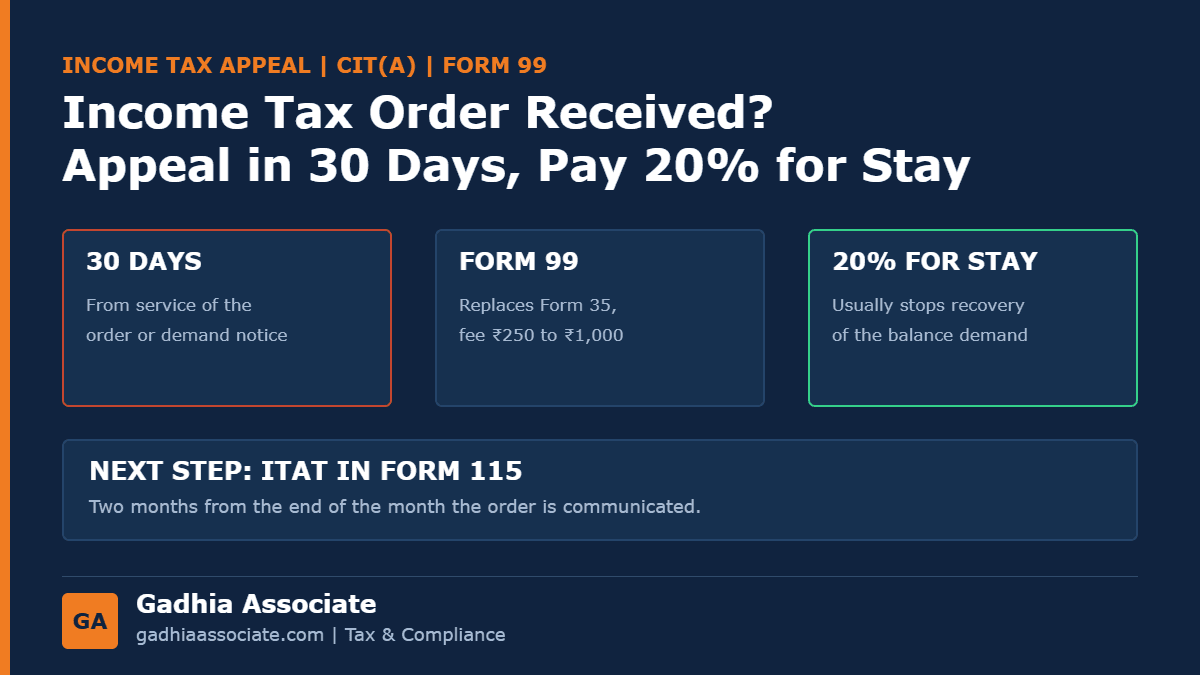
An income tax order can be challenged before the Commissioner (Appeals) within 30 days, and paying 20% of the demand usually stops recovery.
A Veraval exporter receives an assessment order that adds Rs 38 lakh to his income as unexplained cash credits, with a demand of Rs 22 lakh including interest. His accountant says the case is strong and there is no hurry. Six weeks later, the appeal deadline has passed, a penalty notice has arrived, and the bank has frozen the current account for recovery. A strong case is of no use if the appeal is not filed on time.
This article explains how an income tax appeal works under the new Income-tax Act, 2025: what you can appeal against, the deadline, the form and fee, how to stop recovery while the appeal is pending, and what comes after.
Short answer: An order of the Assessing Officer, such as an assessment, reassessment or penalty order, can be challenged before the Joint Commissioner (Appeals) or the Commissioner (Appeals) under Sections 356 to 360 of the Income-tax Act, 2025 (earlier Sections 246A to 251). The appeal is filed online in Form 99, which replaces the old Form 35, within 30 days of receiving the order or demand notice. The fee is Rs 250 to Rs 1,000. Tax on the income you yourself returned must be paid first. Filing the appeal does not stop recovery by itself, but under CBDT guidelines, paying 20% of the disputed demand usually earns a stay of the rest. If the first appeal fails, a second appeal lies to the Income Tax Appellate Tribunal in Form 115.
Which orders can you appeal against?
- Scrutiny assessment and best judgment assessment orders
- Reassessment orders after a notice for escaped income
- Penalty orders
- Intimations with adjustments to your return, and rectification orders
- Orders treating you as a defaulter for TDS or TCS
If the problem is a simple mistake, such as a tax credit not given or an arithmetic error, a rectification request may fix it faster. But rectification does not stop the appeal deadline. If the amount is significant, file the appeal and pursue rectification alongside. Our guide to reading income tax notices explains the orders that usually lead to appeals.
How much time do you have?
30 days from the date the order or demand notice is served on you. The appellate authority can condone a delay if you show sufficient cause, such as illness or the notice not reaching you, but condonation is discretionary. Do not plan on it.
An example: an order served on 5 October 2026 must normally be appealed by 4 November 2026. The festival season falls in between, which is exactly when these deadlines get missed.
How is the appeal filed?
- Pay the tax on your returned income, if any is outstanding. Without this, the appeal is not admitted.
- Pay the appeal fee online.
- Prepare the statement of facts and grounds of appeal. Each ground should state exactly which addition or disallowance is wrong and why.
- File Form 99 on the income tax e-filing portal with the order, the demand notice and supporting documents, and verify it with a DSC or EVC.
- Attend the hearings, which are held online under the faceless appeal system, and file written submissions and evidence.
What is the appeal fee?
- Assessed income up to Rs 1 lakh: Rs 250
- Assessed income above Rs 1 lakh and up to Rs 2 lakh: Rs 500
- Assessed income above Rs 2 lakh: Rs 1,000
- Appeals not linked to assessed income, such as certain penalty orders: Rs 250
How do you stop recovery while the appeal is pending?
This is the part most people get wrong. Filing an appeal does not automatically stop the department from recovering the demand. You must ask for a stay.
- Apply to the Assessing Officer for a stay of demand, attaching the appeal acknowledgement.
- Offer to pay 20% of the disputed demand. Under CBDT guidelines, this ordinarily earns a stay of the remaining 80% until the first appeal is decided. The officer can accept less in a strong case or genuine hardship, or ask for more.
- If the officer refuses, approach the Principal Commissioner for review of the decision.
If recovery has already begun and your bank account is attached, see our guide to getting a frozen bank account released.
In the example above, the exporter would pay 20% of Rs 22 lakh, which is Rs 4.4 lakh, with his stay application. That is money he gets back with interest if he wins.
What decides whether an appeal succeeds?
- Specific grounds: "the addition of Rs 38 lakh ignores the confirmations and bank statements of the lenders filed on 12 August" is far better than "the order is bad in law".
- Evidence on record: new evidence is admitted in appeal only in limited situations, so the reply during assessment matters.
- Legal points: limitation, jurisdiction, validity of the reassessment notice and whether you were given a proper hearing.
- Correct computation: many demands contain errors in interest, credits or set-off of losses.
What if the first appeal fails?
- Income Tax Appellate Tribunal: appeal in Form 115 (earlier Form 36) within two months from the end of the month in which the order is communicated. It is e-filed with a digital signature. The fee is Rs 500 where assessed income is up to Rs 1 lakh, Rs 1,500 up to Rs 2 lakh, and 1% of assessed income above that, subject to a maximum of Rs 10,000.
- High Court: within 120 days, only on a substantial question of law.
The Tribunal is the last authority on facts, so the case must be fully argued there.
A quick checklist when an assessment order arrives
- Note the date of service and the 30-day deadline.
- Download the order, the demand notice and your submissions from the portal.
- Check for simple errors that rectification can fix.
- Pay any tax due on your returned income.
- File Form 99 with specific grounds.
- Apply for a stay of demand, with the 20% payment if needed.
- Watch for penalty notices, which follow most additions and need their own replies.
What we do for you
- Read the order and tell you honestly whether an appeal is worth filing
- Draft the statement of facts and grounds, and file Form 99 within time
- Apply for a stay of demand and negotiate the payment with the officer
- Represent you in the online hearings before the Commissioner (Appeals)
- Reply to penalty notices that follow the assessment
- Take the matter to the Income Tax Appellate Tribunal where needed
Gadhia Associate has been in practice since 2007 and has handled work for over 7,000 clients across Saurashtra and Gujarat, with a 5.0 Google rating from more than 100 reviews. Businesses, professionals and families from Junagadh, Rajkot, Veraval, Porbandar and Amreli come to our Junagadh office, where same-day appointments are available. Appeals and hearings are online, so we handle them for taxpayers anywhere in India. Fixed-fee and monthly plans are available.
Received an assessment order or demand? The 30-day clock is already running. Call or WhatsApp +91 82005 28355. The first consultation is free.
Frequently asked questions
What is the time limit for filing an income tax appeal?
30 days from the date the order or demand notice is served. Delay can be condoned only for sufficient cause.
Which form is used for an income tax appeal now?
Form 99, filed online, which replaces Form 35 under the Income-tax Rules, 2026. The Tribunal appeal is in Form 115, which replaces Form 36.
Does filing an appeal stop the recovery of tax?
No. You must apply for a stay. Under CBDT guidelines, paying 20% of the disputed demand usually earns a stay of the rest until the appeal is decided.
What is the fee for an income tax appeal?
Rs 250, Rs 500 or Rs 1,000 depending on the assessed income, and Rs 250 for appeals not linked to assessed income.
Can I file an appeal and a rectification request together?
Yes. Rectification fixes apparent mistakes, while the appeal covers the dispute. File the appeal within time even if rectification is pending.
How long does an income tax appeal take?
It varies widely with the case and the workload of the appellate authority. That is why a stay of demand matters.
Position as of 26 September 2026. The Income-tax Act, 2025 and the Income-tax Rules, 2026 apply from 1 April 2026, and CBDT guidelines on stay of demand are administrative and can change. The older section numbers are shown alongside the new ones because that is how people still search for them. Take advice on your order before you decide.