TDS on Purchases Under Section 194Q in 2026: Who Deducts, What Happened to TCS on Sale of Goods, and the Overlap That Costs Traders
If you are a trader, manufacturer or distributor and your accounts team is arguing every week about TDS on purchases under Section 194Q, this article is written for you. You buy goods worth crores. One buyer deducts 0.1% from your bill, one seller still adds TCS to his invoice, and your purchase ledger, his sales ledger and your Form 26AS do not agree. Nobody in your market in Junagadh, Rajkot or Jamnagar agrees on which applies in 2026 - and the wrong answer is quietly costing you money.
Who has to deduct TDS under 194Q?
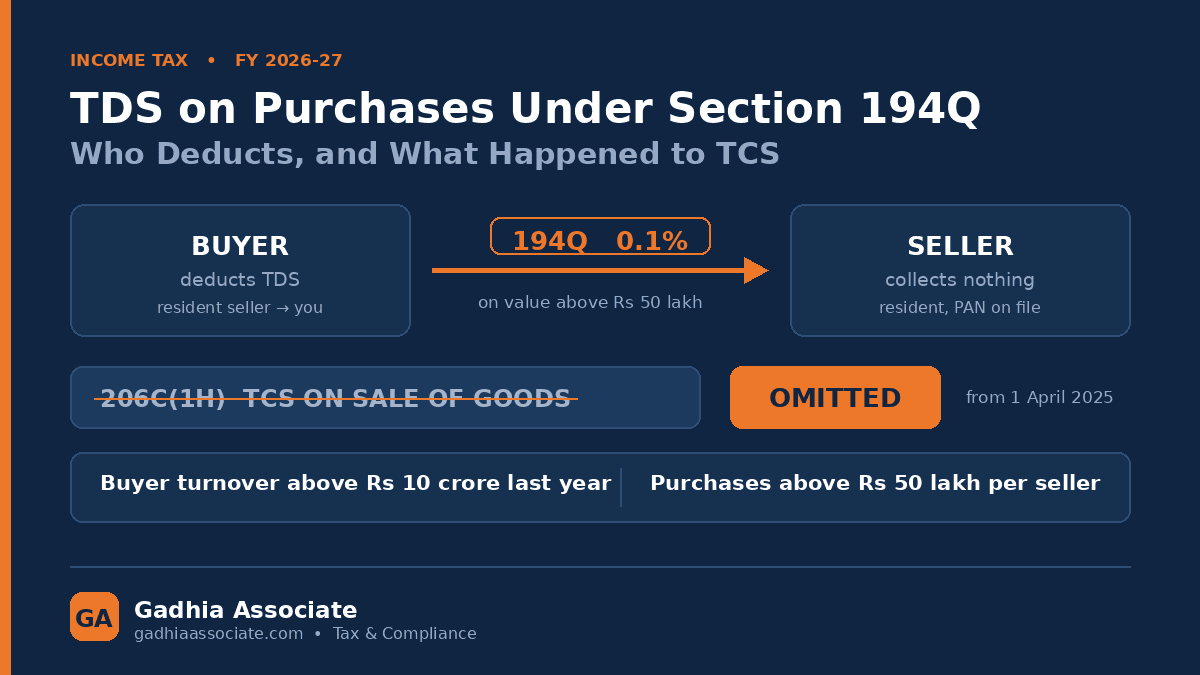
Section 194Q applies to you as a buyer, not a seller. You are covered if your total sales, turnover or gross receipts exceeded Rs 10 crore in the immediately preceding financial year. If so, on purchases of goods from a resident seller exceeding Rs 50 lakh in a financial year, you must deduct TDS at 0.1% on the value exceeding Rs 50 lakh.
Three details decide most disputes:
- The turnover test is on you, not your vendor.
- The Rs 50 lakh threshold is per seller, per financial year - cumulative across all bills from that seller, not per invoice.
- Timing. Deduct at the time of credit to the seller's account or at payment, whichever is earlier. Booking the purchase triggers it even if you pay in ninety days.
If the seller has not furnished a valid PAN, the higher rate of 5% applies. That single gap turns a 0.1% obligation into a fifty-times-larger one, so PAN collection is not a formality.
Is TCS on sale of goods still applicable?
This is the change most businesses have not absorbed. Section 206C(1H) - TCS on sale of goods - has been omitted. That was the provision under which a seller with turnover above Rs 10 crore collected 0.1% from buyers on receipts above Rs 50 lakh. The omission is widely reported as effective from 1 April 2025, so it does not apply for FY 2025-26 onwards. Have the exact effective date confirmed for your own transactions, because the transition year is where the errors sit.
The practical consequence: for current-year transactions, only 194Q operates. The old headache - "does 194Q override 206C(1H)?" - is now historical. The earlier rule was that where both could apply, the buyer's 194Q deduction prevailed and the seller was relieved from collecting. Today there is nothing left to override.
Two cautions. First, other TCS provisions continue - Section 206C(1) on specified goods such as scrap, timber and tendu leaves is untouched, so if you deal in scrap in Saurashtra your seller-side TCS is very much alive. Second, the higher-rate provisions for return non-filers (Sections 206AB and 206CCA) were also removed in the same rationalisation, reported as effective 1 April 2025; verify the current status before building it into your ERP logic.
Do I deduct on the full purchase or only above Rs 50 lakh?
Only on the excess.
Illustrative example, round figures only: your firm's turnover last year was Rs 18 crore, so you are covered. This year you buy goods worth Rs 80,00,000 from one Gujarat supplier. The first Rs 50,00,000 is excluded, so TDS applies on Rs 30,00,000 at 0.1% = Rs 3,000 - not Rs 8,000 on the full value. Had that supplier's PAN been missing, the rate would be 5% on Rs 30,00,000, or Rs 1,50,000. Same transaction, decided purely by a document you did or did not collect.
What is the penalty for not deducting 194Q?
The cost of getting this wrong is not a small late fee. It compounds in four directions:
- 30% disallowance of the purchase. Under Section 40(a)(ia), failure to deduct or to deposit before the return due date can disallow 30% of that expenditure. On a Rs 80 lakh purchase that is Rs 24 lakh added to taxable profit, to save Rs 3,000 of TDS.
- Interest and assessee-in-default status under Section 201, with interest under Section 201(1A) - broadly 1% per month for non-deduction and 1.5% per month where tax was deducted but not deposited.
- Late fees and return defaults on quarterly TDS statements, plus the TRACES default notices that follow - we have written separately on how to read and close those.
- The reconciliation mess. Where a seller wrongly collected TCS and the buyer also deducted 194Q, credits appear twice in Form 26AS, the ledger does not tie and the vendor account stays disputed for months.
Get this checked before your next quarter closes
If you are unsure whether you are a covered buyer, or whether vendors are still adding TCS, get a second pair of eyes on it now rather than at assessment. Gadhia Associate has been practising since 2007 - over 18 years - and serves more than 7,000 clients across Saurashtra and Gujarat, with a 5.0 Google rating from 100+ reviews. Your first consultation is free. Call or WhatsApp +91 82005 28355 and we will tell you plainly whether 194Q applies to you and what your exposure looks like.
What if both 194Q and TCS apply on the same bill?
For current-year transactions they should not, because TCS on sale of goods no longer exists. If it is still happening, either your vendor's billing software was never updated or someone is applying an old circular out of habit. Deal with it like this:
- Identify the affected invoices - every purchase bill carrying a "TCS 206C(1H)" line for periods on or after the omission date.
- Do not net it off unilaterally. Raise a debit note only after written confirmation from the vendor.
- Check Form 26AS before adjusting. If the vendor deposited the TCS and it shows as credit in your 26AS, claim that credit; if he collected but never deposited, insist on a corrected invoice and refund.
- Keep deducting 194Q correctly meanwhile - the vendor's error does not excuse your obligation.
- For older periods where both provisions coexisted, the historical rule that 194Q prevailed governs - review those years separately.
Your practical 194Q compliance workflow
A clean process takes a day to set up and prevents years of trouble:
- Confirm your preceding-year turnover from audited figures - this ties directly to your tax audit position under Section 44AB, covered in a separate article.
- Collect PAN and a written declaration from every material vendor, acknowledging that you will deduct under 194Q.
- Set a cumulative per-seller tracker in your accounting software so the Rs 50 lakh line is flagged automatically.
- Deposit TDS by the due date, file the quarterly TDS return (Form 26Q under the existing forms) and issue Form 16A to each vendor each quarter so they can claim credit.
- Reconcile 26AS quarterly, not annually. Also review your cash payment practices - our article on cash transaction limits explains how those disallowances stack on top of TDS ones.
One forward-looking point: the Income-tax Act, 2025, in force from 1 April 2026, has renumbered these provisions. The substance of 194Q is carried into the new numbering (widely referenced as Section 393 and its tables), and TDS return and certificate forms have been renumbered too. Section references in your older templates, vendor declarations and ERP masters may now be outdated - confirm the exact new numbers before printing them on documents.
Talk to us before you file the next TDS return
From our Junagadh office we offer same-day appointments, and we work fully digitally for clients across India. Whether you need a one-time 194Q applicability review or ongoing TDS handling, we work on fixed fees and monthly plans with a dedicated client manager, so you always know who to call. The first consultation is free - call or WhatsApp +91 82005 28355 with your turnover figure and a sample vendor invoice, and we will give you a clear answer.
Frequently asked questions on Section 194Q
My turnover is Rs 8 crore. Do I still have to deduct?
No. The obligation is triggered only where your total sales, turnover or gross receipts exceeded Rs 10 crore in the immediately preceding financial year. Below that you do not deduct - but confirm the figure from audited accounts, not provisional books.
My supplier is still charging TCS on his invoice. Can I refuse to pay it?
Raise it in writing first. TCS on sale of goods has been omitted for current periods, so the line is very likely an error in his billing setup. Ask for a corrected invoice - refusing payment without written agreement only creates a ledger dispute.
Do I deduct 194Q on GST as well, or only on the goods value?
This depends on how your invoice and contract are structured and on the guidance issued for indirect tax components. It is genuinely fact-specific - have your invoice format reviewed once by a professional, then apply that treatment consistently across all vendors.
I missed deducting for two quarters. What is the fastest way to limit damage?
Act before the return filing date for the year. Broadly, depositing the tax with interest and filing a corrected TDS statement reduces exposure, and where the seller has already offered the income and paid tax, relief from assessee-in-default status may be available on furnishing the prescribed accountant's certificate. The exact route depends on your facts.
Disclaimer: This article reflects the position as we understand it in September 2026. Tax provisions, rates, thresholds, forms and section numbering change through Finance Acts, CBDT notifications and circulars, and the Income-tax Act, 2025 has renumbered many provisions. Outcomes depend entirely on the facts of your case. Please confirm the current position with a qualified professional before acting on anything stated here.