TCS on Foreign Remittance in 2026: LRS Limit, Rs 10 Lakh Threshold, 20% TCS on Travel and Investment, Lower Rates for Education and Medical, and How to Claim the Credit
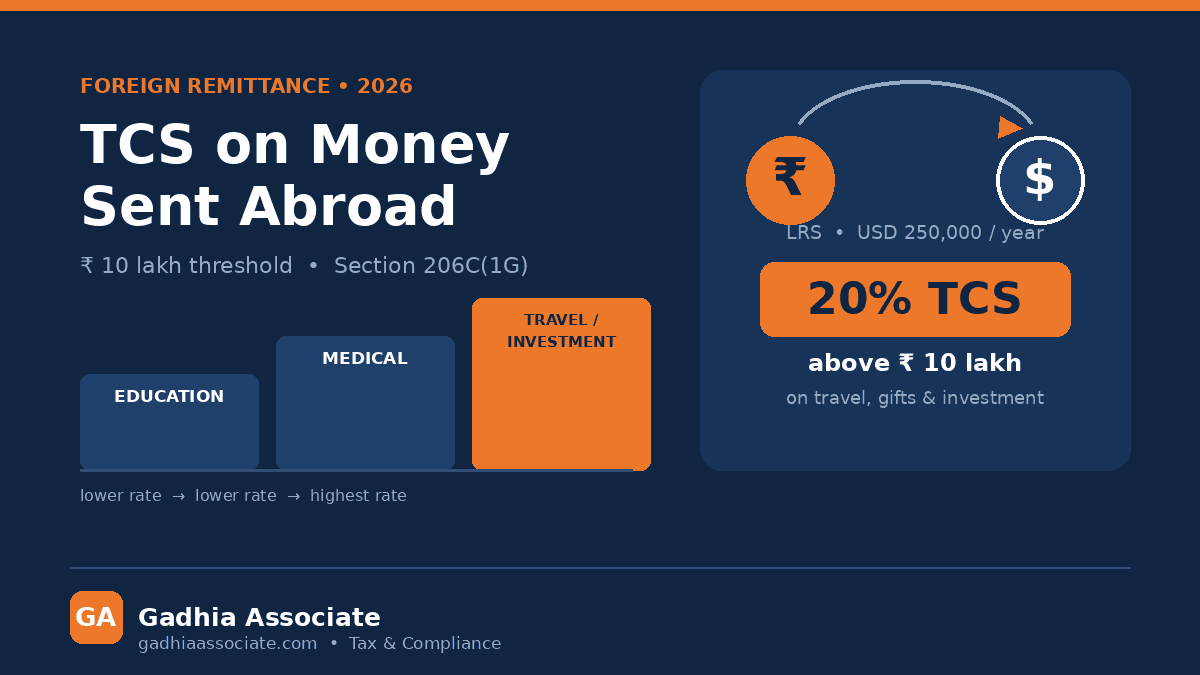
TCS on foreign remittance applies when a resident individual sends money abroad under the RBI's Liberalised Remittance Scheme, and since 1 April 2025 the tax is collected only on the amount that crosses Rs 10 lakh in a financial year. Most purposes such as travel, gifts and overseas investment attract 20% on the excess, while education and medical treatment attract a much lower concessional rate. The most important point is the one most people miss: TCS is not an extra tax, it is an advance credit you claim back in your income tax return.
Every year hundreds of families in Junagadh and across Gujarat send money abroad for a child's university fees, a parent's medical treatment, a holiday, or an investment in overseas shares and property. The bank deducts a chunk at the counter, the remitter panics, and the assumption sets in that the money is gone. It is not. Here is the complete, practical position as things stand in August 2026.
What is the LRS limit per year?
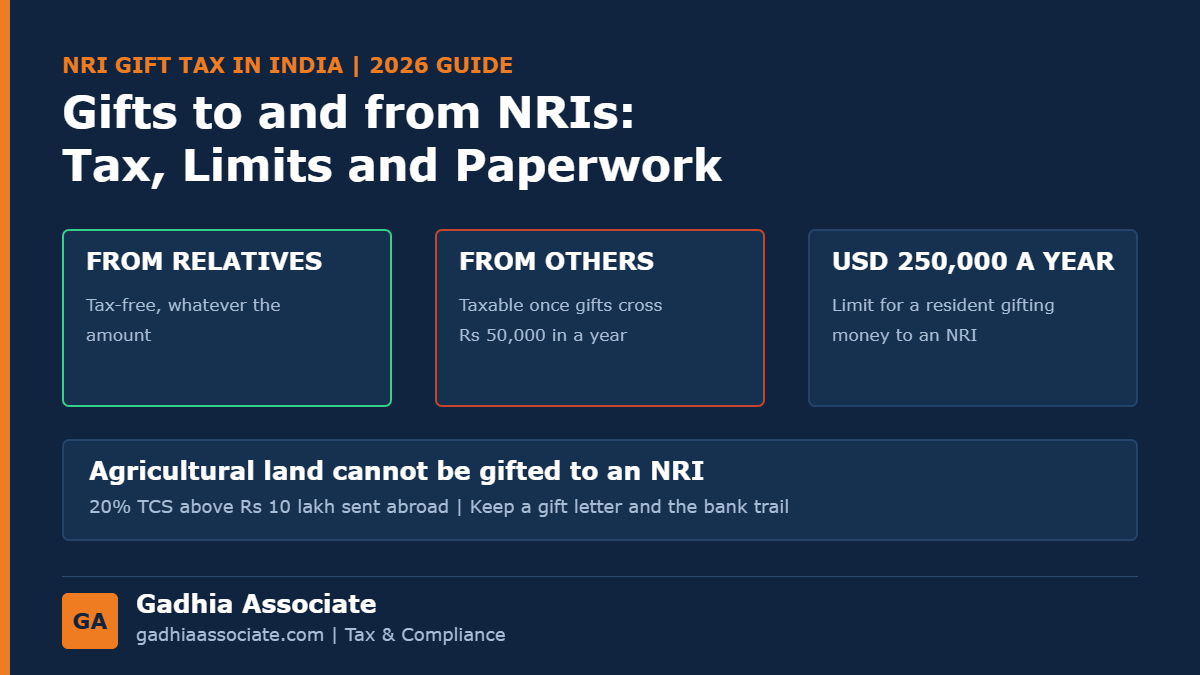
Under the RBI's Liberalised Remittance Scheme (LRS), a resident individual — including a minor, in which case the form is countersigned by a guardian — can remit up to USD 250,000 per financial year without any separate RBI approval. The limit is per person, not per family, so a household of four can legitimately structure remittances across four PAN holders where the funds genuinely belong to each person.
LRS money can be used for a wide set of permitted current and capital account purposes: private and business travel, gifts and donations, maintenance of close relatives abroad, education, medical treatment, employment or emigration expenses, purchase of overseas shares and mutual funds, buying immovable property abroad, and opening a foreign currency account overseas. It cannot be used for prohibited purposes such as margin trading, lottery or forex trading, or remittances to countries identified as non-cooperative by the FATF.
What is TCS on foreign remittance and who collects it?
Tax Collected at Source on foreign remittance is collected by the authorised dealer bank (or the tour operator, for a package) at the time you remit. It was introduced under Section 206C(1G) of the Income-tax Act, 1961. With the new Income-tax Act, 2025 coming into force on 1 April 2026, the TCS provisions have been renumbered into the new Act's scheme — the substance of the levy is unchanged, but the section reference you will see on bank notices and Form 27D may now cite the new numbering rather than 206C(1G). If a document quotes a section number you do not recognise, that is usually why.
Does TCS apply below Rs 10 lakh?
No. The Finance Act 2025 raised the LRS threshold from Rs 7 lakh to Rs 10 lakh with effect from 1 April 2025. TCS on foreign remittance is triggered only on the amount exceeding Rs 10 lakh of aggregate LRS remittances by that individual in the financial year. If you remit Rs 9 lakh across the year, no TCS at all. If you remit Rs 14 lakh, TCS applies on Rs 4 lakh only.
Note that the threshold is cumulative across the year and across banks. Banks rely on your declaration of earlier remittances, so keep your own running record — an omission here creates a mismatch later.
What are the TCS rates on money sent abroad?
Broadly, the structure works like this:
- Education and medical treatment — a concessional rate on the amount above Rs 10 lakh (5% under the Finance Act 2025 position; the rate for remittances made in FY 2026-27 has been revised downward in the current cycle, so confirm the exact notified rate with your bank before remitting).
- Education funded by an education loan from a specified financial institution — the Finance Act 2025 removed TCS entirely on such remittances from 1 April 2025. Previously a token 0.5% applied above the threshold. Today, if the remittance is out of a qualifying education loan, there is no TCS to collect.
- All other purposes — investment in foreign shares, property, gifts to relatives abroad, maintenance, general travel — 20% on the amount above Rs 10 lakh.
- Overseas tour programme packages — treated separately, with their own slab structure and no benefit of the Rs 10 lakh LRS threshold. Under the FY 2025-26 position a lower rate applied up to Rs 7 lakh of packages in the year and 20% beyond that; the slab has since been revisited, so ask your tour operator for the rate currently being applied.
Education vs medical vs travel vs investment: how the treatment differs
Compare four people who each remit Rs 20 lakh in the same year. The parent paying university fees for a child abroad and the family paying for a spouse's cancer treatment overseas both sit in the concessional bracket — the state accepts that these are necessity remittances, so the collection on the Rs 10 lakh excess is modest. If that same parent is funding the fees from a sanctioned education loan, the collection drops to nil. The person buying US stocks or a flat in Dubai is in the 20% bracket on the Rs 10 lakh excess, because investment remittances are exactly what the provision was designed to track. And the person who books a Rs 20 lakh Europe package through an Indian tour operator is in a different regime altogether: the LRS threshold does not shelter them, the operator collects on the package value under the tour-package slab, and it happens at booking rather than at remittance. Same amount of money, four very different outcomes — which is why the purpose code on the Form A2 matters.
Do I get the TCS money back?
Yes. TCS is not a cost, it is a prepayment of your own income tax. Once collected, it is deposited against your PAN, reported by the collector in Form 27D, and reflects in your Form 26AS and AIS. When you file your ITR, you claim it in the tax credit schedule. It first reduces your tax liability for the year; if your liability is lower than the TCS collected, the balance is refunded with interest where applicable.
Salaried remitters have a second, faster route. You can declare the TCS to your employer so that it is factored into your salary TDS for the remaining months of the year, which means you recover the cash through higher take-home pay instead of waiting for a refund. Many people never do this and unnecessarily lock up working capital for a year.
Worked example (illustrative only)
Take a Junagadh parent remitting Rs 25 lakh in FY 2026-27 for a daughter's master's degree in Canada, funded from own savings rather than a loan. The first Rs 10 lakh is outside TCS. The balance Rs 15 lakh falls in the education bracket, so at an assumed concessional rate of 5% the bank collects Rs 75,000 and remits Rs 24,25,000 abroad. That Rs 75,000 appears in the parent's Form 26AS. If the parent's assessed tax for the year is Rs 2,10,000 and salary TDS was Rs 2,00,000, the TCS credit of Rs 75,000 wipes out the Rs 10,000 shortfall and produces a Rs 65,000 refund. The real cost of the TCS was zero — only the timing changed. Figures are illustrative and rounded; your actual rate and liability will differ.
Is TCS applicable to NRIs?
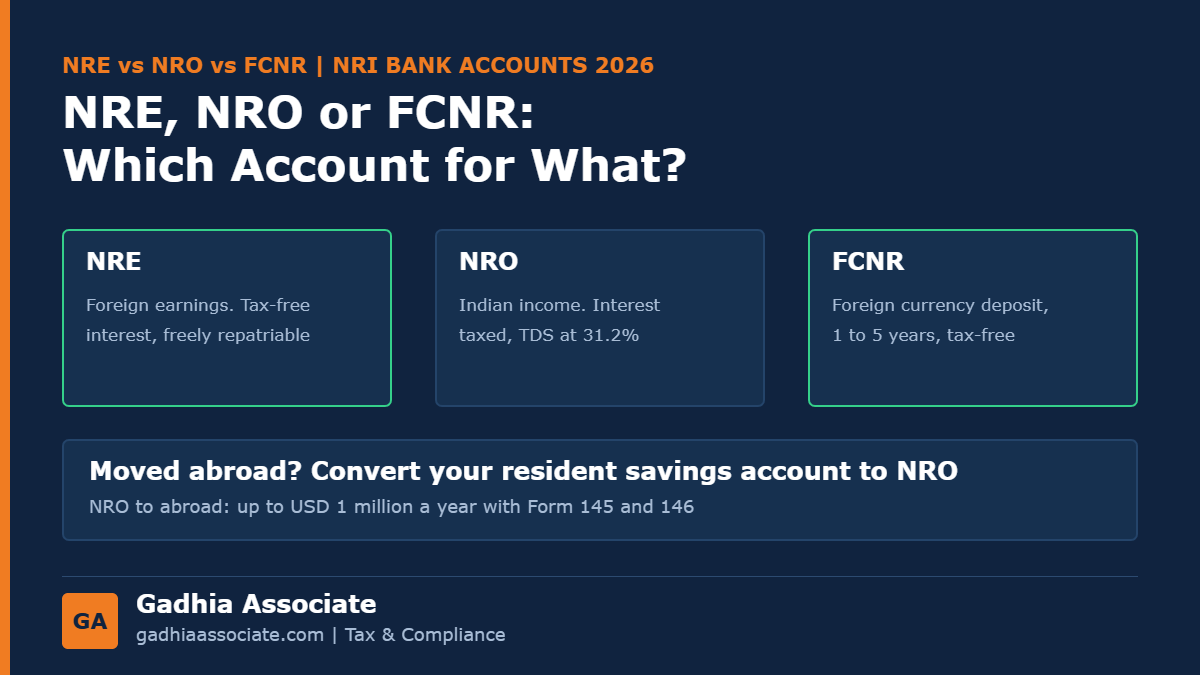
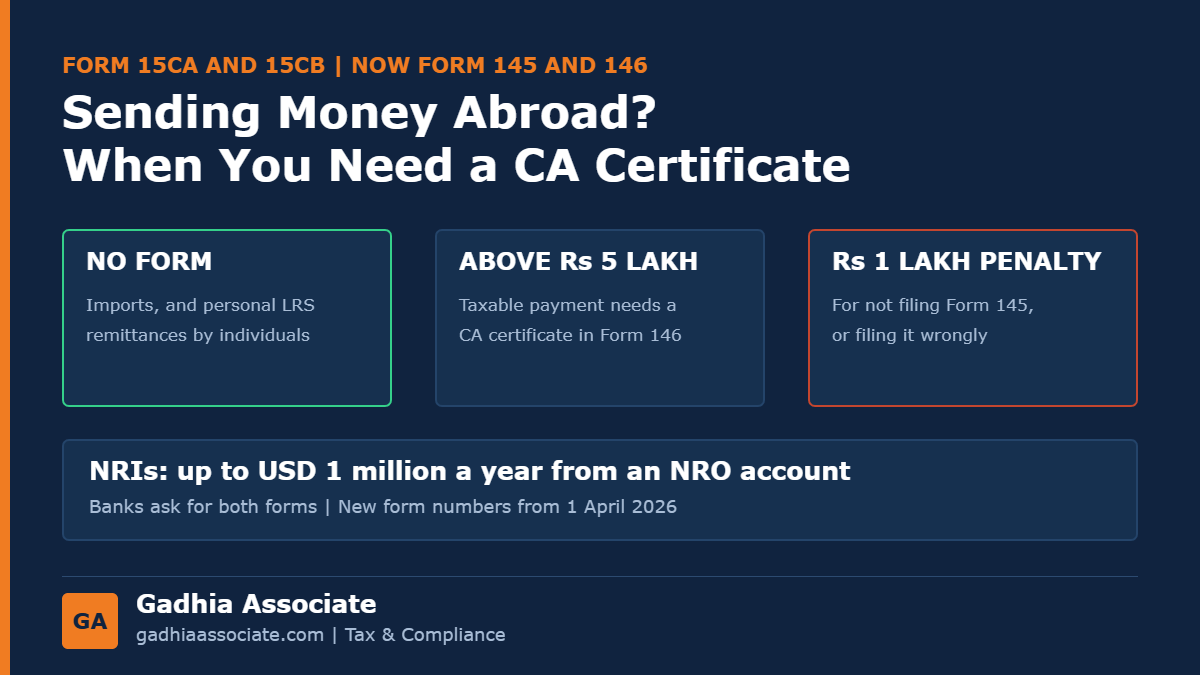
LRS itself is available only to resident individuals, so an NRI remitting funds out of an NRE or FCNR account is outside the LRS-TCS net. Repatriation from an NRO account follows the separate Form 15CA/15CB and Section 195 route with its own limits. The complication arises for returning Indians and recent emigrants, where residential status for the year decides which regime applies — our NRI Desk handles exactly these borderline cases, along with Form 15CA/15CB certification and DTAA relief.
A quick pre-remittance checklist
- Confirm your cumulative LRS remittances so far this financial year, across all banks
- Choose the correct purpose code on Form A2 — education, medical, investment and travel are not interchangeable
- Keep the university invoice, hospital estimate or loan sanction letter ready as supporting proof
- If funding education from a loan, give the bank the sanction letter so no TCS is collected at all
- Collect Form 27D from the bank and check the entry in Form 26AS/AIS a few weeks later
- Tell your employer about the TCS so it is adjusted against salary TDS
- Claim the credit in the tax credit schedule of your ITR — it does not happen automatically
If your remittance is for an overseas investment, remember the exit side too: foreign shares and property bring capital gains, foreign asset reporting in Schedule FA, and possible DTAA credit. Our Income Tax services cover the full cycle, and the Capital Gain Tax Calculator on our website is a useful first estimate before you commit funds abroad. Business owners routing funds through an overseas subsidiary should look at the Business Structure Advisor and our Company Registration team instead, since ODI rules rather than LRS may apply.
How Gadhia Associate Can Help
We advise families and businesses across Junagadh, Gujarat and the rest of India on LRS planning, TCS computation, Form 15CA/15CB, ITR credit claims and refunds, and NRI taxation. If you are planning a large remittance this year — for a child's education, medical treatment or an overseas investment — talk to us before you transfer, not after. Book a free consultation with Gadhia Associate today.
Disclaimer: This article reflects the position as of August 2026. TCS rates, thresholds and LRS conditions change through CBDT and RBI notifications and annual Finance Acts. Please confirm the current position with a qualified professional before acting on this information.