Taking a Loan from an NRI Relative or Friend in 2026: FEMA Rules for Individuals and Companies, the New ECB Route, NRO Repayment and TDS on Interest
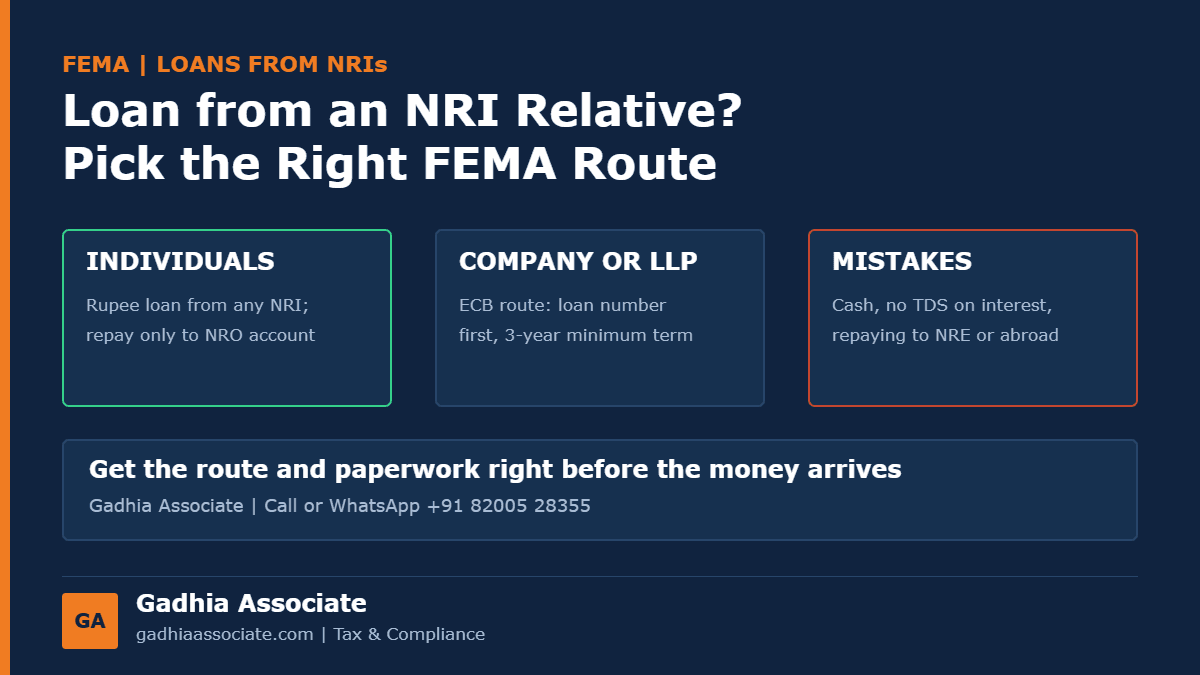
A loan from an NRI relative or friend is allowed under FEMA, but the route, repayment account and paperwork differ for individuals and companies.
Hiteshbhai runs a casting unit in Rajkot through a private limited company and needs about Rs 60 lakh for a new CNC line. His brother Paresh, a US citizen with an OCI card, has offered to lend it for five years. A college friend who works in Dubai on an Indian passport is ready to lend Hiteshbhai another Rs 15 lakh personally for his house renovation. Everyone around him says family money needs no paperwork, so both amounts can simply come into his savings account.
Almost every family in Saurashtra has someone abroad, and loans from them are common for business, weddings and houses. RBI amended the borrowing rules in February 2026, and they are different for a person and for a company. Here is how they work.
Short Answer: A resident individual can borrow rupees from any NRI, or from an OCI cardholder who is a relative, if the money comes through the bank on a non-repatriation basis and interest and repayment go only to the lender's NRO account. A foreign currency loan of up to USD 250,000 can be taken from relatives abroad, interest-free and for at least one year. A company or LLP must use the External Commercial Borrowing route, which since February 2026 allows any non-resident, including an individual, to lend, with a loan registration number before the money arrives and a three-year minimum term. Interest paid to the lender needs TDS.
Our team structures loans from NRIs and handles the ECB filings and the TDS on interest. Call or WhatsApp +91 82005 28355, or see the details at the end of this guide.
Which route applies to you
- Individual, rupee loan: from any NRI, or from an OCI cardholder who is a relative.
- Individual, foreign currency loan: only from relatives abroad, up to USD 250,000.
- Company or LLP: only through the External Commercial Borrowing (ECB) route.
- Partnership firm: the rupee route is for individuals and the ECB route is for bodies registered under a law, so take advice before a firm borrows from abroad.
- Who is a relative: the Companies Act meaning applies, which covers spouse, parents, sons and daughters and their spouses, brothers and sisters. Uncles, aunts, cousins, nephews and nieces are not covered.
Rupee loan to an individual
- How the money comes: by inward remittance from abroad, or from the lender's NRE, NRO or FCNR(B) account. Cash is not allowed.
- Non-repatriation: interest and repayment go only into the lender's NRO account, not the NRE account and not abroad. See NRE, NRO and FCNR accounts.
- Tenor and interest: the amended regulation does not fix a period or an interest ceiling in its text, so put a reasonable rate and repayment date in writing and confirm the terms with your bank.
- Proprietors: a proprietor borrows as an individual, so this route can cover business needs too.
- Not allowed for: chit funds, Nidhi companies, real estate business, farmhouses, most agriculture and plantation, trading in development rights, dealing in shares, or lending the money onward for these.
Foreign currency loan from a relative abroad
- Limit: up to USD 250,000 or its equivalent.
- Lender: only a relative living outside India.
- Terms: under RBI's long-standing terms, the loan is interest-free and for at least one year.
- Receipt: by inward remittance through the bank, or from the lender's NRE or FCNR(B) account.
Loans to a company or LLP: the ECB route
- What changed: since February 2026 any person living outside India, including an individual, can lend. Earlier an individual could generally lend only as a shareholder with at least 25%.
- Loan registration number: the company applies through its bank in Form ECB 1 and can draw the money only after the number is allotted.
- Minimum term: an average maturity of three years, or one to three years for manufacturers within a USD 150 million cap.
- Interest: in line with market conditions.
- Limit: the higher of USD 1 billion of ECB, or total borrowings up to 300% of net worth.
- Reporting: Form ECB 2 through the bank within seven days of the end of a month in which money is drawn or repaid, with a late fee for delays.
- Companies Act: money received from a non-resident in line with FEMA is not treated as a deposit.
- Equity instead: if the lender wants a stake, shares need separate reporting. See NRI investment in a private limited company and converting a loan into shares.
Income tax on the loan
- Through the bank: a loan of Rs 20,000 or more cannot be taken or repaid in cash. See cash transaction limits.
- Proof of source: keep the loan agreement, the lender's passport and visa or OCI card, the bank's remittance advice and the lender's bank statement, because the tax officer can ask you to prove the loan is real.
- TDS on interest: interest paid to a non-resident needs TDS at 30% plus cess, or the lower treaty rate with a tax residency certificate. See DTAA and Form 41.
- Sending it abroad later: the lender can remit NRO money abroad within the USD 1 million a year limit, with Forms 145 and 146. See Form 145 and 146.
- Loan or gift: a gift from a relative is tax-free, but one from a friend above Rs 50,000 is taxed, so a friend's money usually works better as a documented loan. See gifts to and from NRIs.
Lending to an NRI relative
- A resident can lend rupees to an NRI or OCI relative within the USD 250,000 a year remittance limit, interest-free and for at least one year, credited to the borrower's NRO account.
- The money cannot be sent abroad, and similar banned uses apply.
Common mistakes
- Taking the money into a company's account before the loan registration number is issued.
- Repaying a rupee loan into the lender's NRE account or directly abroad.
- Taking cash from a visiting relative and calling it a loan.
- Borrowing rupees from a foreign-citizen friend who is not a relative.
- Paying interest without TDS.
- Using the money for land dealing, farming or the share market.
Back to Hiteshbhai. His brother's Rs 60 lakh goes to the company as an ECB: the bank files Form ECB 1, the money is drawn only after the loan registration number arrives, the five-year term clears the three-year minimum, and interest is fixed at a market rate with TDS at the India-US treaty rate. His Dubai friend, an Indian citizen, lends the Rs 15 lakh to Hiteshbhai personally by bank remittance under a written agreement, and it will be repaid only into the friend's NRO account. Nothing comes in cash, and both files are ready if the bank or the tax officer asks.
How we help
- Choosing the right route for loans from NRIs and foreign lenders
- Loan agreements and bank documentation
- ECB applications, loan registration numbers and reporting
- TDS on interest, treaty rates and Forms 145 and 146
- Regularising past loans taken without paperwork
- Converting foreign loans into equity with FC-GPR reporting
Gadhia Associate has been in practice since 2007 and has handled work for over 7,000 clients, with a 5.0 Google rating from more than 100 reviews. Business owners and families from Junagadh, Rajkot, Jamnagar, Porbandar and Keshod come to our Junagadh office, where same-day appointments are available. NRIs and clients elsewhere are handled online.
Planning to borrow from a relative or friend abroad? Get the route and paperwork right before the money arrives. Call or WhatsApp +91 82005 28355, or message us on WhatsApp. The first consultation is free.
Frequently asked questions
Can I take a loan from an NRI relative?
Yes. An individual can borrow rupees from any NRI or an OCI relative through the bank, or up to USD 250,000 in foreign currency from a relative abroad.
Can an NRI friend lend me money?
Yes, in rupees, if the friend is an NRI. A foreign citizen with an OCI card can lend rupees to an individual only if he or she is a relative.
Where must a loan from an NRI be repaid?
A rupee loan and its interest are paid only into the lender's NRO account.
Can an NRI lend money to my private limited company?
Yes, through the ECB route, with a loan registration number before the money arrives and a three-year minimum average maturity.
Is TDS deducted on interest paid to an NRI?
Yes, at 30% plus cess, or the lower treaty rate with a tax residency certificate.
Can I take a loan from an NRI in cash?
No. It must come through banking channels, and a cash loan of Rs 20,000 or more also attracts an income tax penalty.
Position as of 10 November 2026, under the Foreign Exchange Management (Borrowing and Lending) Regulations as amended in February 2026 and the Income-tax Act, 2025. Banks follow RBI's detailed directions, so confirm the terms for your loan before signing.