Paying Directors of a Private Limited Company in 2026: Salary or Sitting Fees, TDS, GST Reverse Charge, Approvals and Tax Deduction
How a private company pays its directors decides the TDS, whether GST applies under reverse charge, and which approvals the payment needs.
Two brothers run a polymer company in Jamnagar as whole-time directors, paid Rs 2 lakh a month each as directors' remuneration with 10% TDS cut as professional fees. Their father, a director who no longer works daily, gets Rs 50,000 a month as sitting fees, with no GST paid on it. The elder brother's son works as general manager at Rs 3 lakh a month. A GST audit and the company's tax audit have both raised questions about these payments.
Paying directors looks simple in a family company, but the label on the payment changes the TDS section, the GST and the approvals. Here is how it works in 2026.
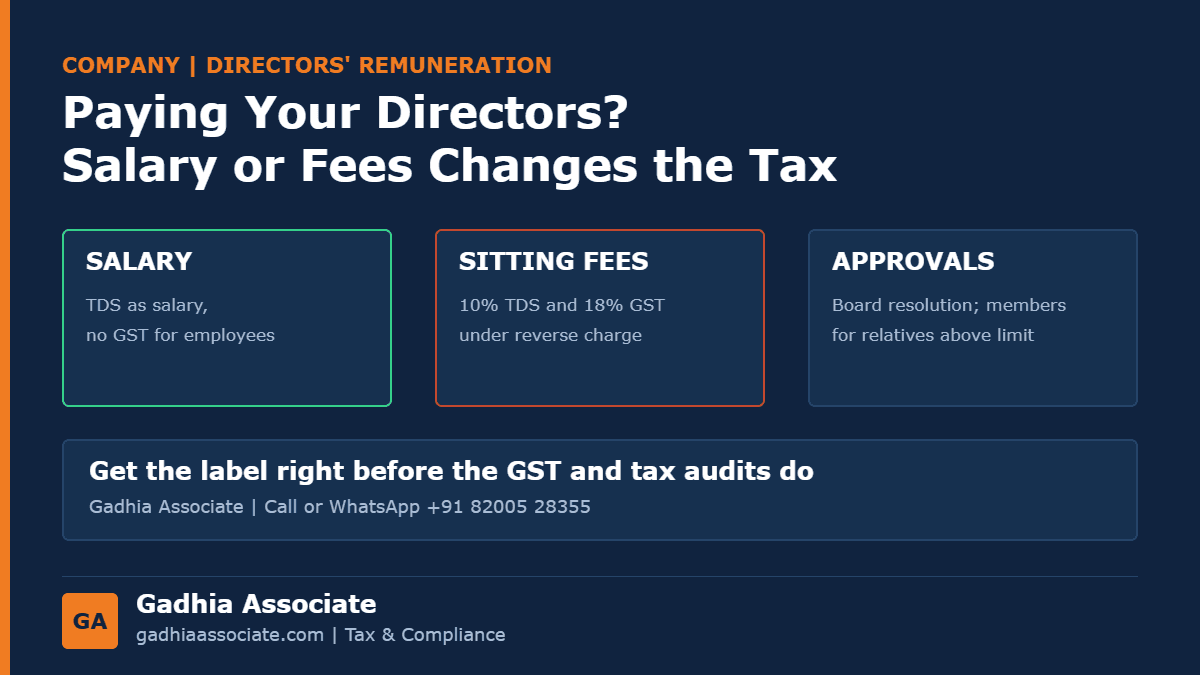
Short Answer: A director who works in the company as an employee is paid salary, with TDS under the salary rules and no GST. Sitting fees or commission paid to a director who is not an employee carry 10% TDS, and the company pays 18% GST on them under reverse charge, claiming it back as credit. Private companies are not bound by the remuneration ceilings that apply to public companies, but the payments need board approval, and members' approval where the articles require it; a director's relative in a job paying over Rs 2.5 lakh a month may also need members' approval. Reasonable remuneration is a deductible business expense.
Our team sets up director pay, TDS, GST and the approvals for private companies. Call or WhatsApp +91 82005 28355, or see the details at the end of this guide.
Salary to working directors
- Employees: whole-time and managing directors with an employment arrangement are paid salary.
- TDS: deducted under the salary rules, with the standard deduction and the director's chosen tax regime.
- No GST: services by an employee to the employer are outside GST.
- Perquisites: a company car, house or other benefit is valued and added to salary. See buying a car in the company's name.
- Document it: a board resolution and appointment terms showing salary, duties and benefits.
Sitting fees and commission to other directors
- TDS: 10% on sitting fees, commission and other payments to a director that are not salary.
- GST under reverse charge: the company pays 18% GST on these payments itself, and can claim it as credit.
- Common mistake: treating working directors' pay as professional fees, or paying non-executive directors without the reverse charge.
- Employee or not: the facts decide. See employee or consultant.
Approvals under the Companies Act
- No ceiling for private companies: the overall limits on managerial remuneration apply to public companies, not private ones.
- Board approval: remuneration is approved by the board, and by members if the articles say so.
- Relatives: appointing a director's relative to a job paying more than Rs 2.5 lakh a month needs members' approval, unless the terms are at arm's length in the ordinary course of business.
- Disclosure: payments to directors and their relatives are shown as related party transactions in the accounts.
- Changes in directors: see appointing or removing a director.
Income tax for the company
- Deduction: reasonable remuneration to directors is a business expense.
- Excessive payments: pay to directors and their relatives can be cut down if it is excessive for the services.
- TDS failures: missed TDS can lead to part of the expense being disallowed, plus interest.
- Salary or dividend: the right mix depends on rates and cash needs. See taking money out of your company.
Year-end checklist
- Board resolutions for every director's pay, with dates and amounts
- TDS under the right section for each payment, and quarterly returns filed
- Reverse charge GST paid on non-salary payments to directors
- Members' approval for relatives above the limit
- Related party disclosures in the accounts
Back to the Jamnagar company. The brothers' pay is put on proper appointment terms as salary, with TDS under the salary rules from the next month and no GST. Their father's sitting fees now carry 10% TDS, and the company pays 18% GST under reverse charge with interest for past months, claiming it back as credit. The son's appointment at Rs 3 lakh a month is approved by members, all payments are disclosed as related party transactions, and the auditors' questions are answered with the resolutions on file.
How we help
- Structuring directors' pay as salary, fees or commission
- TDS on salary and director payments, and TDS returns
- Reverse charge GST on director payments
- Board and members' resolutions and related party approvals
- Tax planning for directors between salary and dividend
- Replies to GST audits and tax audit queries
Gadhia Associate has been in practice since 2007 and has handled work for over 7,000 clients, with a 5.0 Google rating from more than 100 reviews. Companies from Junagadh, Rajkot, Jamnagar, Morbi and Gondal come to our Junagadh office, where same-day appointments are available. Work for companies elsewhere in India is handled online.
Paying your directors without clear TDS, GST or approvals? Get it set right before the next audit. Call or WhatsApp +91 82005 28355, or message us on WhatsApp. The first consultation is free.
Frequently asked questions
Is GST payable on directors' remuneration?
Not on salary to a director who is an employee. On sitting fees and commission to other directors, the company pays 18% under reverse charge.
What TDS applies to directors' sitting fees?
10%, under the provision for payments to directors other than salary.
Is there a limit on directors' pay in a private company?
No overall ceiling, but board approval, and members' approval where required, is needed.
Does a director's relative's salary need approval?
It can. A job paying more than Rs 2.5 lakh a month needs members' approval unless it is on arm's length terms in the ordinary course of business.
Is directors' remuneration deductible for the company?
Yes, if it is reasonable for the services and TDS is deducted correctly.
Should working directors be paid salary or professional fees?
Salary, where they work as employees. Calling it professional fees changes the TDS and can attract GST.
Position as of 6 November 2026, under the Companies Act, 2013, the GST law in force and the Income-tax Act, 2025. Your articles and appointment terms can change the answer, so take advice on your own company.