Small Company Limits Raised to Rs 10 Crore Capital and Rs 100 Crore Turnover: What Your Private Company Saves in 2026 and What Still Applies
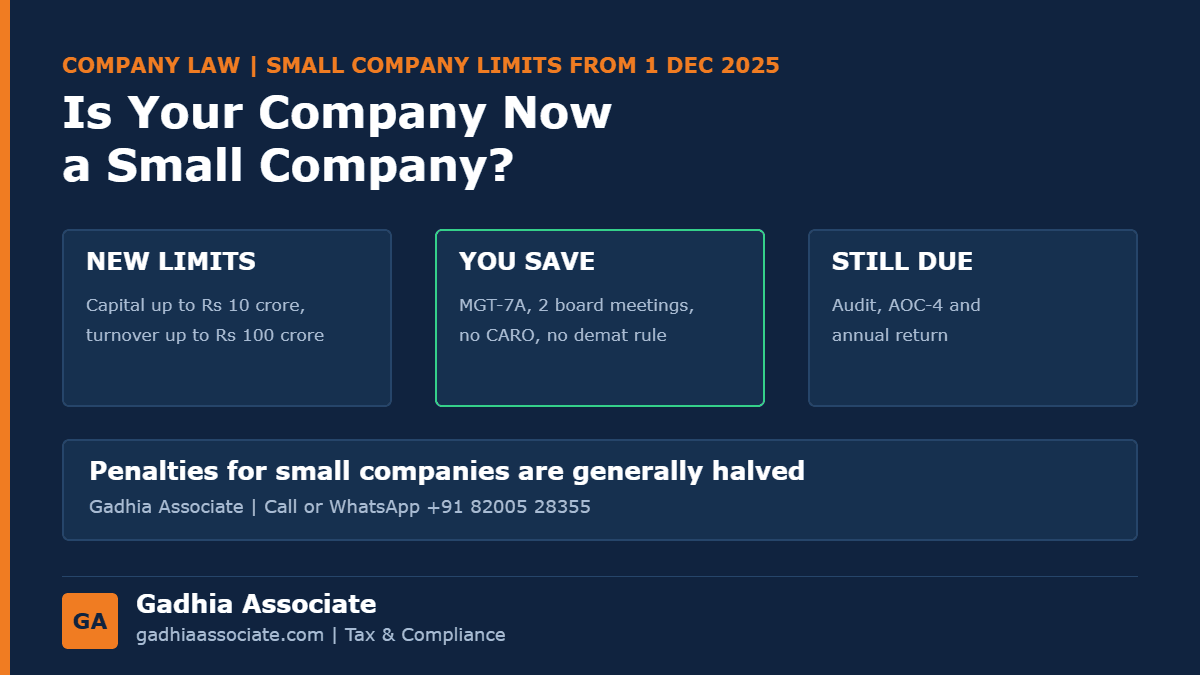
Since 1 December 2025, many more private companies count as small companies, with paid-up capital up to Rs 10 crore and turnover up to Rs 100 crore.
Kishorbhai's private limited company in Morbi trades in ceramic tiles, with a paid-up capital of Rs 2 crore and a turnover of about Rs 70 crore. Because its turnover crossed the old Rs 40 crore limit, it was treated as a regular private company: four board meetings a year, a cash flow statement, extra audit reporting, the full annual return and a plan to move its shares to demat. Its accountant has not yet noticed that the rules changed.
The small company limits were raised sharply in December 2025, and most family-run private companies in Saurashtra now fall within them. Being a small company cuts paperwork and penalties, but only if you know it applies. Here is how it works in 2026.
Our team checks your company's status and handles its ROC filings, board compliance and audit. Call or WhatsApp +91 82005 28355, or see the details at the end of this guide.
Who is a small company now
- Paid-up capital: Rs 10 crore or less, earlier Rs 4 crore.
- Turnover: Rs 100 crore or less in the last financial year, earlier Rs 40 crore.
- Both tests: the company must meet both limits.
- Not covered: public companies, holding or subsidiary companies, Section 8 companies, and companies governed by a special Act.
- From when: the new limits apply from 1 December 2025.
What a small company saves
- Annual return: the shorter Form MGT-7A instead of MGT-7. See private limited company annual compliance.
- Cash flow statement: not required as part of the financial statements.
- Board meetings: one in each half of the calendar year, at least 90 days apart, instead of four a year.
- Board's report: a shorter, abridged report is allowed.
- Audit reporting: the CARO report and the auditor's report on internal financial controls do not apply.
- Demat: the rule requiring private companies to issue and transfer shares only in demat form does not apply. See share transfer and the demat rule.
- Penalties: generally half of the usual penalty, with caps for the company and its officers.
- Mergers: two small companies can merge through the faster, simpler route.
What does not change
- Statutory audit: every company still needs its accounts audited.
- Annual filings: financial statements in AOC-4 and the annual return are still due every year.
- Directors: DIR-3 KYC, disclosures and registers still apply. See DIR-3 KYC.
- Charges and other events: loan charges, director changes and share issues are filed as before. See charge registration for company loans.
- Tax: income tax, tax audit and GST rules are not affected by small company status.
Check every year
- Status can change: growth in turnover or capital can take the company out of the definition, so test it each year on the latest accounts.
- Group structure: becoming a holding or subsidiary company ends small company status, whatever the size.
- New share issues: raising capital above Rs 10 crore changes the status. See converting directors' loans into share capital.
Back to Kishorbhai. With paid-up capital of Rs 2 crore and turnover of Rs 70 crore, his company is a small company under the new limits, and it has no holding or subsidiary links. From this year it files MGT-7A, drops the cash flow statement, holds two board meetings a year, and its auditor no longer adds the CARO and internal controls reports. The demat project is shelved, any penalty for a slip is halved, and the company checks its status again when each year's accounts are finalised.
How we help
- Checking small company status each year
- AOC-4 and MGT-7A filings
- Board meetings, minutes and registers
- Statutory audit and financial statements
- Share issues, transfers and demat where required
- Responses to ROC notices and compounding of defaults
Gadhia Associate has been in practice since 2007 and has handled work for over 7,000 clients, with a 5.0 Google rating from more than 100 reviews. Companies from Junagadh, Rajkot, Morbi, Jamnagar and Gondal come to our Junagadh office, where same-day appointments are available. ROC work for companies elsewhere in India is handled online.
Not sure whether your company is now a small company? Get it checked and cut your compliance load. Call or WhatsApp +91 82005 28355, or message us on WhatsApp. The first consultation is free.
Frequently asked questions
What is a small company under the Companies Act now?
A private company with paid-up capital of Rs 10 crore or less and turnover of Rs 100 crore or less, from 1 December 2025.
Can a subsidiary be a small company?
No. Holding and subsidiary companies are excluded, whatever their size.
Which annual return does a small company file?
Form MGT-7A, the shorter annual return.
How many board meetings must a small company hold?
At least one in each half of the calendar year, with a gap of at least 90 days.
Does a small company need a statutory audit?
Yes. The audit remains compulsory, though the CARO report does not apply.
Do small company shares have to be in demat form?
No. The demat requirement for private companies does not apply to small companies.
Position as of 3 November 2026, under the Companies Act, 2013 and the small company limits in force from 1 December 2025. Your company's structure decides its status, so check with your adviser each year.