Converting Directors' Loans into Share Capital in 2026: Authorised Capital and SH-7, Preferential Allotment, Valuation, PAS-3 and the Tax Questions
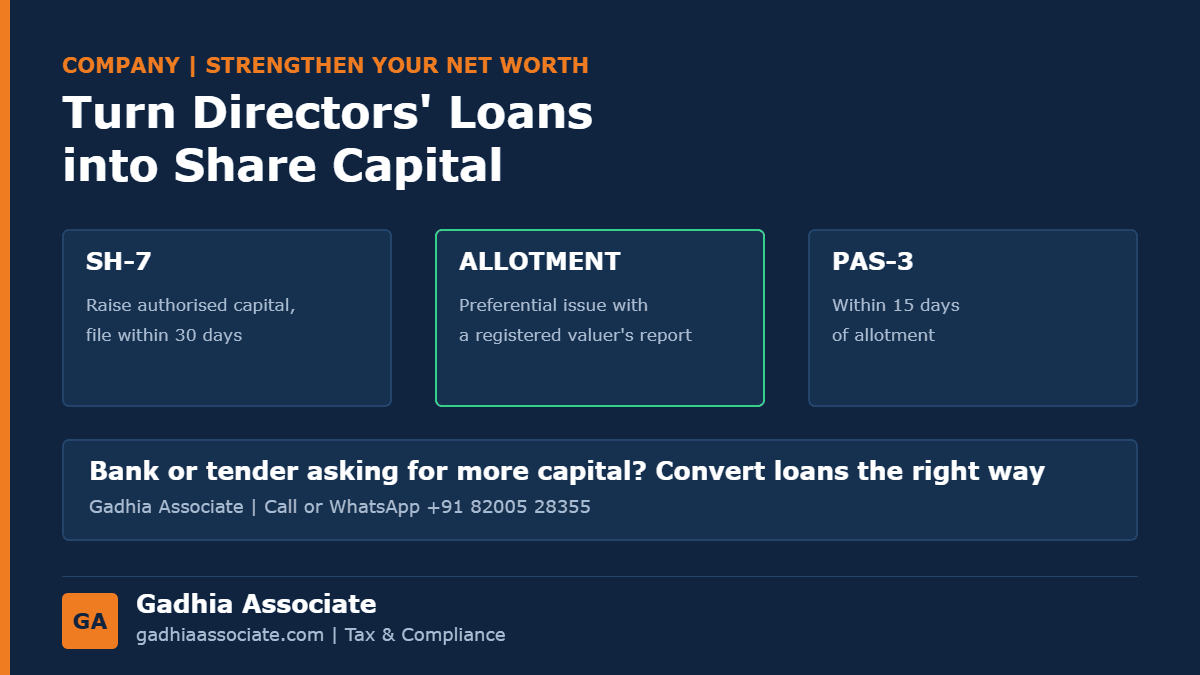
Directors' loans to a private limited company can become share capital to lift its net worth for a bank loan or tender, if the steps are right.
Darshanbhai and his brother run a packaging company in Rajkot with an authorised and paid-up capital of just Rs 10 lakh. Over the years they have lent it Rs 60 lakh from their own savings. Their bank is ready to sanction a Rs 3 crore term loan, but wants Rs 75 lakh of promoter capital in the balance sheet, and a government tender they want needs a net worth of Rs 1 crore.
Many family companies in Saurashtra are funded by directors' loans rather than share capital, which looks weak to banks and tender committees. Converting those loans into shares fixes that, but it involves company law, valuation and tax steps. Here is how it works in 2026.
Our team handles authorised capital increases, valuations, allotments and the ROC filings, with the tax side checked. Call or WhatsApp +91 82005 28355, or see the details at the end of this guide.
Why convert loans into shares
- Net worth: share capital counts towards net worth; directors' loans do not.
- Bank ratios: lower debt and higher promoter capital improve the debt-equity ratio banks look at. See what banks want in a loan file.
- Tenders: many tenders set a minimum net worth.
- Quasi-equity option: some banks accept directors' loans kept in the business and subordinated to the bank loan as quasi-equity, without conversion.
Step 1: check and increase authorised capital
- The ceiling: a company cannot issue shares beyond its authorised capital.
- The approval: an ordinary resolution of members, if the articles allow it.
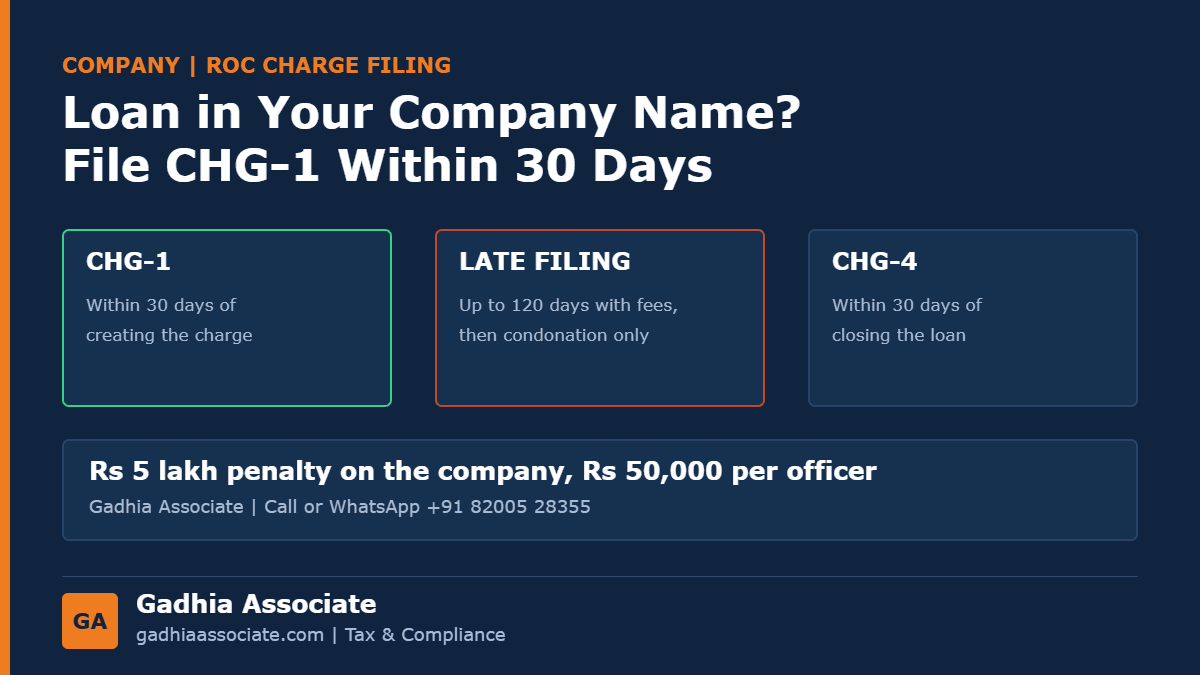
- Form SH-7: filed with the ROC within 30 days, with the altered memorandum, the fee and stamp duty.
Step 2: choose the route
- Conversion clause: if the loan was taken with an option to convert it into shares, approved by special resolution before the loan, it can be converted on those terms.
- Preferential allotment: otherwise, the loan is converted by allotting shares to the directors, approved by special resolution, with a registered valuer's report on the price.
- Rights issue: or existing shareholders subscribe for new shares in proportion to their holding, and the company repays the loans from that money. With members' consent, a private company can shorten the offer period.
Step 3: the filings
- Form MGT-14: for the special resolution, within 30 days.
- Offer and allotment: the offer letter and records required for a preferential issue, then a board resolution for allotment.
- Form PAS-3: the return of allotment, within 15 days for a preferential issue and 30 days for a rights issue.
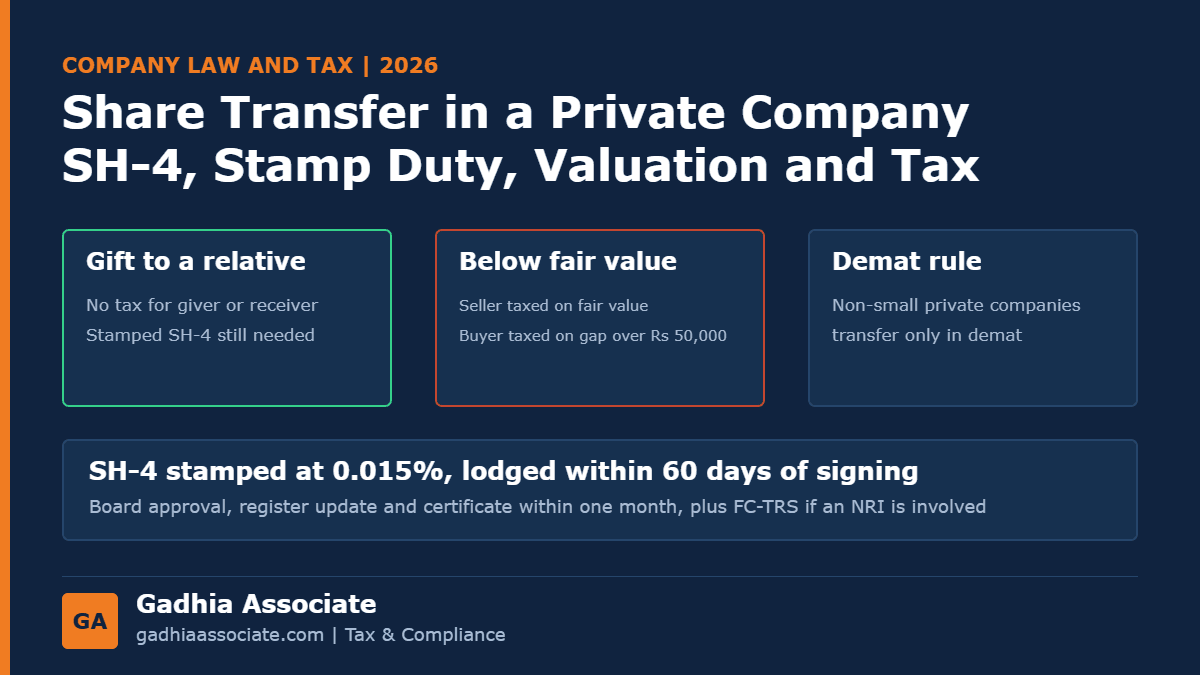
- Share certificates: issued within 60 days, with stamp duty paid, and the register of members updated.
- Demat: companies that are not small companies must issue shares only in demat form. See share transfer and the demat rule.
The tax questions
- Source of funds: for a closely held company, the tax officer can ask a shareholder to explain where the money came from. Keep the bank trail of each loan and the directors' returns.
- Price: shares issued at a fair value backed by the valuer's report keep the price defensible.
- No angel tax: the tax on share premium above fair value was abolished from 2024-25.
- Interest stops: once converted, the company no longer pays interest on that money, and directors receive dividends instead, if declared. See taking money out of your company.
Points to watch
- Deposit rules: loans from directors, and from their relatives in a private company, are not deposits only if the director declares in writing that the money was not borrowed.
- NRI directors: shares to a non-resident need FEMA reporting. See NRIs in Indian companies.
- Control: shares allotted unequally change voting control, so agree the split between family members first.
- Loan documents: board minutes and loan confirmations should back every rupee being converted.
Back to Darshanbhai. The members pass an ordinary resolution raising the authorised capital to Rs 1 crore, and SH-7 is filed within 30 days. A registered valuer values the shares, and the Rs 60 lakh of loans is converted through a preferential allotment approved by special resolution, with MGT-14 and PAS-3 filed on time. The brothers subscribe Rs 15 lakh more through a rights issue, so paid-up capital reaches Rs 85 lakh. The bank sees the promoter capital it wanted, the tender's net worth test is met, and the bank trail of every loan is kept ready for any tax query.
How we help
- Authorised capital increase and SH-7 filing
- Valuation through registered valuers
- Preferential allotments and rights issues, end to end
- MGT-14, PAS-3, share certificates and registers
- Tax review of share capital and directors' loans
- Bank loan files and tender net worth certificates
Gadhia Associate has been in practice since 2007 and has handled work for over 7,000 clients, with a 5.0 Google rating from more than 100 reviews. Companies from Junagadh, Rajkot, Morbi, Jamnagar and Gondal come to our Junagadh office, where same-day appointments are available. ROC work for companies elsewhere is handled online.
Bank or tender asking for more capital in your company? Convert your loans the right way. Call or WhatsApp +91 82005 28355, or message us on WhatsApp. The first consultation is free.
Frequently asked questions
Can a director's loan be converted into shares?
Yes, usually through a preferential allotment approved by special resolution, at a price backed by a registered valuer's report.
Which form is filed to increase authorised capital?
Form SH-7, within 30 days of the members' resolution.
What is the time limit for filing PAS-3?
15 days from allotment for a preferential issue, and 30 days for a rights issue.
Is a valuation report needed to convert a loan into shares?
Yes, for a preferential allotment, from a registered valuer.
Do private company shares have to be in demat form?
Yes, unless the company is a small company.
Does converting a loan into shares attract angel tax?
No. The angel tax on share premium was abolished from 2024-25.
Position as of 30 October 2026, under the Companies Act, 2013 and its rules, and the Income-tax Act, 2025. Your articles and loan documents can change the route, so take advice on your own company.