Bank Asking for a Project Report and CA Certificates for Your Business Loan? Here Is Exactly What They Want and Why Files Get Rejected
Your banker has handed you a list. It says project report, CMA data, net worth certificate, provisional financials, stock statement, UDIN. You understand about half of it, your sanction has been sitting at the branch for six weeks, and the season you wanted the money for is getting closer. If you run a trading firm, a workshop, a food processing unit or any MSME in Junagadh, Gondal, Veraval or elsewhere in Saurashtra, and your working capital or term loan file has stalled, this is written for you.
Bankers are not being difficult. Each document answers a specific question the sanctioning authority will ask, and the branch manager has to defend your file upwards. Once you see what each paper is for, the list stops being intimidating.
What is a project report for a bank loan?
A project report is your business explained in forward-looking numbers: a description of the business and promoters, the purpose of the loan, cost of the project and means of finance, then projected financials — projected profit and loss, balance sheet and cash flow, usually for three to five years.
The banker is looking for one thing: can this business service the proposed EMI out of its own cash flow? Everything else exists to make that answer believable. If projections show a sudden 60% jump in turnover with no new machine, no new customer and no extra working capital, the banker will not fight for your file, because he cannot defend it.
What is CMA data?
CMA stands for Credit Monitoring Arrangement — a standardised set of statements banks use to assess working capital limits such as cash credit, overdraft and letter of credit. Unlike a project report, it is a rigid format the banker feeds straight into their own assessment.
It covers past audited years plus the current and projected years in one continuous series, with an operating statement, balance sheet analysis, working capital gap and current-ratio analysis, computation of permissible bank finance, and a funds flow statement. The key output is the working capital gap: how much of your inventory and receivables cycle the bank funds, and how much you must fund yourself as margin.
Why do banks ask for a CA certificate — and what is UDIN?
A CA certificate is not a formality. When a chartered accountant certifies your financials, net worth or turnover, they sign with their membership number, firm registration number and a UDIN — Unique Document Identification Number, mandatory on CA certificates under ICAI norms and generated on the ICAI portal.
The practical consequence: the banker can verify that UDIN independently. That is why a certificate cannot simply be typed on a letterhead by anyone. If the UDIN is missing or does not verify, the certificate is worthless and your file goes back.
What is a net worth certificate?
It states the promoter's or firm's assets minus liabilities on a date, with a schedule of those assets and how they were valued. Banks want it because personal guarantees are usually taken from promoters — they need to know the guarantee is worth something. A turnover certificate does the same job for sales, tying GST returns and books together for the banker.
What does a delayed or rejected loan file actually cost you?
This is the part MSME owners underestimate.
You miss the cycle you borrowed for. A groundnut or cotton trader who needs limits before the season and gets them two months late has not been inconvenienced — he has lost the year's margin. An order you cannot execute goes to a competitor and rarely comes back.
You pay more for the same money. A weak file rarely gets the rate you were quoted. Illustratively, on ₹50,00,000 of working capital, a poorly presented file that pushes you from 9.5% to 12.5% costs roughly ₹1,50,000 a year in extra interest — every year, for a document set that could have been prepared properly once.
A rejection leaves a mark. Enquiries and declines are visible to the next lender. Two or three in quick succession make the fourth banker cautious before he opens your file, and push you towards NBFCs at higher rates.
If your file is stuck, do not keep resubmitting the same papers. Send us the banker's list and your last two years of financials, and in the first call we will tell you what is missing and what will not survive scrutiny. The first consultation is free — call or WhatsApp +91 82005 28355.
Why was my loan file rejected? The reconciliation that decides everything
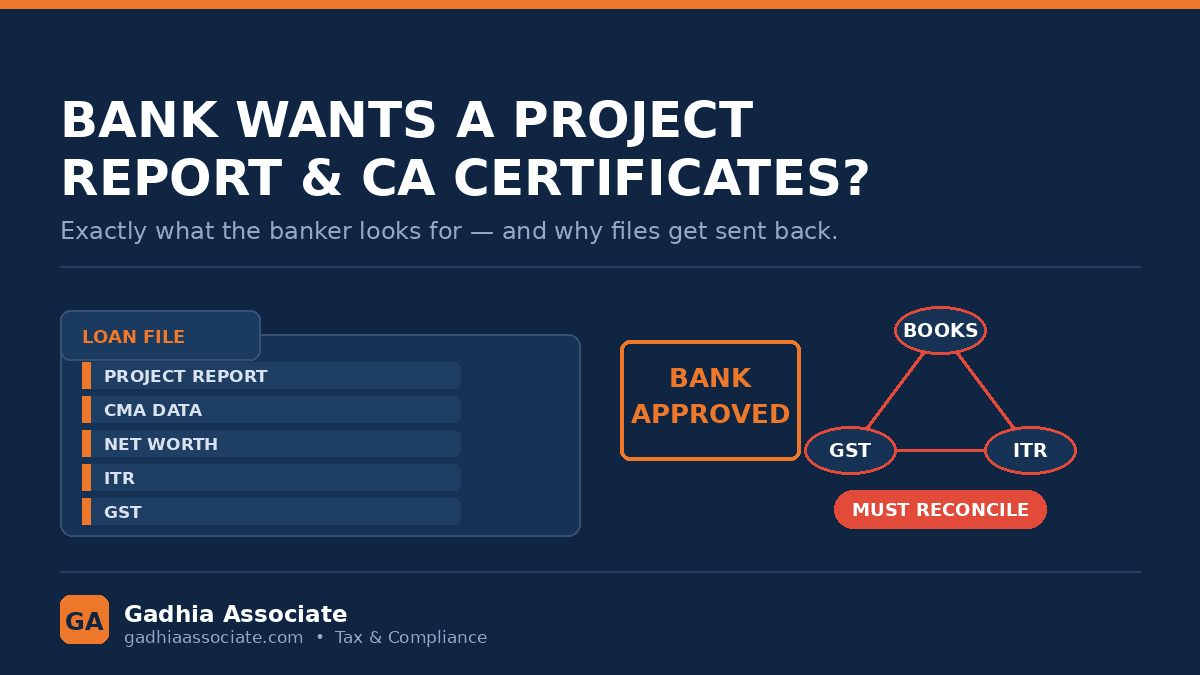
The single biggest reason MSME files get sent back: your books, your GST returns and your income tax return must tell the same story. Bankers pull GST and ITR data themselves. Three different turnover figures for one year is not a clerical issue in their eyes — it is a credibility issue.
An illustrative example. For FY 2024-25:
- Turnover as per books and the CMA statement: ₹4,20,00,000
- Turnover as per GSTR-3B filed for the year: ₹3,65,00,000
- Turnover declared in the income tax return: ₹3,90,00,000
Three numbers, three sources, no explanation attached. The banker must assume either the books are inflated to get a bigger limit or GST has been under-reported. Either conclusion sinks the file. Usually there is a perfectly good explanation — exempt supplies, exports, credit notes, a branch transfer, an amendment filed later — but it must be reduced to a written reconciliation with figures and attached. Nobody at the bank will do that for you.
The other recurring killers:
- Projections that do not reconcile with historical GST returns or ITRs — growth assumed with no basis
- Negative net worth, or heavy unsecured loans from directors, partners and related parties that the banker treats as unstable
- CIBIL issues — a forgotten credit card default, a co-signed loan gone bad, or an old settled account still showing as written off
- Missing or expired documents — an old Udyam certificate, an unsigned balance sheet, a stock statement that is three months stale
- Stock and debtor statements that do not match the balance sheet closing figures
Why must projections be defensible rather than optimistic?
Inflated projections feel harmless — you assume the bank discounts them anyway. They do the opposite. The branch manager must present your case upwards and answer questions on it. If projected growth has no anchor in your GST filings, capacity or order book, he cannot answer, so he cuts your limit or lets the file drift. A conservative projection you can justify line by line is sanctioned faster than an ambitious one you cannot.
The complete document set to keep ready for an MSME loan
- Project report with projected profit and loss, balance sheet and cash flow
- CMA data covering past audited years, current year and projected years (for working capital limits)
- Audited or CA-certified financial statements for the last two to three years, with UDIN
- Provisional financials for the current year up to a recent date
- ITRs with computation of income for the last two to three years
- GST returns for the period, with a turnover reconciliation against the books
- Net worth certificate for promoters and a turnover certificate, both UDIN-backed
- Stock and debtor ageing statements (essential for cash credit limits, usually monthly once sanctioned)
- Bank statements of all operating accounts, typically twelve months
- KYC of the entity and promoters, constitution documents, and a current Udyam registration certificate
- Quotations, title documents or lease deeds supporting the project cost, where applicable
Can I get a business loan without collateral?
Often, yes. Under the CGTMSE guarantee framework, eligible micro and small enterprises can access credit where guarantee cover substitutes for third-party collateral, so the lender relies on your business and cash flow rather than property. The lender must be a member institution and the facility must fit the scheme's conditions, so eligibility and cover are decided case by case — not something to assume before your banker confirms it.
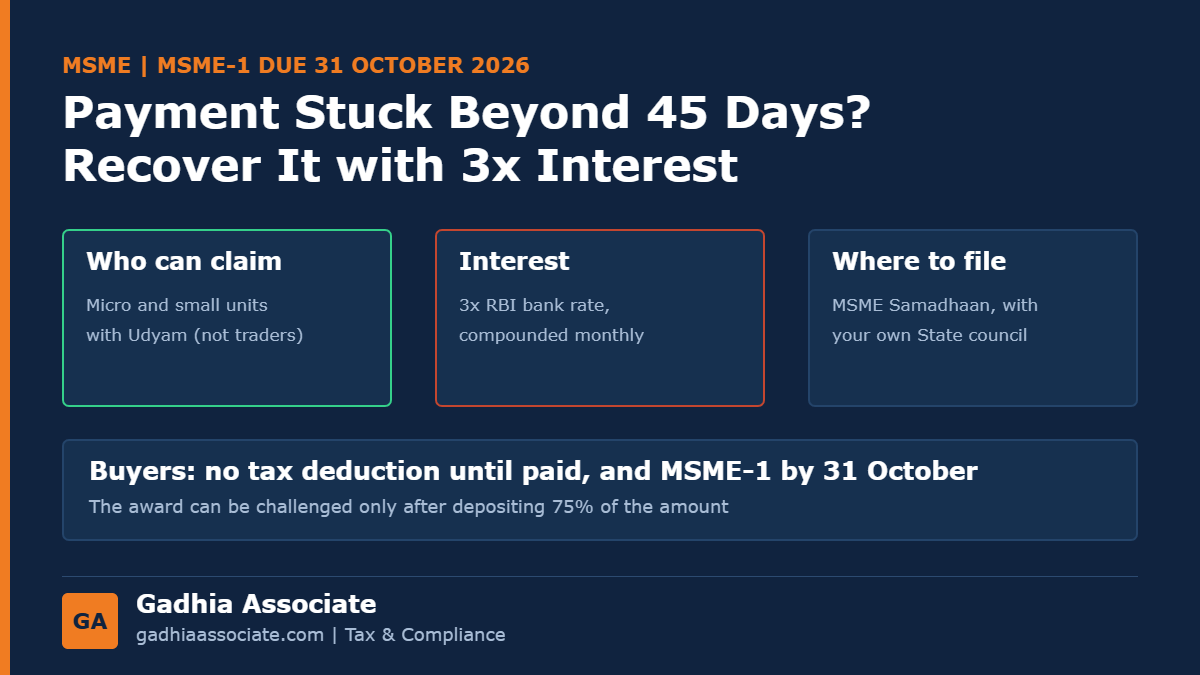
What is not optional is Udyam registration. Every MSME-specific scheme, subsidy or priority treatment runs off a valid Udyam number, and its details should match your PAN, GST and bank records. If yours is old or was filed with wrong turnover or investment figures, correct it before the file goes in. Our articles on Udyam registration, MSME benefits and government grants, and the MSME 45-day payment rule cover this ground — and if you are still choosing between proprietorship, partnership, LLP or private limited, our Business Structure Advisor tool is a good starting point, since your constitution affects both your limit and your compliance cost.
Let us prepare a file your banker can defend
Gadhia Associate has been practising since 2007 — more than 18 years — serving over 7,000 clients across Saurashtra and Gujarat, with a 5.0 Google rating from 100+ reviews. Junagadh's trading and MSME businesses come to us for exactly this work: project reports and CMA data that hold up, UDIN-backed certificates, the books-GST-ITR reconciliation written out properly, and projections a branch manager can take upstairs without flinching. Fixed-fee and monthly plans, a dedicated client manager, fully digital across India, same-day appointments at our Junagadh office. The first consultation is free — call or WhatsApp +91 82005 28355 and bring your banker's list.
Frequently asked questions
Can I prepare the project report myself and save the fee?
You can, and for a very small proposal it may pass. The risk is that the numbers must reconcile with your GST returns, ITRs and audited accounts, and be certified where the bank requires it. A report the banker sends back twice costs far more in delay than the fee saved.
My CIBIL score is poor. Is there any point applying?
Often yes, but sequence matters. Pull your credit report and see what is actually reported — frequently a stale entry or a settled account never marked closed — and get it corrected first. Applying repeatedly while the report is wrong adds enquiries and makes things worse.
Why does the bank want a stock statement every month?
Because a cash credit limit is secured against your inventory and receivables. The monthly statement lets the bank confirm the security still exists and compute drawing power. Late or inconsistent statements are the fastest way to have a limit reviewed downward at renewal.
How long does the whole process take?
With a complete, reconciled document set, many MSME proposals move through in a few weeks. The variable is rarely the bank's assessment time — it is how often the file goes back for a missing certificate, a stale document or an unexplained difference. Timelines vary by lender and branch.
This article reflects the position as of September 2026 and is general information, not advice for your specific case. Documentation requirements differ from one lender to another and change through RBI, CBIC and CBDT notifications and individual bank policy. Please confirm the current requirements with your banker and a qualified professional before acting.