MSME Benefits and Government Grants in 2026: The Subsidies, Cheap Credit and Tender Preference Most Business Owners Never Claim
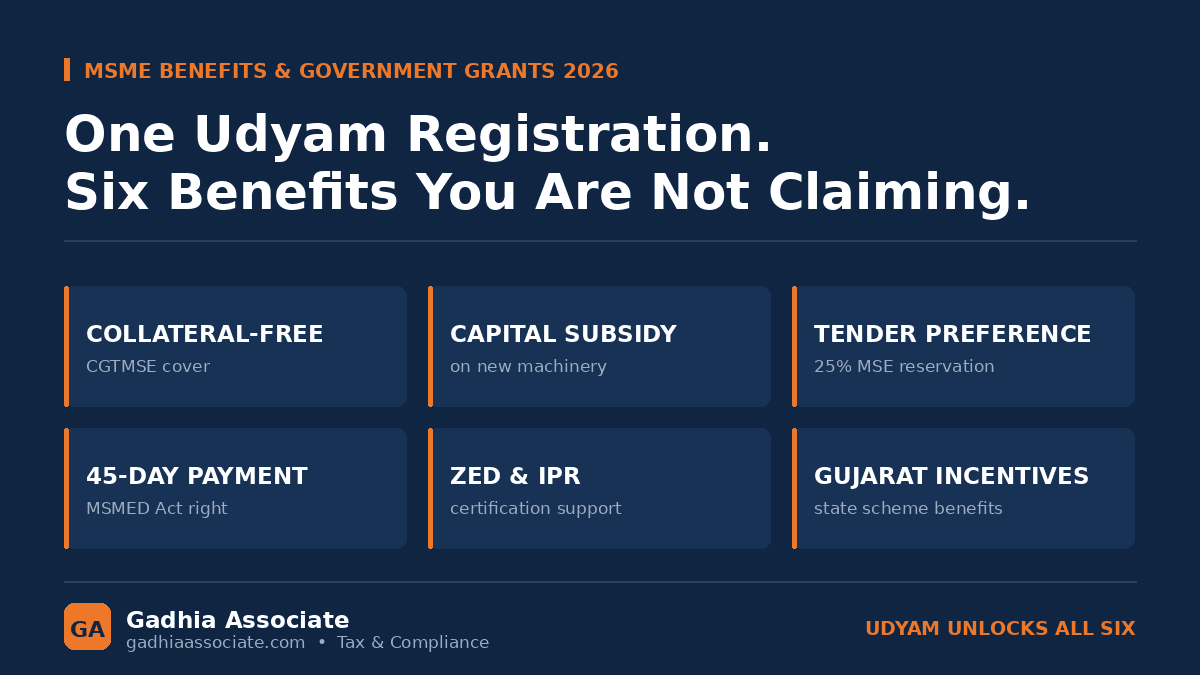
Your Udyam certificate is sitting in a folder somewhere. You got it because a bank asked for it, or because a tender form demanded the number. And that is where it stopped. Meanwhile the MSME benefits attached to that certificate keep piling up unclaimed: collateral-free credit, a capital subsidy on your new machine, interest subsidy from the Gujarat government, a legal right to be paid within 45 days, and reserved space in government tenders. Most owners we meet in Junagadh are claiming one of these. A few claim none. The government grants for MSME units are not hidden - they are just not automatic, and nobody knocks on your door to hand them over.
This is a walkthrough of what your registration actually entitles you to in 2026, and the exact first move for each one.
What benefits do I get after Udyam registration?
First, check you are classified correctly, because everything downstream depends on it. From 1 April 2025 the MSME definition was widened considerably:
- Micro - investment up to Rs 2.5 crore and turnover up to Rs 10 crore
- Small - investment up to Rs 25 crore and turnover up to Rs 100 crore
- Medium - investment up to Rs 125 crore and turnover up to Rs 500 crore
Both limits must be satisfied, exports are excluded from turnover, and the same table applies to manufacturers and service units. The practical effect is that businesses which had outgrown MSME status are back inside it, and a lot of enterprises that thought of themselves as "small" are now formally micro - which matters, because the richest benefits (credit guarantee, tender reservation, PMEGP, the highest state subsidy slabs) are aimed at micro and small units.
Udyam is self-declared and free, and the portal now pulls investment and turnover data automatically from your income tax and GST filings, so your category can shift on its own at the start of a financial year. If you have no GST number and operate informally, you can still register through the Udyam Assist Platform, and that certificate is treated on par with Udyam for priority sector lending. We have covered the registration mechanics in detail in our separate article on Udyam registration.
Which government subsidy can a small manufacturer claim? Start with cheap credit
How do I get a collateral-free business loan?
Through CGTMSE - the credit guarantee trust that stands behind your loan so the bank does not demand your house as security. The bank lends, the trust guarantees a large share of the exposure, and you pay a small annual guarantee fee instead of pledging property. From 1 April 2025 the guarantee cover for micro and small enterprises was doubled from Rs 5 crore to Rs 10 crore, with the annual guarantee fee structure rationalised downward. Startups get higher cover, and ZED-certified units get enhanced coverage plus a discount on the guarantee fee.
Who qualifies: Udyam-registered micro and small enterprises in manufacturing or services, borrowing from a member lending institution. First step: ask your branch manager, in writing, to process your proposal under CGTMSE cover. Banks do not always offer it - a collateral-backed loan is easier for them. You have to name the scheme.
The Budget 2025 credit measures
Three additions worth knowing about. Customised credit cards with a Rs 5 lakh limit for micro enterprises registered on Udyam - working capital for raw material and small purchases without a fresh loan file each time. A scheme for first-time entrepreneurs, specifically including women and SC/ST entrepreneurs, offering term loans of up to Rs 2 crore. And a Mutual Credit Guarantee Scheme for MSMEs to support term loans for the purchase of plant and machinery, alongside a Fund of Funds for startups. Availability varies bank to bank as these roll out - ask your lender what has actually been operationalised at their end before you build a plan around it.
Capital and interest subsidies: the MSME subsidy money most owners never touch
What is PMEGP subsidy?
PMEGP - the Prime Minister's Employment Generation Programme - is for setting up a new unit, not expanding an existing one. The government pays part of your project cost as margin money subsidy:
- General category - 15% in urban areas, 25% in rural areas
- Special category (SC, ST, OBC, women, minorities, ex-servicemen, PwD) - 25% urban, 35% rural
Project cost ceilings are Rs 50 lakh for manufacturing units and Rs 20 lakh for service and trading units. The subsidy is not cash in hand - the bank holds it as a term deposit and adjusts it against your loan after roughly three years of running the unit properly and completing EDP training. Miss the EMIs or shut the unit and you lose it.
First step: a bankable project report, then the online application on the KVIC PMEGP portal - before you buy anything.
ZED, technology and IPR support
Under the MSME Sustainable (ZED) certification scheme, taking the ZED pledge carries a joining reward of Rs 10,000 usable against certification, and the certification cost itself is subsidised at 80% for micro, 60% for small and 50% for medium units, with an extra 10% for women and SC/ST-owned enterprises and units in specified regions. Certified units get better CGTMSE terms. Lean Manufacturing and the MSME Champions components sit alongside it for productivity and grievance support.
On intellectual property, MSMEs get reimbursement of patent, trademark, design and GI filing costs through the MSME Innovative / IPR scheme, with separate ceilings for domestic patents, foreign patents, trademarks and GI registration. If you are building a brand and have not registered the trademark because of cost, that objection has largely been removed.
Getting paid on time - and early
What if a buyer does not pay my MSME invoice?
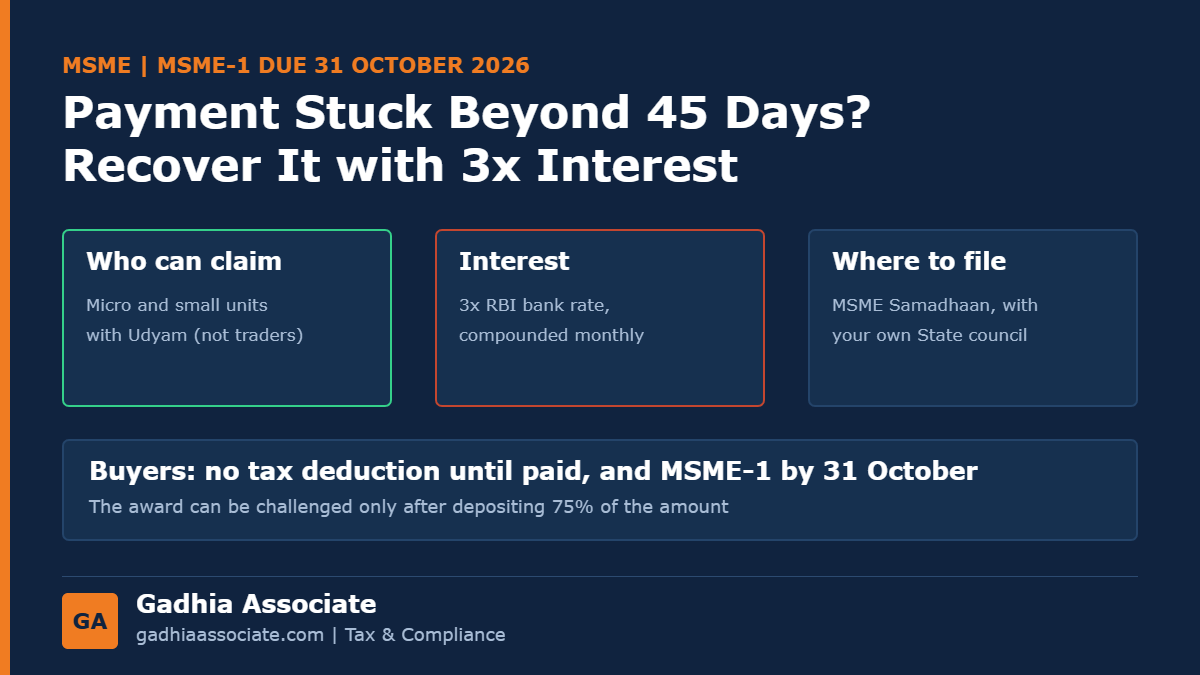
You have a statutory remedy, not just a polite reminder. Section 15 of the MSMED Act requires a buyer to pay a micro or small supplier within the agreed date or 45 days, whichever is earlier. Section 16 makes the defaulting buyer liable to compound interest at three times the RBI notified bank rate. And under Section 43B(h) of the Income-tax Act, a buyer who has not paid a micro or small enterprise within that window cannot claim the expense as a deduction in that year - which is why corporate buyers suddenly started clearing MSME dues in March. Our separate article on the 45-day payment rule and Section 43B(h) explains how to use this in negotiations.
First step: file free on the MSME Samadhaan portal. It is a genuine referral to the Micro and Small Enterprise Facilitation Council, not a complaint box. And make sure your invoices and purchase orders actually state your Udyam number - buyers routinely claim they did not know you were an MSME.
Separately, TReDS lets you discount your accepted invoices on an electronic exchange and get paid immediately, with financiers bidding to buy your receivable. Companies with turnover above Rs 250 crore and CPSEs are mandated to be onboard, down from the earlier Rs 500 crore threshold, so most of your larger buyers should already be there. If your money is stuck in 90-day credit cycles, this is the fastest structural fix available to you.
Do MSMEs get preference in government tenders?
Yes, and this is the most under-used benefit of the lot. Under the Public Procurement Policy for Micro and Small Enterprises, central ministries, departments and CPSEs must source at least 25% of their annual procurement from MSEs, with a 4% sub-target for SC/ST-owned enterprises and 3% for women-owned enterprises within that 25%. MSEs also get tender documents free, exemption from Earnest Money Deposit, and the right to match the L1 price where their bid falls within the L1 plus 15% band - so you can lose on price and still win the order.
First step: register as a seller on GeM with your Udyam number linked, and get your product categories and specifications listed properly. An unlinked or half-completed GeM profile is why the exemptions do not show up at bid time.
What MSME schemes are available in Gujarat?
On top of the central schemes, Gujarat runs its own package for MSMEs under the Aatmanirbhar Gujarat Scheme, notified in 2022 for a multi-year period. The benefit types are:
- Capital subsidy on eligible fixed capital investment, with the percentage and ceiling depending on your enterprise category and the taluka classification of your location
- Interest subsidy on term loans for a defined number of years, again varying by category and taluka
- EPF reimbursement on the employer's contribution for new employees, subject to a per-employee monthly cap
- SGST reimbursement on eligible investment for a specified period
- Electricity duty exemption and power-related relief for new units
Gujarat also supports quality certification, technology acquisition, patent assistance, market development and ICT adoption for MSMEs through the same policy framework. The rates and ceilings differ meaningfully between Category 1, 2 and 3 talukas, and they are revised by government resolution - so confirm your specific entitlement against the current GR for your taluka before you commit to an investment. Junagadh district units are frequently eligible for better slabs than owners assume.
Before you apply, get these in order
- Udyam certificate current, with the correct NIC activity codes and your actual address and bank details
- PAN, GST and Udyam details matching each other exactly - name, address, constitution
- GST returns and income tax returns filed and up to date, with no long-pending defaults
- Business bank account with clean statements, and a CIBIL / commercial credit report you have actually looked at
- A proper project report - cost of project, means of finance, projected profitability, DSCR, break-even
- Formal quotations for machinery and equipment, on the supplier's letterhead, with GST details
- Land or shed documents, rent agreement, GPCB or pollution consent, fire and municipal NOCs as applicable
- Photographs, electricity connection details and EPF or ESIC registration where the scheme requires them
An illustrative example
The numbers below are illustrative and rounded, meant only to show how the pieces stack. They are not a promise of any specific sanction or subsidy.
Suppose you run a small engineering unit in Junagadh and are adding machinery worth Rs 60 lakh, with a total project cost of about Rs 75 lakh including installation and working capital. You bring in Rs 15 lakh and the bank sanctions Rs 60 lakh as a term loan.
With the loan structured under CGTMSE cover, you avoid pledging additional immovable property and pay a modest annual guarantee fee instead - the family house stays out of the security documents. If your unit and location qualify under the state scheme, a capital subsidy on eligible fixed capital investment and an interest subsidy on the term loan together reduce your effective cost of the project and your monthly outgo over the loan tenure. EPF reimbursement on new employees and electricity duty relief add a smaller but recurring saving. On a project of this size, the combined effect of a state capital subsidy, several years of interest subsidy and the avoided collateral is typically not a rounding error - it is a material difference to your cash flow, and it exists whether or not you apply for it.
Why claims get rejected
Honestly, most rejections are self-inflicted:
- Wrong classification. The unit is showing as small when it is actually micro, or the Udyam entry was never updated after the 2025 limits changed, so a benefit reserved for micro units is denied.
- Mismatched details. Udyam says one address, GST says another, the bank account is in a slightly different name. Automated checks fail and the file goes back.
- Weak project report. Projections with no basis, no quotations, no working capital assessment. Banks and sanctioning committees reject these quickly.
- Applying after the purchase. This is the expensive one. Several capital and interest subsidy schemes require the application to be filed within a defined window, and some require it before the investment is made. Buy the machine first and you may permanently lose the subsidy on it.
- Compliance gaps. Unfiled GST returns, unfiled ITRs, an overdue account. Almost every scheme screens for these.
If you are still deciding on your legal structure before making the investment - proprietorship, partnership, LLP or private limited - that decision affects which schemes and tender categories you can access. Our Business Structure Advisor tool on this site will give you a starting view before you commit.
How Gadhia Associate Can Help
We handle the whole chain, not just the paperwork:
- Check and correct your Udyam classification against the revised limits, and fix mismatches across Udyam, PAN and GST
- Prepare a bankable project report with proper costings, projections and documentation
- Coordinate with your bank so the facility is actually structured under CGTMSE cover instead of against your property
- Identify which central and Gujarat schemes you qualify for, file the subsidy applications and follow them up until disbursement
- File MSME Samadhaan complaints and issue Section 15 / 16 demands for delayed payments
- Keep your GST and income tax filings clean so applications do not get rejected on compliance grounds
First consultation is free. We are based in Junagadh and work with clients across Gujarat and India. Call or WhatsApp +91 82005 28355 and tell us what you are planning to invest in - we will tell you what you can claim on it.
This article reflects the position as of September 2026. Scheme terms, subsidy rates, guarantee ceilings and eligibility conditions change through government notifications, budget announcements and state government resolutions. Confirm your specific eligibility and the current scheme terms before applying or committing to any investment.