GST Department Audit Notice in ADT-01? What They Will Ask For and How to Prepare Before They Arrive
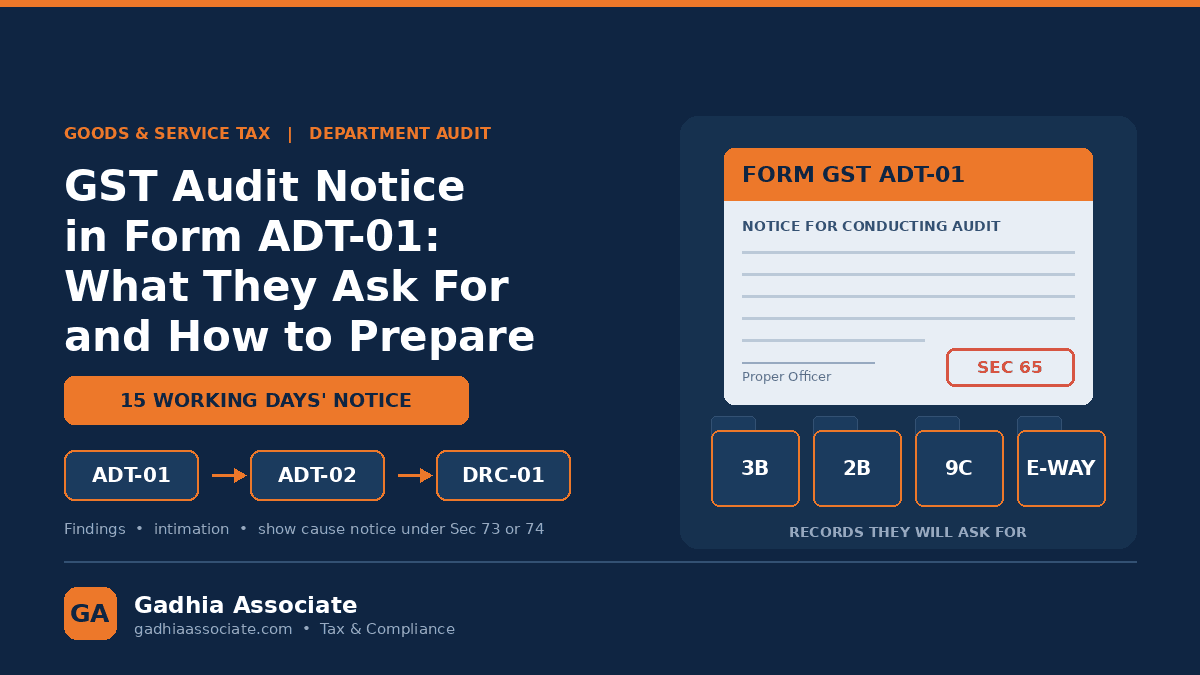
An envelope or an email has arrived from the GST department, and the heading says Form GST ADT-01. It names an officer, names a financial year or two, and states a date on which the audit will begin. If you run a trading business, a manufacturing unit, a contracting firm or a services practice in Junagadh, Rajkot or anywhere in Saurashtra, and this is the first GST department audit notice you have received, your first reaction is probably a bad night's sleep. Put that aside. A Section 65 audit is a routine, rule-bound process with a fixed timeline, and how well it ends depends almost entirely on what you do in the fifteen working days before the officer sits down.
What is an ADT-01 notice, and how is it different from a scrutiny notice or a search?
Form GST ADT-01 is the notice issued when the tax authorities decide to audit a registered person under Section 65 of the CGST Act. The Commissioner, or an officer authorised by a general or specific order, may order it. The audit may be conducted at your place of business or in the officer's own office, and the notice will tell you which.
The most important number in the rules is this: the notice must be issued not less than 15 working days before the audit is conducted. That is your preparation window, and it is short.
It helps enormously to know what this is not:
- It is not scrutiny of returns under Section 61. Scrutiny is a desk exercise where the officer compares your filed returns, flags discrepancies and asks for an explanation in Form GST ASMT-10. It is narrower and does not involve anyone visiting you.
- It is not an inspection, search or seizure under Section 67. That requires a written authorisation from an officer not below the rank of Joint Commissioner, based on a recorded reason to believe that tax is being evaded or that goods or documents are being concealed. It arrives without notice. An ADT-01 audit, by contrast, is announced in advance and is procedural.
- It is not, by itself, a demand. No tax is payable simply because an audit has been ordered.
What it does carry is an obligation. Under Section 65(5), you are required to make available the books of account, records, and the facilities the officer needs to verify them, and to furnish the information sought. Refusing or dragging your feet is the one response that reliably makes the outcome worse.
How long does a GST audit take, and where can it end?
The timeline is defined, and knowing it stops the process feeling open-ended:
- ADT-01 is served at least 15 working days before the audit is conducted.
- The audit must be completed within three months from the date of commencement. "Commencement" means the date on which the records and other documents called for are made available, or the date the audit actually begins, whichever is later. So the clock does not start on the date printed on the notice; it starts when you hand over the records.
- The Commissioner may, for reasons recorded in writing, extend the period by a further six months.
- On conclusion of the audit, the officer must inform you of the findings, the reasons for them, and your rights and obligations, within thirty days, in Form GST ADT-02.
- If the findings show tax not paid, short paid, erroneously refunded, or input tax credit wrongly availed or utilised, the officer may proceed. In practice you will usually first receive a DRC-01A intimation of liability, giving you the chance to pay or to explain, followed if unresolved by a show cause notice under Section 73 or Section 74, issued with Form DRC-01.
There is a separate route worth knowing about. Under Section 66, at any stage of scrutiny, inquiry, investigation or other proceedings, an officer (with the prior approval of the Commissioner) may direct you in Form GST ADT-03 to get your records audited by a chartered accountant or a cost accountant nominated by the Commissioner. This is the special audit, it is distinct from the Section 65 departmental audit, and you do not choose the auditor.
What does it cost you to be unprepared?
The financial exposure is not the audit itself. It is where it lands.
If discrepancies are confirmed, you pay the tax and interest on the shortfall. Then the question becomes which section the demand is raised under, and the difference is large:
- Section 73 applies where there is no fraud, no wilful misstatement and no suppression of facts. The penalty is limited: broadly 10% of the tax or Rs 10,000, whichever is higher. Critically, if you pay the tax with interest within thirty days of the show cause notice, no penalty is payable and the proceedings are treated as concluded.
- Section 74 applies where fraud, wilful misstatement or suppression of facts to evade tax is alleged. The penalty here is of the order of 100% of the tax, with reduced penalties available if you pay at earlier stages.
The same underlying mistake, an input tax credit claim you cannot reconcile, can be characterised either way. Whether it is treated as an error or as suppression depends heavily on the quality of your records and the explanations on file. A business that produces clean reconciliations and a coherent narrative is on far stronger ground than one that produces nothing and lets the officer draw his own conclusions.
That is the real cost of inaction: not producing records invites adverse inferences on quantum, and every unexplained gap gets estimated against you. Add the ongoing interest, the professional cost of contesting a demand that could have been prevented, and the risk of your credit ledger being blocked while the matter runs.
An illustrative example (round figures, for illustration only)
A Junagadh trading firm with a turnover of Rs 6 crore claims input tax credit of Rs 40,00,000 in a year. The officer's GSTR-2B extract supports Rs 36,00,000. The Rs 4,00,000 gap is partly suppliers who filed late (credit since reflected), partly two invoices booked twice, and partly credit on a motor vehicle that was blocked. If the firm walks in with a supplier-wise 2B reconciliation showing exactly which is which, the exposure is limited to the genuinely inadmissible portion, with interest and a Section 73 level penalty at worst. If it walks in with nothing, the whole Rs 4,00,000 is on the table, with the character of the demand open to argument.
If an ADT-01 notice is sitting on your desk right now, the fifteen working days are already running. Gadhia Associate will review the notice with you at no charge in a free first consultation, tell you what the officer is likely to focus on for your line of business, and build the reconciliation file before the audit begins. Call or WhatsApp +91 82005 28355. Same-day appointments are available at our Junagadh office, and we work fully digitally if you are elsewhere.
What documents will the GST officer ask for?
The ADT-01 or the accompanying annexure usually lists the records. Expect most or all of the following, typically for each financial year under audit:
- GSTR-1, GSTR-3B and, where applicable, GSTR-9 and GSTR-9C for the periods under audit
- Books of account and trial balance, along with the audited financial statements, the balance sheet, profit and loss account and notes
- Sales register and purchase register, invoice-wise, with HSN codes and tax rates
- Input tax credit ledgers and GSTR-2B reconciliations, supplier-wise
- Reverse charge (RCM) workings covering freight, legal services, director remuneration, import of services and the rest
- E-way bills and the e-invoice data, where e-invoicing applies to you
- Stock records, opening and closing stock statements, and consumption or production records for manufacturers
- Bank statements, and reconciliations of receipts with declared turnover
- Agreements and contracts, purchase orders, lease deeds, job work challans and export or LUT documents
- Credit and debit notes, discount schemes and rate change workings
- Copies of any earlier notices, replies, DRC-03 payments and appeal papers
The reconciliations to finish before the officer sits down
Do not present raw registers. Present reconciliations, each with a short note explaining the differences. These five carry most of the weight:
- GSTR-3B versus GSTR-1 versus books. Outward tax declared, outward tax reported, and outward tax recorded, month by month, with each difference explained (amendments, credit notes, timing).
- GSTR-2B versus credit actually claimed. Supplier-wise, with the excess split into late-filing suppliers, ineligible or blocked credit, duplicates, and credit reversed under Rule 42 or 43.
- RCM working. A schedule of every expense head attracting reverse charge, the tax paid, the month it was paid in, and the credit taken against it.
- E-way bills versus tax invoices. Both directions: e-way bills with no matching invoice, and high-value invoices with no e-way bill.
- GSTR-9 and 9C versus audited financials. Turnover as per the profit and loss account reconciled to turnover as per returns, with a clear explanation for every reconciling item (non-GST income, other income, schemes, cross-charges).
What are the findings that usually generate demands?
Across the audits we have handled, the same four issues generate the large majority of demands: excess input tax credit not supported by GSTR-2B, reverse charge liability not discharged on common expense heads, blocked credits claimed on motor vehicles, construction, employee benefits and the like, and turnover differences between the financial statements and the returns. Add late reversals under Rules 37, 42 and 43, and classification or rate disputes on specific goods. None of these are exotic. All of them are findable in advance if someone sits down with your data before the department does.
Our separate articles on how to reply to a GST notice, on GST input tax credit and Rule 86A credit ledger blocking, and on GSTR-9 and GSTR-9C filing cover these areas in more depth and are worth reading alongside this one.
How should you conduct yourself during the audit?
A few practical rules that consistently produce better outcomes:
- Give exactly what is asked for, in writing, with an acknowledgement. Maintain a register of every document handed over and the date. Do not hand over loose folders, personal diaries, rough estimate sheets, WhatsApp printouts or unreconciled internal workings that nobody has verified. Casual documents create questions you then have to answer for months.
- Route everything through one person. One point of contact, ideally with your consultant present. Staff answering questions helpfully but inaccurately in a corridor is a real and common problem.
- Answer questions in writing where the answer has any complexity. "We will confirm that by tomorrow in writing" is a perfectly professional response.
- Do not concede a position verbally. Agreeing that something "looks like a mistake" during a conversation can end up recorded as an admission.
- Consider paying uncontested short payments early through DRC-03, with advice, since early payment materially reduces penalty exposure. Do it deliberately, not reflexively.
- Reply to ADT-02 and DRC-01A properly and on time. These are your best chances to close issues before they become a formal show cause notice.
You do not have to face the officer alone, and you should not. Gadhia Associate has been practising since 2007, more than eighteen years, and has served over 7,000 clients across Saurashtra and Gujarat, with a 5.0 Google rating from more than 100 reviews. We work on fixed-fee and monthly plans with a dedicated client manager, so you know the cost before we begin and always know who to call. Our Junagadh office offers same-day appointments and we serve clients fully digitally across India. Book your free first consultation on +91 82005 28355.
Frequently asked questions
Can I ask for more time to produce the records?
Yes, and a reasoned written request made early is usually received far better than silence followed by an incomplete file. Explain what you are producing now, what needs more time, and why (an accountant on leave, records at a branch, data being extracted from an old system). Give a specific date. What does not work is a vague request for an indefinite extension, or asking for time on the morning the audit is due to start.
Does an ADT-01 notice mean the department suspects fraud?
No. Section 65 audits are selected on risk parameters, turnover, sector and sometimes simply on a rotational basis. Receiving one is not an accusation. It becomes a fraud question only if the findings support an allegation of wilful misstatement or suppression, which is exactly why the quality of your explanations and records matters so much.
Our books are not fully reconciled. Should we delay the audit or come clean?
Delay rarely helps and cannot be sustained. The better route is to identify the gaps yourself in the preparation window, quantify them, decide with advice which are genuinely payable, and consider a voluntary DRC-03 payment for those. Walking in with your own honest reconciliation, including the items against you, is a far stronger position than being shown the same items by the officer.
We are based outside Junagadh. Can you still handle this?
Yes. We work fully digitally across India and for NRI-owned businesses. You share the notice and data, we build the reconciliation file and draft the replies, and we can join meetings remotely or attend in person for clients in Junagadh, Rajkot and across Saurashtra and Gujarat. Same-day appointments are available at our Junagadh office when the notice is urgent.
This article reflects the position as of September 2026. GST law and procedure change frequently through amendments, CBIC circulars and notifications, and outcomes depend entirely on the specific facts, records and periods involved in your case. Please confirm the current position with a qualified professional before acting on anything stated here.