TDS on Rent in 2026: Section 194-I vs 194-IB, the Rs 50,000 Per Month Rule for Tenants, Form 26QC and Penalties for Not Deducting
TDS on rent in 2026: the short answer
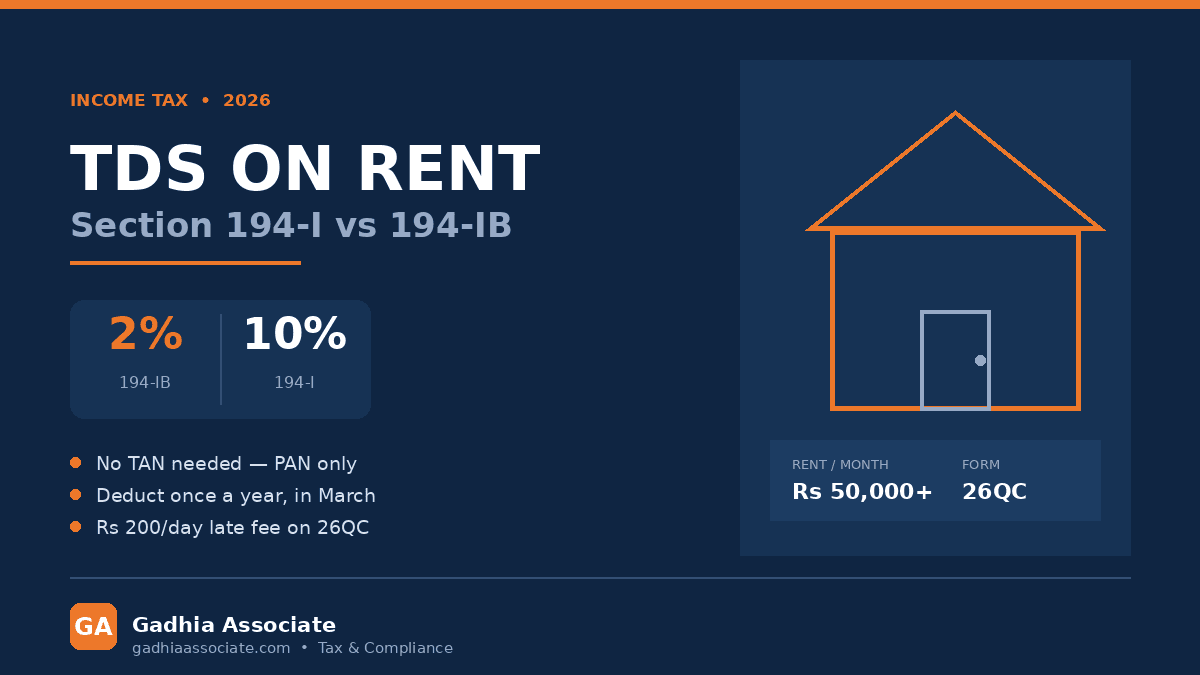
TDS on rent in 2026 works through two separate provisions. If you are a business, company, firm or a person liable to tax audit, Section 194-I applies and you deduct 10% on rent for land, building and furniture and 2% on rent for plant, machinery or equipment. If you are an individual or HUF who is not liable to tax audit and you pay rent of more than Rs 50,000 per month for a house or shop, Section 194-IB applies and you deduct 2% once a year, deposit it with Form 26QC and hand your landlord a Form 16C.
That one-paragraph answer covers most people. The details below are where the money is lost, because the late fee for a missed Form 26QC runs at Rs 200 per day and keeps running until you file.
Do I have to deduct TDS on my house rent?
Only if your rent crosses the monthly threshold. Section 194-IB is triggered when rent for a month, or part of a month, exceeds Rs 50,000. It does not matter whether you are salaried, a freelancer or a retired person, and it does not matter whether you claim HRA. If the rent is Rs 51,000 a month, you are a tax deductor for that property.
If your rent is Rs 50,000 or below, you deduct nothing under 194-IB. Note that the threshold is tested per month, not on the annual total, and where two or more tenants share a flat, the test is generally applied to the rent each person actually pays to the landlord. Where a single tenant pays Rs 60,000 for a flat shared with friends, the tenant whose name is on the agreement and who pays the landlord is the one carrying the obligation.
What is the difference between Section 194-I and Section 194-IB?
Think of it as two different deductors facing two different systems.
Section 194-I is the old, business-facing provision. It applies to any person other than an individual or HUF not liable to audit - so companies, LLPs, firms, trusts, and individuals or HUFs whose turnover crossed the tax audit limit in the preceding year. The rate is 10% on land, building (including factory building), land appurtenant to a building, and furniture or fittings, and 2% on plant, machinery and equipment. Historically the annual threshold was Rs 2,40,000. Budget 2025 raised it, with effect from 1 April 2025, so that no deduction is required unless rent exceeds Rs 50,000 for a month or part of a month - which works out to roughly Rs 6,00,000 for a full year. A 194-I deductor needs a TAN, deducts every month at the time of credit or payment, deposits by the 7th of the following month, and files quarterly TDS returns in Form 26Q with Form 16A certificates.
Section 194-IB is the retail-facing provision for individuals and HUFs not liable to audit. The rate was 5% until it was reduced to 2% with effect from 1 October 2024. There is no TAN. Deduction happens once in the year, not monthly. Reporting is a single challan-cum-statement, Form 26QC, and the certificate is Form 16C. In short: 194-I is a monthly, TAN-based, return-filing regime for businesses; 194-IB is an annual, PAN-based, one-form regime for households.
Do I need a TAN to deduct TDS on rent under 194-IB?
No. This is the single most useful feature of Section 194-IB and the one most tenants do not know. You use your PAN and the landlord's PAN on Form 26QC. Applying for a TAN, filing 26Q or issuing Form 16A is not required. If you are covered by Section 194-I, however, a TAN is compulsory.
When exactly is TDS deducted under Section 194-IB?
Once a year, and only at one of two moments: at the time of credit or payment of rent for the last month of the financial year, or the last month of the tenancy if you vacate during the year. You do not deduct 2% every month. You let the rent run, then in March - or in the month you move out - you deduct the full year's TDS from that month's payment and pay the landlord the balance.
There is an important protective rule here. The deduction cannot exceed the rent payable for the last month. If a full year's 2% works out to more than one month's rent, your deduction is capped at that last month's rent, and the balance has to be settled between you and the landlord.
What is Form 26QC and when must it be filed?
Form 26QC is a combined challan and statement. It is not a return in the traditional sense - you fill in tenant PAN, landlord PAN, property address, period of tenancy, rent, TDS amount, and pay in the same flow on the income tax portal. It must be filed within 30 days from the end of the month in which the deduction was made. So a March deduction is generally due by 30 April.
After Form 26QC is processed, you download Form 16C from TRACES and give it to the landlord within 15 days of filing 26QC. That certificate is what lets your landlord claim the credit in their own return, so landlords chase it.
Your Section 194-IB checklist
- Confirm monthly rent actually exceeds Rs 50,000
- Collect and verify the landlord's PAN in writing - without PAN the rate jumps to 20%
- Confirm the landlord is a resident, not an NRI
- Note the last month of the FY or of the tenancy as your deduction date
- Deduct 2% of the total rent for the year, capped at last month's rent
- File Form 26QC within 30 days of the end of that month
- Download Form 16C from TRACES and issue it within 15 days
- Keep the challan, 26QC acknowledgement and 16C with your ITR papers
A worked example (illustrative only)
Take Rakesh, a salaried professional in Junagadh who rents a flat at Rs 60,000 per month for the full financial year and is not liable to tax audit. Annual rent is Rs 7,20,000. TDS at 2% is Rs 14,400. He pays Rs 60,000 each month from April to February. In March he deducts Rs 14,400, pays the landlord Rs 45,600, and deposits Rs 14,400 through Form 26QC by 30 April. He then issues Form 16C within 15 days. Since Rs 14,400 is well under one month's rent, the cap is not an issue. These figures are illustrative and rounded - your own numbers should be checked before you pay.
What if my landlord is an NRI?
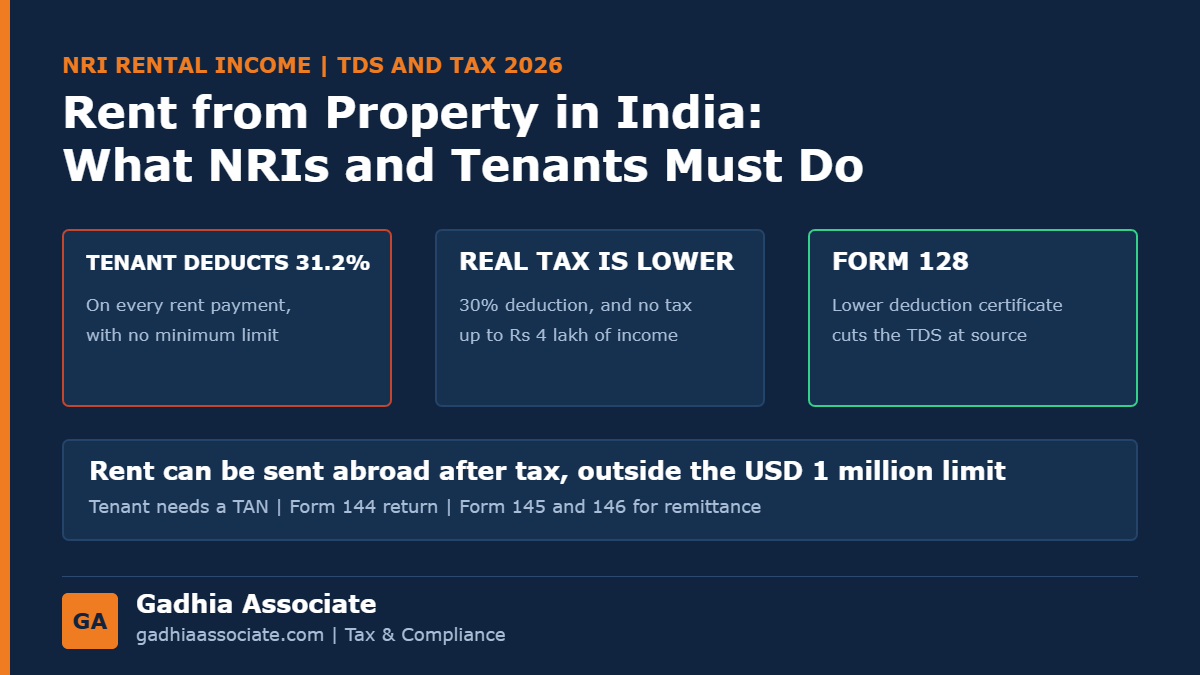
Then Section 194-IB does not apply at all. Rent paid to a non-resident landlord falls under Section 195, which is a different regime altogether: the deductor needs a TAN, deducts at the rates in force for non-residents (plus applicable surcharge and cess), deposits monthly, files Form 27Q, and issues Form 16A. Form 15CA and often a Chartered Accountant's Form 15CB come into play as well.
This is the most common and most expensive mistake we see. Tenants file Form 26QC at 2% for an NRI landlord, and the deduction is treated as short. Always confirm your landlord's residential status before the first payment. Our NRI Desk handles exactly this situation for property owners settled abroad who let out flats in Gujarat.
What is the penalty for not deducting TDS on rent?
There are three separate costs and they stack. First, interest for failing to deduct, generally 1% per month from the date the tax was deductible until it is deducted. Second, interest for failing to deposit after deducting, generally 1.5% per month until deposit. Third, a late fee of Rs 200 per day for every day Form 26QC is late, which cannot exceed the TDS amount itself but very often reaches that ceiling on small deductions. A separate penalty may also be levied for prolonged non-filing, and a delayed Form 16C attracts its own daily fee.
None of this is discretionary, and it is picked up automatically from portal data. A Rs 14,400 deduction filed a year late can quietly cost more than the tax itself.
Does the new Income-tax Act, 2025 change any of this?
The Income-tax Act, 2025 came into force on 1 April 2026 and reorganises and renumbers the TDS provisions, consolidating them into a restructured set of sections and schedules. The substance for rent - who deducts, the 2% and 10% rates, the Rs 50,000 monthly trigger and the Form 26QC mechanism - has been carried forward rather than rewritten. What changes is the section numbering you will see on challans, notices and portal screens. If you are unsure which new section corresponds to old 194-I or 194-IB in a particular notice, check it before replying rather than assuming.
How Gadhia Associate can help
We handle TDS on rent end to end for tenants, landlords and businesses across Junagadh and Gujarat - threshold checks, Form 26QC filing, Form 16C issue, Section 195 compliance for NRI landlords, and correction of past defaults. It connects naturally with our Income Tax services and, for landlords structuring rental income, our Business Structure Advisor; if you also need indirect tax support, see our GST Services and the free GST Calculator on our site. Book a free consultation and we will tell you in one call whether you need to deduct at all.
Position as of August 2026. TDS rates, thresholds and forms change through CBDT notifications, circulars and Finance Act amendments. Please confirm the current position with a qualified professional before acting on this article.