GST on Rent in 2026: Residential vs Commercial Property, 18% Rate, Reverse Charge Rules for Unregistered Landlords and ITC
GST on Rent in 2026: The Short Answer
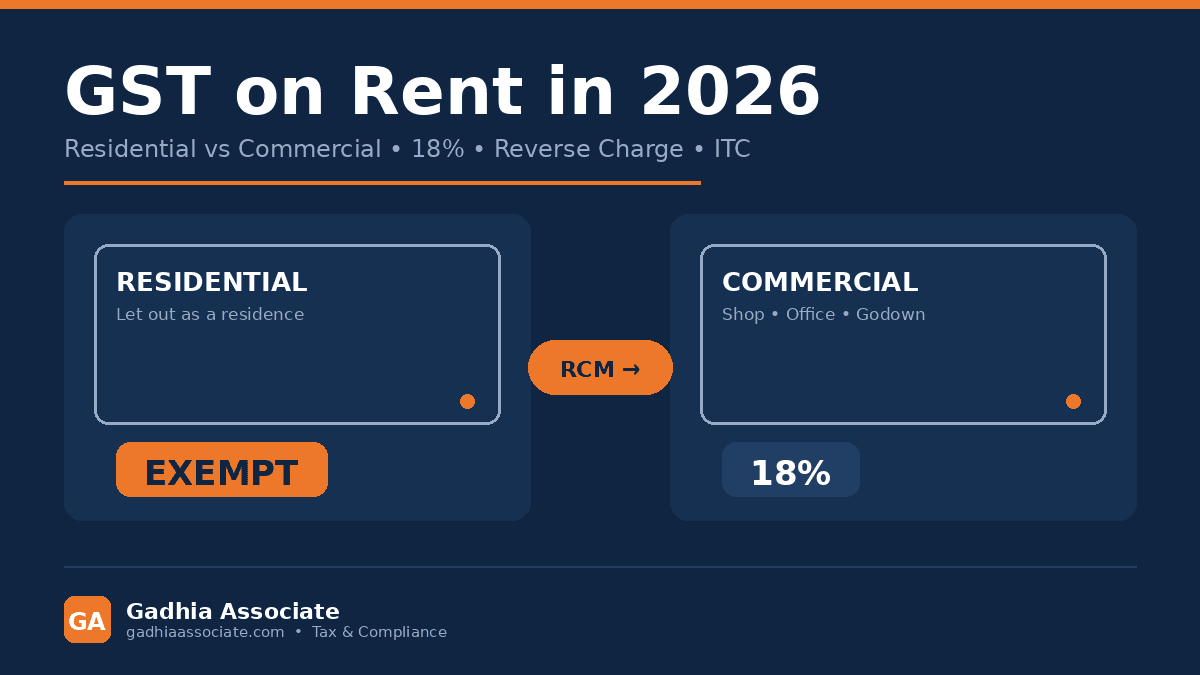
GST on rent depends on two things only: what the property is used for, and who the landlord and tenant are. Renting a residential dwelling for use as a residence to an unregistered person is exempt. Renting commercial property — a shop, office, godown or factory — is taxable at 18%, either by the landlord under forward charge or by the registered tenant under reverse charge if the landlord is unregistered.
That is the whole framework. Everything below is detail: when the reverse charge rules kicked in, who is excluded from them, when a landlord must register, and when a tenant can claim input tax credit on the rent it pays.
Is GST applicable on house rent?
Usually not. Renting a residential dwelling for use as a residence to an unregistered person is exempt from GST. A salaried tenant renting a flat in Junagadh or Rajkot pays no GST, and the landlord has no GST obligation on that rent regardless of how much rent he collects.
The complication arrived on 18 July 2022, when renting of a residential dwelling to a registered person was brought under the reverse charge mechanism. From that date, if a GST-registered business took a flat on rent, the business had to pay GST at 18% on the rent under RCM, even though the landlord was unregistered.
That was clarified at the end of December 2022. Where a proprietor takes a residential dwelling in his personal capacity for his own residence, and on his own account rather than for the business, the renting stays exempt and RCM does not apply. So a proprietor's home is not caught merely because his firm holds a GSTIN. A company taking a flat as a guest house or staff accommodation, however, is a different matter and generally attracts RCM.
Is GST charged on commercial rent?
Yes. Renting of immovable property for commercial or business use is a taxable supply of service at 18%. There is no exemption based on the type of tenant. Where the landlord is GST-registered, he charges 18% on the rent invoice, collects it from the tenant and deposits it — this is the ordinary forward charge route.
Shop and office landlords in Junagadh, Rajkot and across Gujarat who own several units frequently cross the registration threshold without realising it, because they think of rent as passive income rather than a supply of service. It is a supply of service, and GST law treats it accordingly.
Do I need GST registration for rental income?
If your aggregate turnover from commercial rent and any other taxable supplies crosses Rs 20 lakh in a financial year, you must register and charge GST under forward charge. Aggregate turnover is computed on your PAN across all your properties and businesses, not property by property. Exempt residential rent does not create a liability, but do check how it interacts with your overall turnover computation. Our GST Calculator is a quick way to see the tax on a given monthly rent, and our GST Services team handles registration and monthly filings.
Who pays GST on rent under reverse charge?
With effect from 10 October 2024, renting of any property other than a residential dwelling by an unregistered landlord to a registered tenant was brought under the reverse charge mechanism. In that situation the landlord issues a rent bill without GST, and the registered tenant self-assesses 18% GST on the rent, deposits it in cash, and reports it in its own returns.
There is an important carve-out. Following the 55th GST Council meeting, taxpayers who have opted for the composition levy were excluded from this RCM with effect from January 2025, so a composition dealer renting a shop from an unregistered landlord does not have to discharge GST under this entry. The intervening period from 10 October 2024 was regularised on an "as is where is" basis, which means composition taxpayers who already paid under RCM in that window are not getting refunds. If your situation falls in that window, get it reviewed rather than assumed.
Forward charge versus reverse charge — the practical difference
Under forward charge, a registered landlord is the taxpayer. He raises a tax invoice with 18% GST, the tenant pays rent plus GST to him, and the landlord deposits the tax and files the returns. The tenant's paperwork is simple: it holds a valid tax invoice and takes credit on it.
Under reverse charge, the landlord is out of the picture. He is unregistered, so he neither charges nor deposits anything. The registered tenant becomes the person liable. The tenant must issue a self-invoice, pay the 18% in cash — RCM liability cannot be set off against existing input tax credit balance — and only then take credit of that same amount in the following step. The cash outflow is real even where the credit is fully available.
Can I claim ITC on office rent?
Yes, in most cases. Rent paid on premises used in the course or furtherance of business is an eligible input service, so a registered tenant can claim input tax credit on GST charged on office, shop, godown or factory rent, subject to the usual conditions — a valid invoice, receipt of the service, the supplier having reported and paid the tax, and the credit not being blocked. Where the tenant pays under RCM, the tax paid in cash is likewise available as credit in the same or the following period, so the RCM is generally cash-flow neutral over time. A composition dealer, by contrast, cannot take credit at all, which is one reason the composition exclusion from RCM mattered so much.
What about maintenance charges and municipal taxes?
Where the landlord recovers maintenance or common area charges from the tenant as part of the letting arrangement, these generally form part of the value of the renting service and carry the same GST treatment as the rent itself. Municipal or property taxes borne by the landlord and recharged to the tenant are usually also treated as part of the consideration for the supply unless the tenant is genuinely paying the authority on its own account. Security deposits that are refundable and not adjusted against rent are not consideration and do not attract GST; a deposit adjusted towards rent does. Electricity and water recovered on an actual, metered, pure-agent basis are treated differently from charges bundled into a lump-sum rent, so how the agreement and the invoice are drafted really does change the tax outcome.
A worked example (illustrative only)
Assume a registered trading firm rents a shop for Rs 1,00,000 per month from a landlord who is not registered under GST.
- The landlord issues a simple rent bill for Rs 1,00,000 with no GST, because he is unregistered.
- The tenant, being registered, raises a self-invoice and computes GST at 18% — Rs 18,000.
- The tenant deposits that Rs 18,000 in cash through its electronic cash ledger; it cannot use its existing credit balance to pay an RCM liability.
- The tenant then claims Rs 18,000 as input tax credit, since the shop is used for its business.
- Net effect over the cycle: the tax is neutral, but Rs 18,000 leaves the bank first and comes back as credit afterwards.
Change one fact and the answer changes. If the same tenant were a composition dealer, it would fall outside this RCM after the January 2025 amendment. If the landlord were registered, he would simply bill Rs 1,18,000 and the tenant would take credit of Rs 18,000 from his invoice.
Checklist for landlords and tenants
- Classify the property correctly — residential dwelling used as a residence, or commercial.
- Check the registration status of both parties; it decides who pays.
- Landlords: track aggregate turnover across all properties against the Rs 20 lakh threshold.
- Registered tenants with unregistered landlords: raise self-invoices monthly and pay RCM in cash.
- Composition dealers: confirm your exclusion from the commercial rent RCM and document it.
- Spell out maintenance, municipal taxes, deposits and utilities separately in the rent agreement.
- Reconcile rent expense in your books with the GST returns and with your TDS records every quarter.
Do not forget TDS on rent
GST is only half the story. The same rent payment usually triggers a TDS obligation as well — Section 194-I for businesses paying rent above the prescribed limit, and Section 194-IB for individuals and HUFs not liable to audit. The two run on different thresholds, different rates and different deposit mechanics, and tenants routinely get the GST right and the TDS wrong. Read our separate article on TDS on rent under Sections 194-I and 194-IB alongside this one, because in practice a landlord and tenant need both.
How Gadhia Associate Can Help
We advise shop, office and godown landlords and their tenants across Junagadh and Gujarat on GST registration for rental income, RCM compliance and self-invoicing, input tax credit reviews, and drafting rent agreements so the tax treatment of maintenance, deposits and utilities is not left to interpretation. Look through our GST Services and Income Tax services, use the GST Calculator for a quick figure, and if you are structuring a new property-holding business, our Business Structure Advisor and Capital Gain Tax Calculator may help too. Book a free consultation and we will review your position.
Position as of August 2026. GST law changes frequently through CBIC notifications, circulars and GST Council recommendations. Please confirm the current position with a qualified professional before acting on this article.