Gift Deed or Will: Which Is Better to Transfer Property to Your Children in Gujarat?
A couple in their mid-sixties, a house in Junagadh bought decades ago, a son in Ahmedabad and a daughter married in Surat. One relative says gift it now. A neighbour insists a will is safer. Somebody's advocate friend mentioned stamp duty and the room went quiet. If that is roughly your family, you are in the right place. Deciding nothing is the expensive option, because when a parent dies with no document, the children usually spend far more on affidavits, heirship certificates and lawyers than the stamp duty would have cost.
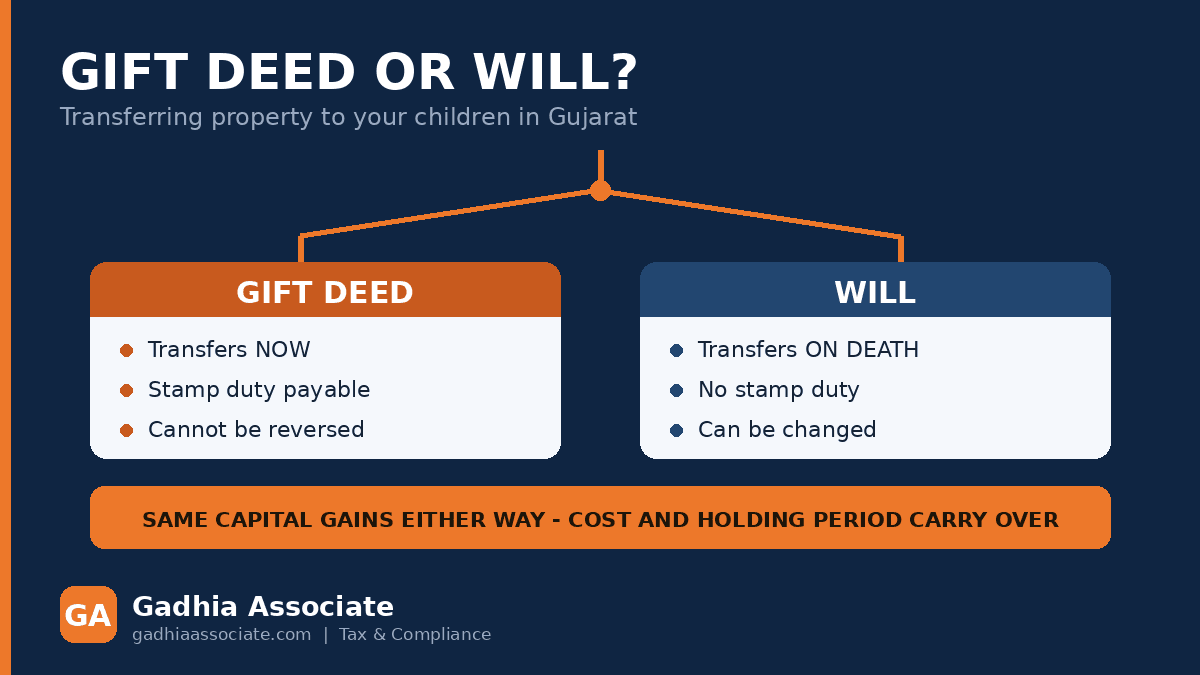
Short answer: There is no single right choice. A gift deed transfers the property now, needs registration and stamp duty, and cannot be taken back. A will transfers it only after death, costs nothing today and can be changed anytime. The income tax outcome is broadly the same, because cost and holding period carry over to the child either way.
What does a gift deed actually involve, and what does it cost in Gujarat?
A gift of immovable property is valid only if made by a registered instrument, signed by the donor, attested by two witnesses and accepted by the donee in the donor's lifetime. That is Section 123 of the Transfer of Property Act, with the compulsory registration requirement in Section 17 of the Registration Act, 1908. There is no valid oral gift of a house.
On cost, Gujarat allows a concessional rate of stamp duty on gifts to specified blood relatives, commonly applied at around 1 per cent of value, against the full conveyance rate of about 4.9 per cent (3.5 per cent duty plus 1.4 per cent surcharge) for anyone outside that list. A registration fee of about 1 per cent normally applies, with an exemption ordinarily available where the transferee is a woman. Treat those figures as indicative. The rates have moved by state notification more than once, "blood relative" is narrower than families assume, and duty goes on Jantri or market value, whichever is higher. Confirm the current rate at your Sub-Registrar's office.
The appointment itself is short. Donor and donee attend with two witnesses, photographs and thumb impressions are taken on the spot, and you are out in a couple of hours. Getting there takes longer: Jantri valuation, index copy, prior title chain, property tax receipts, PAN and Aadhaar of both sides. The clause families most often forget is the donee's express acceptance, and a deed that omits it is the defect that surfaces fifteen years later when someone tries to sell.
What does making a will involve, and is registration compulsory?
A will costs nothing in stamp duty, and registration is optional under the Registration Act. It takes effect only on death and can be rewritten as often as you like. It must be in writing, signed by the testator, and attested by two witnesses who saw the testator sign; neither witness should be a beneficiary. Registering it is still worth the small fee, since a registered will is harder to attack as a forgery. Probate is mandatory only in certain jurisdictions, historically the old presidency towns, and is generally not required in Gujarat. Banks and societies still want their own comfort documents before mutating records, and that is where the delay sits.
Will my child pay more income tax if I gift the house instead of leaving it in a will?
No, and this is the point most families get wrong. Both routes are tax-free on receipt and leave the child in the same capital gains position later. A gift from a "relative" as defined in Section 56(2)(x) is exempt regardless of value, and parents fall within that definition. Property received under a will or by inheritance sits outside the charge altogether. On a later sale, Section 49(1) makes the cost of acquisition the cost to the previous owner, and the previous owner's holding period is added to the child's.
Illustrative example, round numbers. Parents bought the Junagadh house in 2005 for Rs 6,00,000. Gift it to the son now and his cost stays Rs 6,00,000, holding period running from 2005. Leave it by will and he inherits later: cost still Rs 6,00,000, same 2005 start. Sell at Rs 1,00,00,000 and the gain is identical. Stamp duty paid on the gift is not deductible against it. If a sale is likely, look at Sections 54, 54F and 54EC, and our Capital Gain Tax Calculator.
Not sure which one fits your family? Sit with us for an hour.
Bring the index copy, the property tax receipt and a rough idea of who should get what. We will run the numbers on your actual Jantri value and lay out the trade-off in plain Gujarati or English. Gadhia Associate has been practising since 2007 and has served over 7,000 clients across Saurashtra and Gujarat, with a 5.0 Google rating from 100+ reviews. First consultation is free, fees are fixed, and the Junagadh office can usually offer a same-day appointment. Call or WhatsApp +91 82005 28355.
Can transferring property to my wife or minor child backfire on my tax return?
Yes, and this catches people who gift to the wrong family member. Where a house is transferred to a spouse or minor child otherwise than for adequate consideration, Section 27 treats the transferor as deemed owner, so the rental income keeps getting taxed in the transferor's hands. Section 64 does the same more broadly, clubbing income from assets so transferred back into the transferor's income. Love and affection is not adequate consideration. A gift from parents to an adult son or daughter does not attract clubbing, which is why most family transfers are done that way. Property held through an HUF follows different rules again.
How do families in Gujarat usually get this wrong?
Almost always through informality. The commonest pattern is an oral promise made in front of relatives, a son already living in and maintaining the house, and no document anywhere. When the parent dies, the other siblings are not being greedy; they are legal heirs, and the law knows nothing about the promise. Next commonest is a "gift deed" typed on stamp paper but never registered.
One more, specific to older properties around Junagadh and the surrounding talukas: revenue records still show a grandfather's name, mutation was never done, and the family discovers this only when the sub-registrar refuses the document. Sorting that chain takes months, not days.
Which one should I choose, gift deed or will?
Choose a gift deed if you want the matter settled while you are alive to explain your reasoning, if you expect a dispute between children, if one child has genuinely maintained the property, or if the child needs the title in their own name for a loan.
Choose a will if you want freedom to change your mind, if you may need to sell or mortgage the property in your lifetime, if you own several properties and want to divide the estate as a package, or if you cannot say how relationships will stand in ten years. Plenty of families do both. Two hard rules either way: do not gift the only house you live in without reserving a right of residence, and write a will even if you gift.
Ready to get the document done properly?
Gadhia Associate is a tax and compliance practice based in Junagadh, Gujarat, working with families, businesses and NRIs across India on income tax, capital gains and property transfers, most of it workable digitally if you are not in Saurashtra. We will confirm the current stamp duty position with the Sub-Registrar, draft the deed or the will, and tell you the tax consequence before you sign rather than after. Free first consultation, fixed fees, monthly plans available. Call or WhatsApp +91 82005 28355.
Frequently asked questions
Is there any inheritance tax or estate duty in India in 2026?
No. India currently levies no inheritance tax or estate duty, so a child receiving property under a will pays nothing on receipt. The subject resurfaces in public debate periodically, but as things stand there is no such levy. Tax arises only later, on sale, as capital gains, using the previous owner's cost and holding period under Section 49(1).
Can a gift deed be cancelled after registration?
Generally no. Once a gift is validly made, accepted by the donee and registered, it is irrevocable, and the donor cannot cancel it unilaterally. Narrow exceptions exist, such as a condition agreed by both parties at the time of the gift, or a gift obtained by fraud, which needs a court. Senior citizens have a separate remedy where a transfer rested on a broken promise of maintenance.
Do I have to pay stamp duty on a will in Gujarat?
No stamp duty is payable on a will anywhere in India, and registration is optional rather than compulsory. If you register it, only a modest fee applies. The saving is real but it is a deferral, not an escape: when the property eventually passes to the beneficiary and records are mutated, the family still carries the procedural cost and the waiting.
Does a gifted property have to be shown in my income tax return?
A gift from a relative under Section 56(2)(x) is not taxable, so there is no income to offer. Keep the registered deed safe even so, because the registering authority reports the transaction and it may appear in your Annual Information Statement. If you cross the threshold requiring the schedule of assets and liabilities, disclose it there. Our articles on gift taxation under Section 56(2)(x) and on HUFs go further.
Position as of September 2026. Income tax rules change through Finance Acts and CBDT notifications, and stamp duty and registration charges are fixed by state notification and revised from time to time. The Gujarat rates above are indicative and must be confirmed with the Sub-Registrar or a local advocate for your property and relationship before you act. General information, not advice for a specific case.