TDS Default Notice from TRACES? Short Deduction, Late Fee and Interest Demands Explained and How to Clear Them
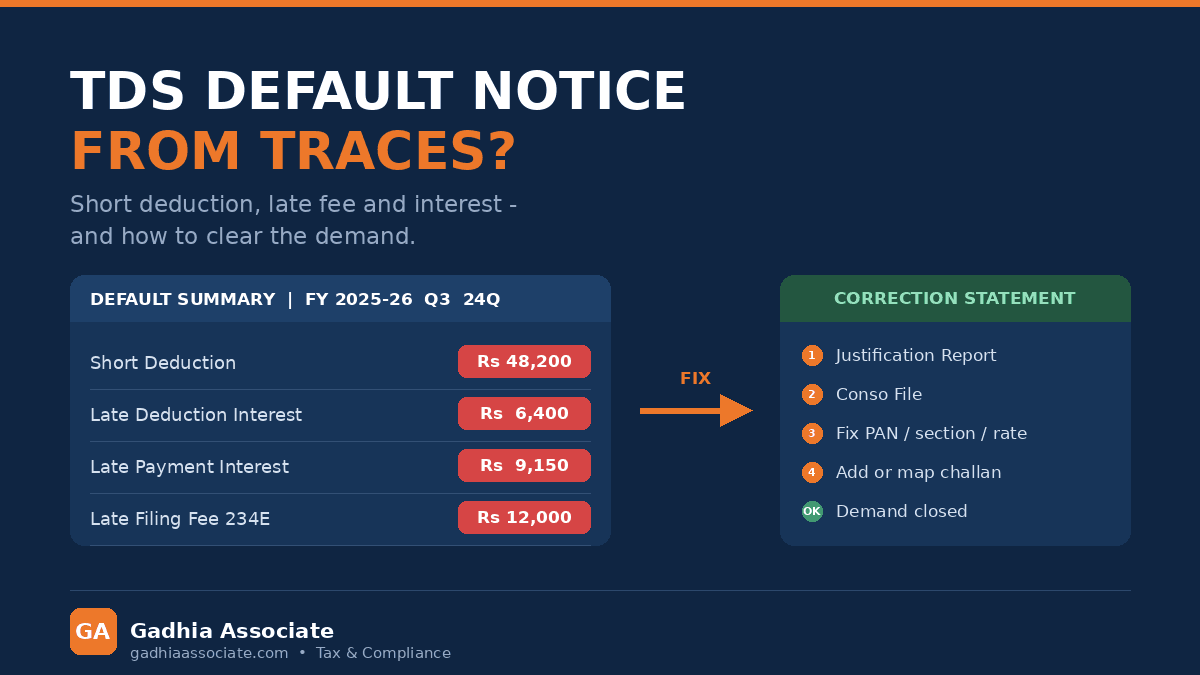
You filed your TDS return on time, and weeks later an email from TRACES says there is a default against your TAN. There is a demand — sometimes thousands, sometimes lakhs — with words like short deduction, short payment, late deduction interest and late filing fee. Nothing in your books suggests you did anything wrong, yet a TDS default notice from TRACES is sitting there with a deadline.
Most of these demands are not because you cheated. They are because a PAN, a date, a section code or a challan did not line up. Almost all are fixable through a correction statement rather than by paying up.
Why did I get a TDS default notice from TRACES?
TRACES matches every quarterly statement against the challan system and the PAN database. Wherever the two disagree, a default is raised automatically. No officer looked at your file — a machine compared numbers and something did not match.
Check this in two minutes before you do anything else
Log in to the TRACES deductor portal with your TAN. Open Dashboard > Default Summary — it breaks the demand down by financial year, quarter and form type (24Q salary, 26Q other resident payments, 27Q non-residents, 27EQ TCS). Then request the Justification Report under Defaults, and check Track Correction Request for anything already pending.
What is short deduction in TDS, and why does it keep happening?
Short deduction means TRACES calculated more tax on the payment than you deducted. The defaults fall into short deduction, short payment (challan not matched) and lateness — in deducting, depositing or filing. Each has its own fix, visible in the Justification Report.
Cause 1: The deductee's PAN is invalid or inoperative
The single most common reason. If a vendor or employee gave you an inoperative PAN — usually one not linked with Aadhaar — or a PAN that does not exist, the system treats it as no PAN and applies the higher rate under Section 206AA. Your 10 per cent deduction is recomputed at 20 per cent, and the difference becomes the demand.
How to confirm: open the Justification Report. It shows the deductee row, the PAN quoted, a PAN status flag and the rate the system expected. If the flag reads invalid, inoperative or PANNOTAVBL, this is your cause.
The fix: get the correct PAN, or get the deductee to link Aadhaar so the PAN becomes operative, then file a correction statement replacing it. Note the limits — correction statements allow PAN changes only within permitted structural rules, and a correction changing too many characters is rejected; that deductee then has to be re-reported. Our earlier article on inoperative PAN covers the linking process.
Timeline: PAN linking takes a few days to reflect; the correction statement processes in roughly one to three weeks, after which the demand drops off the portal.
Cause 2: Wrong section code or wrong rate applied
You paid a contractor but reported it under the professional-fees code, or applied a lower rate under a certificate not valid for that quarter or section. The system recomputes and raises the difference.
The fix: a correction statement changing the section code and, where needed, the rate. If a lower-deduction certificate applied, check the certificate number, deductee PAN and validity period match exactly — any mismatch voids the concession.
Cause 3: Short payment and unmatched challans
Short payment usually is not a shortfall at all. It is a challan that exists but which your statement quoted with the wrong BSR code, serial number, date or assessment year. TRACES cannot find it, so it treats the tax as unpaid.
How to confirm: use Statements/Payments > Challan Status and see whether the challan is unconsumed or unmatched. Cross-check the OLTAS counterfoil.
The fix: file an online correction and use add-challan and challan-correction to map the right challan to the deductee rows. If there is a real shortfall, pay it under the correct TAN, assessment year and minor head, then map it. An unmapped challan clears nothing.
Cause 4: Late deduction and late payment interest
Under Section 201(1A), interest runs at 1 per cent per month from when tax should have been deducted to when it actually was, and 1.5 per cent per month from deduction to deposit. Part of a month counts as a full month — one day late across a month boundary costs you two months.
The fix: interest is usually genuinely payable. Pay it under the correct minor head and file a correction mapping that challan. But check the deduction and payment dates in your statement first — a date typo is a very common way to inflate interest you do not actually owe.
Cause 5: Late filing fee under Section 234E
File the quarterly statement late and a fee of Rs 200 per day applies, capped at the TDS in that statement. It is a fee, not a penalty, so it is not ordinarily waived. Separately, Section 271H allows a penalty of Rs 10,000 to Rs 1,00,000 for not filing or filing an incorrect statement — with relief where the tax, interest and fee are paid and the correct statement is filed within the period specified in that section.
A note on numbering: the Income-tax Act, 2025 took effect from 1 April 2026 and renumbered these provisions. The substance continues; only the numbers moved. Map any unfamiliar section number back to the old provision before you respond.
How do I file a TDS correction statement?
The practical workflow, in order:
- Log in to TRACES with your TAN and download the Justification Report for the exact FY, quarter and form type
- Download the Conso File for the same statement
- Open the Conso File in your return-preparation utility and make the corrections — PAN, section, rate, deduction date, challan details
- Pay any genuine shortfall or interest with a fresh challan under the correct TAN and assessment year
- Add and map that challan to the corrected deductee rows
- Validate, generate the FVU file and upload it, or use TRACES online correction with a registered Digital Signature
- Track it under Track Correction Request until status shows processed
Once processed, the demand disappears from your default summary. Allow one to three weeks, sometimes longer at quarter end.
Can I avoid a demand if the deductee has already paid tax?
Yes — the escape route most deductors miss. Under the first proviso to Section 201(1), if the resident payee has included the amount in their return and paid tax on it, you are not treated as an assessee in default for the tax. You still owe interest for the delay period, but the principal demand goes.
The mechanism is Form 26A with an accountant's certificate confirming the payee offered the income and paid the tax. It is filed through TRACES and needs the deductee's cooperation — but on a large demand it is the difference between paying lakhs and paying nothing.
An illustrative example
A Junagadh trading firm pays Rs 20,00,000 to a contractor in FY 2025-26 and deducts Rs 20,000 at 1 per cent. The contractor's PAN is inoperative, so TRACES recomputes at 20 per cent and raises a short deduction of Rs 3,80,000 plus interest. The contractor links Aadhaar, a correction statement goes in, and the demand collapses to a small interest figure. Figures are illustrative only.
What makes it worse, and what not to do
Do not pay the demand blindly. Paying an amount raised because of a PAN flag does not fix the flag — the demand regenerates and you are out the money too. Read the Justification Report first, always.
Do not file a fresh original return for a quarter that already has one. That creates a duplicate statement, compounds the mismatch and can trigger fresh late-fee exposure. Corrections go through the Conso File route, never through a new original.
Do not ignore it. Unresolved TDS demands get adjusted against refunds and get flagged when you apply for a lower-deduction certificate. And do not repeat the same reporting error next quarter while arguing about the last one. Our article on responding to income tax notices covers replying within the stated window.
When to stop DIY and get help
Handle it yourself if it is one quarter, one deductee and a clear PAN typo. Call a professional when defaults repeat across quarters or years, when the demand runs into lakhs, when Form 26A and an accountant's certificate are the right route, when challans are unmatched across several years, or when the deadline is short.
How Gadhia Associate Can Help
We do this every week. We log in to TRACES for your TAN, read the Justification Report line by line and tell you which part of the demand is real and which is a data error. We file the correction statement — PAN, section, rate, challan additions and mapping — and track it to processed. Where the payee has already paid, we arrange Form 26A with the accountant's certificate so the principal demand is dropped. We compute interest correctly instead of accepting the system figure, and fix the process so the default does not repeat.
We are based in Junagadh, Gujarat, serving clients across Gujarat and India digitally — no travelling required. The first consultation is free. Call or WhatsApp +91 82005 28355 with your TAN and quarter, and we will tell you within a day what the demand really is and what it takes to clear it.
This article reflects the position as of August 2026. TDS provisions, rates, fees and procedures change through CBDT notifications, circulars and portal updates, and the Income-tax Act, 2025 has renumbered several provisions referred to here. Outcomes depend on the facts of each case and on the deductee's cooperation. General information only, not a substitute for professional advice.