Selling Old Machinery, Vehicles or Furniture of Your Business in 2026: GST on Capital Goods, the Higher-Of Rule, 18% on Used Car Margin and Income Tax
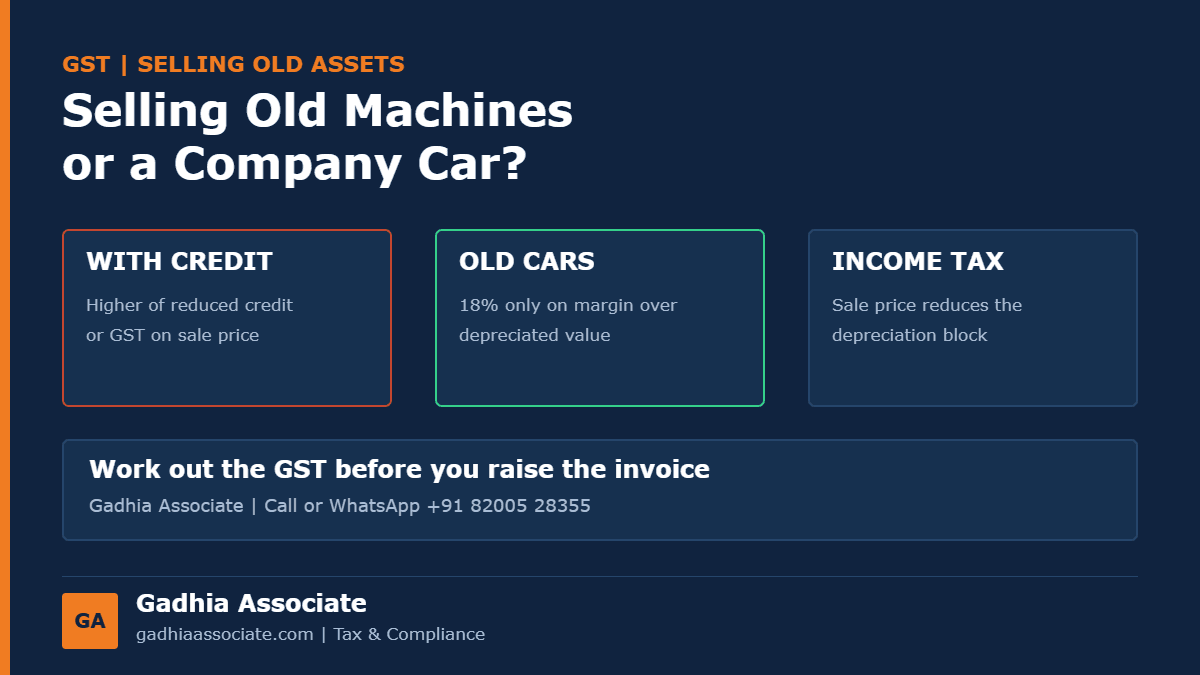
When a business sells old machinery, furniture or vehicles, GST applies, and where credit was claimed, the higher-of rule decides the tax.
Pravinbhai runs a plastic moulding unit in Rajkot. He is selling two machines bought in April 2025 for Rs 30 lakh, on which he claimed Rs 5.4 lakh of GST credit, to another unit for Rs 12 lakh, because his product line has changed. He is also selling the firm's 2021 car, on which no credit was claimed, for Rs 9 lakh. His accountant plans to charge 18% on Rs 12 lakh for the machines and no GST at all on the car.
Old assets are sold every year, when machines are replaced, offices move or vehicles are upgraded. GST on these sales follows special rules that many businesses miss, and the income tax depreciation changes too. Here is how it works in 2026.
Our team works out GST and income tax on asset sales, and handles invoices, returns and notices for businesses. Call or WhatsApp +91 82005 28355, or see the details at the end of this guide.
The higher-of rule for assets with credit
- Which assets: machinery, equipment, computers, furniture and fittings on which you claimed GST credit.
- The rule: pay the higher of the credit taken, reduced by 5 percentage points for every quarter or part of a quarter since the purchase invoice, or the GST on the sale price.
- An example: credit of Rs 5.4 lakh, used for 7 quarters, leaves 65%, or Rs 3.51 lakh; GST at 18% on a sale price of Rs 12 lakh is Rs 2.16 lakh; so Rs 3.51 lakh is payable.
- On the invoice: charge GST on the sale price; the extra amount under the rule is paid by you, and the buyer can claim only the GST on the invoice.
- Scrap: moulds, dies, jigs, fixtures and refractory bricks sold as scrap pay tax only on the sale price.
- Related buyers: sales to a related person, or at a token price, can be valued at the open market value.
Old vehicles
- Cars without credit: GST still applies when a business sells its car, but at 18% only on the margin, that is the sale price less the depreciated value claimed for income tax.
- No margin, no GST: if the sale price is below the depreciated value, nothing is payable.
- Condition: the margin rule applies only where no GST credit was claimed on the vehicle. See buying a car in the company's name.
- Trucks and other vehicles with credit: the higher-of rule applies instead.
- TCS: a business seller covered by the TCS rules collects 1% on a motor vehicle sold for more than Rs 10 lakh.
Scrap and the whole business
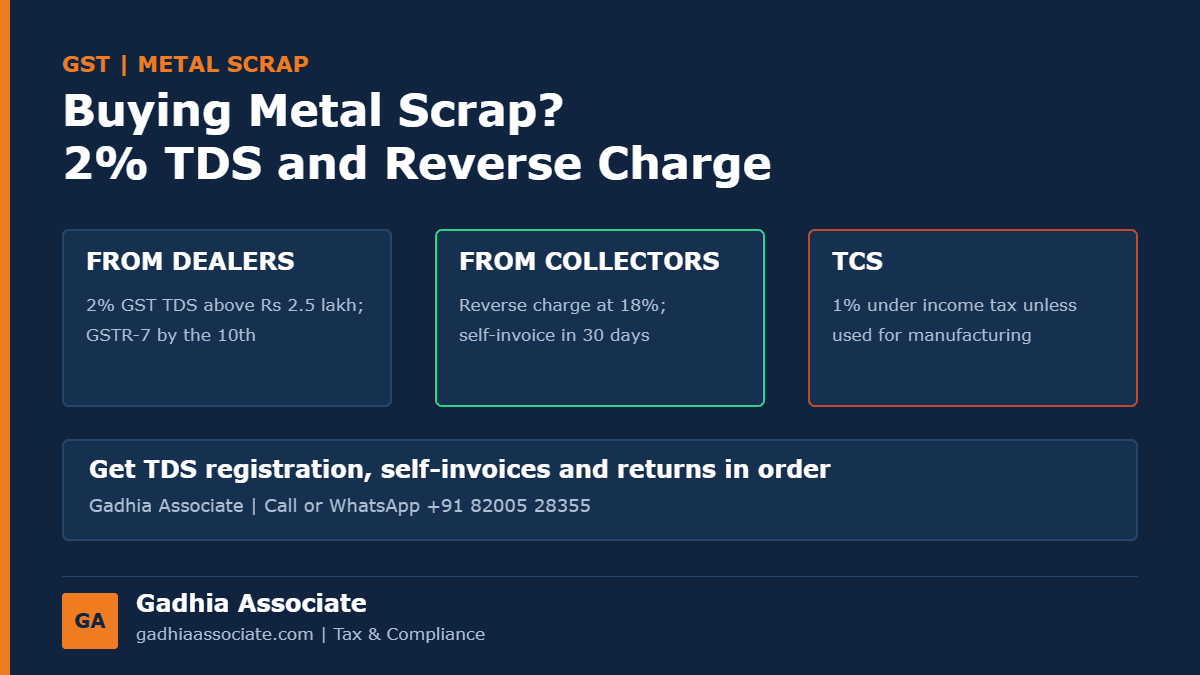
- Machines sold as metal scrap: the buyer may have to deduct GST TDS or pay under reverse charge. See GST on metal scrap.
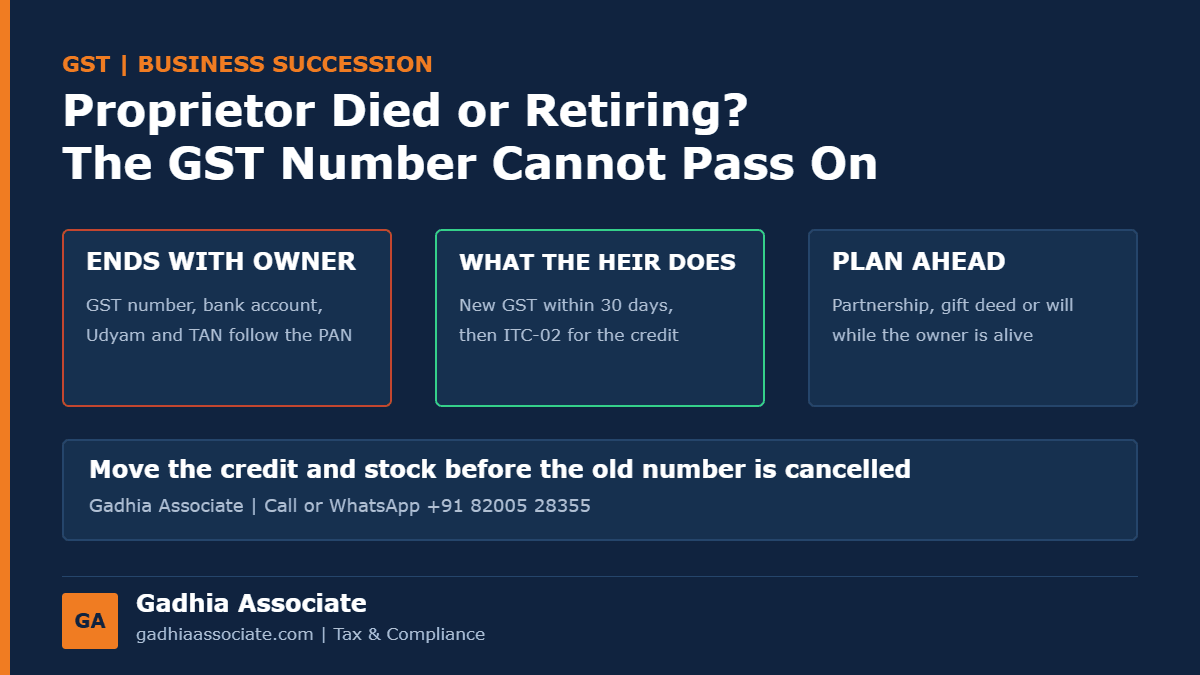
- Selling the whole business: a transfer as a going concern is free of GST, and the credit can move to the buyer. See business transfer and ITC-02.
- Slump sale: income tax on the sale of a running business follows its own rules. See selling a running business.
The income tax side
- Asset block: the sale price is reduced from the block of assets, and depreciation continues on the balance.
- Capital gain: a gain arises only if the block becomes negative or the whole block is sold, and it is short-term. See machinery depreciation.
- Records: keep the original purchase bill, the credit claimed and the depreciation schedule for each asset.
Paperwork
- Invoice: a proper tax invoice with the HSN code, and an e-invoice where your turnover requires it.
- E-way bill: needed to move goods worth more than Rs 50,000. See goods detained for an e-way bill mistake.
- Returns: report the sale in GSTR-1 and pay the tax, including any extra amount, in GSTR-3B. See our GST return calendar.
Common mistakes
- Charging GST on the sale price without checking the higher-of rule.
- Selling a company car with no GST, or with GST on the full price instead of the margin.
- Moving old machines without an e-way bill.
- Forgetting to reduce the asset block for depreciation.
- Selling assets to relatives or group firms at token prices.
- No fixed asset register showing the credit claimed on each asset.
Back to Pravinbhai. The machines were used for 7 quarters, so 65% of the Rs 5.4 lakh credit, or Rs 3.51 lakh, is more than 18% of the Rs 12 lakh sale price. His invoice charges Rs 2.16 lakh of GST, and he pays the remaining Rs 1.35 lakh himself in his return. The car's depreciated value is Rs 6 lakh, so GST is 18% on the Rs 3 lakh margin, or Rs 54,000, and no TCS applies because the price is below Rs 10 lakh. Both sales are reduced from his asset blocks for depreciation, and e-way bills go with the machines.
How we help
- Working out GST on the sale of machinery, furniture and vehicles
- Invoices, e-way bills and GSTR-1 and GSTR-3B reporting
- Depreciation and capital gains on asset sales
- Fixed asset registers with credit details
- Business transfer, ITC-02 and slump sale planning
- Replies to GST notices on asset sales
Gadhia Associate has been in practice since 2007 and has handled work for over 7,000 clients, with a 5.0 Google rating from more than 100 reviews. Manufacturers and traders from Junagadh, Rajkot, Jamnagar, Morbi and Gondal come to our Junagadh office, where same-day appointments are available. Businesses elsewhere in Gujarat are handled online.
Selling old machines or a company vehicle? Get the GST worked out before you raise the invoice. Call or WhatsApp +91 82005 28355, or message us on WhatsApp. The first consultation is free.
Frequently asked questions
Is GST payable on the sale of old machinery?
Yes. Where credit was claimed, pay the higher of the reduced credit or the GST on the sale price.
How is the credit reduced when an asset is sold?
By 5 percentage points for every quarter or part of a quarter since the purchase invoice.
Is GST payable when a company sells its old car?
Yes, at 18% on the margin over the depreciated value, where no credit was claimed, and nil if there is no margin.
Is GST payable on the sale of old office furniture?
Yes, at the rate for that furniture, applying the higher-of rule if credit was claimed.
Does selling an asset affect depreciation?
Yes. The sale price is reduced from the block of assets, and a short-term gain can arise if the block turns negative.
Is GST payable if I sell my whole business?
Not on a transfer as a going concern, which is exempt.
Position as of 26 November 2026, under section 18(6) of the CGST Act, the CGST Rules, the GST rate notification for old and used vehicles and the income tax depreciation rules. Check the facts of each asset before invoicing.