CIBIL MSME Rank (CMR) in 2026: How Banks Judge Your Business Credit Score, What Pulls It Down and How to Fix Errors
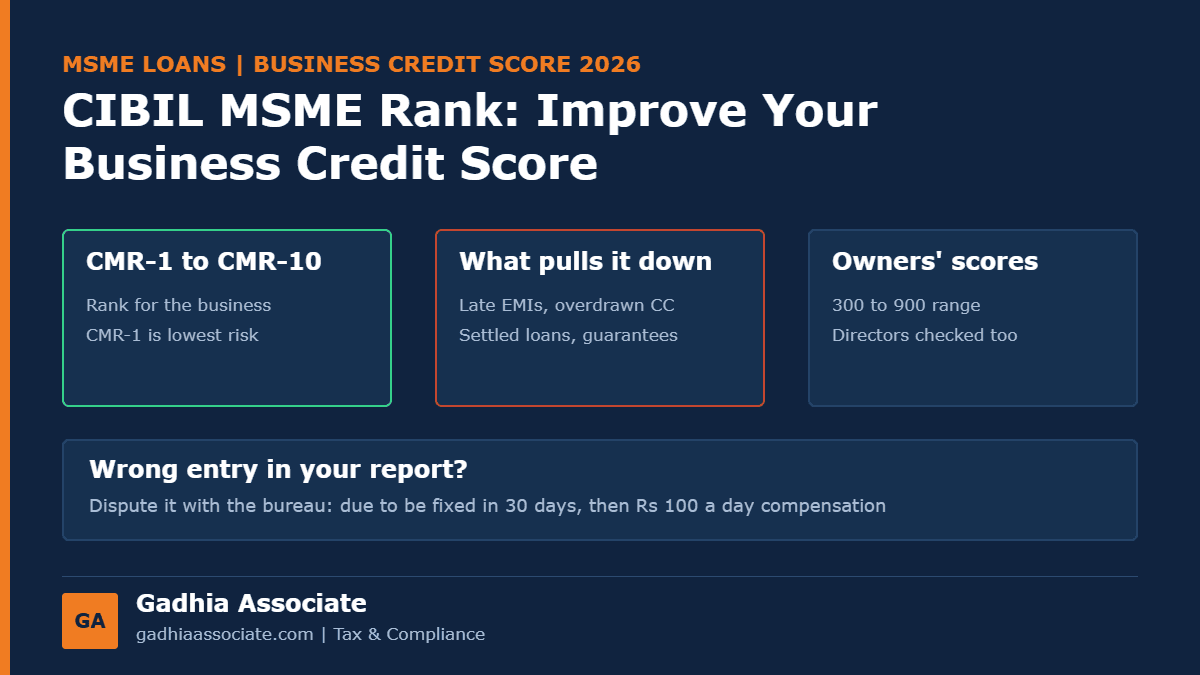
Banks check your CIBIL MSME Rank and the owners' credit scores before a business loan, and late EMIs or an overdrawn CC account pull both down.
Bhavesh and his brother run a packaging unit in Shapar near Rajkot through a private limited company. They asked their bank to raise the cash credit limit from Rs 40 lakh to Rs 75 lakh, and the bank said no. The company's CIBIL MSME Rank was CMR-7, and his brother's personal score was 682. Two EMIs on a machinery loan had been paid late during a slow quarter, the CC account had run above its drawing power in several months, and his brother had stood guarantee for a friend's car loan that was later settled for less than the dues.
Most business owners in Saurashtra see their credit reports only after a loan or a limit increase is refused. The reports can be checked and fixed months before you apply. Here is how business credit scores work in 2026.
Short Answer: Before an MSME loan, banks check the business's credit report and the personal credit scores of its owners. TransUnion CIBIL ranks businesses from CMR-1, the lowest risk, to CMR-10, the highest, and personal scores run from 300 to 900, with 750 or more generally seen as good. Late EMIs, a cash credit account above its limit, settled or written-off loans, many loan applications in a short time, and defaults on loans you guaranteed all pull them down. Wrong entries can be disputed with the bureau, and if a complaint is not resolved within 30 days, you are entitled to compensation of Rs 100 a day.
Our team reviews credit reports, raises disputes and prepares loan proposals and CMA data for MSMEs. Call or WhatsApp +91 82005 28355, or see the details at the end of this guide.
What lenders look at
- Business credit report: for companies, LLPs and firms, a commercial report lists every loan, limit and guarantee, with its repayment history.
- CIBIL MSME Rank: a rank from CMR-1 to CMR-10, where CMR-1 is the lowest risk of default; lenders grow cautious towards the higher end.
- Owners' scores: the personal scores of the proprietor, partners or directors, from 300 to 900, are checked too, and for a proprietorship they matter most.
- Other bureaus: Experian, Equifax and CRIF High Mark also keep reports, and a bank may check any of them.
- Beyond the score: GST returns, bank statements, ITRs and audited accounts are read alongside. See project reports and CA certificates for loans.
What pulls the score down
- Late payments: an EMI or interest paid even a few days late is reported as days past due.
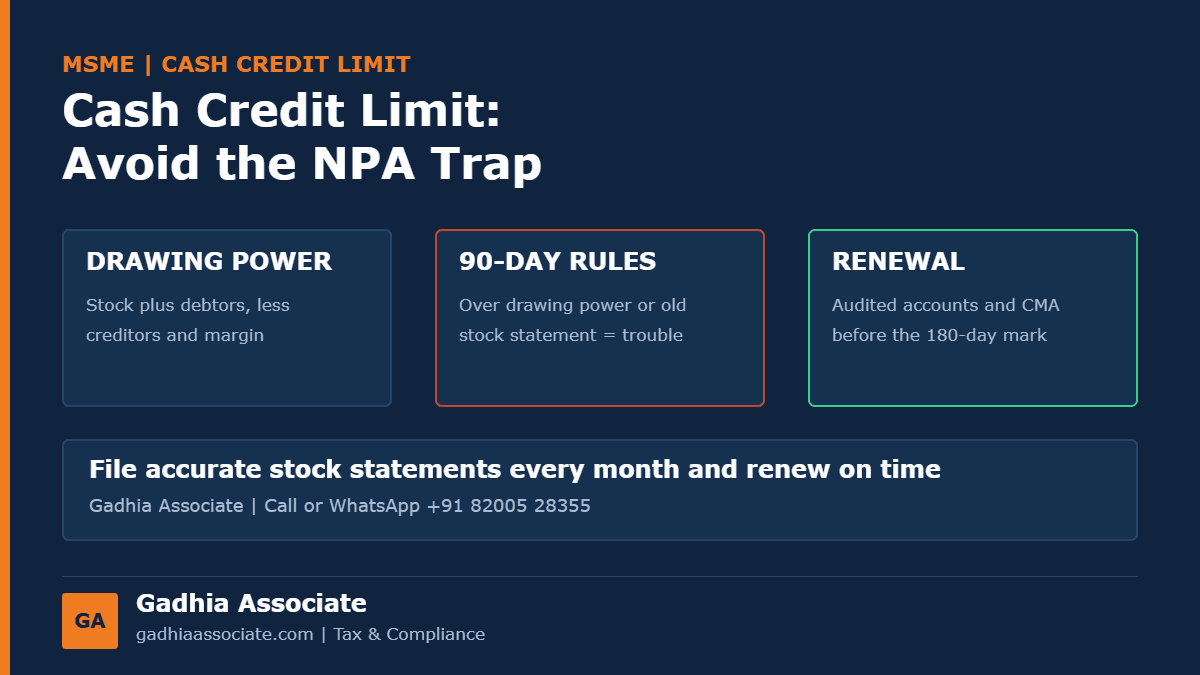
- Irregular CC or OD: a cash credit or overdraft drawn above its limit or drawing power shows as irregular. See cash credit limits.
- SMA tags: dues unpaid for up to 30, 31 to 60 and 61 to 90 days are tagged SMA-0, SMA-1 and SMA-2, and beyond 90 days the account becomes an NPA.
- Settled or written off: settling for less than the dues leaves a status that lenders read as a loss.
- Guarantees: loans you guaranteed appear in your report, and their defaults count against you.
- Many enquiries: applying to several lenders in a short time suggests an urgent need for credit.
Checking your reports
- Personal reports: each individual can get one free full credit report a year from every bureau.
- Business reports: companies and firms can buy their commercial report and rank online from the bureau.
- What to look for: loans you never took, closed loans shown as open, wrong overdue amounts, duplicate accounts and wrong PAN or address details.
- Alerts: lenders must send an SMS or email when they report a default, so do not ignore these messages.
- Update speed: lenders now report to the bureaus every fortnight, so repayments and corrections show faster than before.
Fixing wrong entries
- Raise a dispute: file it online with the bureau, with proof such as a no dues certificate or closure letter.
- The lender's role: the bureau checks with the lender, which must confirm or correct the data.
- 30 days: the complaint must be resolved within 30 days of filing; after that, you are entitled to compensation of Rs 100 for each day of delay.
- Escalate: if it is still not resolved, complain to the RBI Ombudsman online.
- Only errors: a dispute can correct wrong data, but a true record of late payments stays until good repayments outweigh it.
Building a better rank
- Match EMI dates to cash flow: ask the bank to set EMI dates after your main customer payments arrive.
- Keep the CC in order: stay within the limit and submit stock statements on time, so the drawing power does not drop below the balance.
- Close settled loans properly: where possible, pay the balance and ask the lender to report the account as closed.
- Apply selectively: compare offers first and apply to one or two lenders at a time.
- Guarantee with care: sign guarantees only for loans you can keep an eye on.
- Use the schemes: micro and small units with Udyam get collateral-free loans up to Rs 10 lakh and CGTMSE cover for larger loans. See business loans for companies and Udyam registration.
Common mistakes
- Ignoring an EMI paid a few days late.
- Running the CC account above its drawing power for months.
- Accepting a settlement without knowing how it will show in the report.
- Applying to many banks at once after a rejection.
- Signing guarantees for friends' and relatives' loans without tracking them.
- Checking the reports only after a loan is refused.
Back to Bhavesh. Both brothers pull their free personal reports and the company buys its commercial report. A vehicle loan closed in 2023 is still shown as active, so they dispute it with the closure letter, and the bureau corrects it within the 30 days. The friend pays the balance on the settled car loan and the lender agrees to report it as closed. Stock statements now reach the bank by the 10th of every month, so the drawing power stays above the CC balance, and the EMI date is moved to the 15th, after the main customer payments come in. Six months later, with clean repayments on record, they apply again with CMA data and projections.
How we help
- Reviewing business and personal credit reports before you apply
- Disputes for wrong entries with the bureau and the lender
- Stock statements and drawing power working for CC accounts
- CMA data, projections and project reports for loans
- GST returns, ITRs and audited accounts on time for lenders
- Proposals for new loans, renewals and limit increases
Gadhia Associate has been in practice since 2007 and has handled work for over 7,000 clients, with a 5.0 Google rating from more than 100 reviews. Business owners from Junagadh, Rajkot, Shapar, Jetpur and Morbi come to our Junagadh office, where same-day appointments are available. Clients elsewhere in Gujarat are handled online.
Planning a loan or a limit increase? Check and fix your credit reports before the bank does. Call or WhatsApp +91 82005 28355, or message us on WhatsApp. The first consultation is free.
Frequently asked questions
What is CIBIL MSME Rank?
A rank from CMR-1 to CMR-10 that TransUnion CIBIL gives businesses with borrowings, where CMR-1 means the lowest risk of default.
What is a good credit score for a business loan?
For owners, a personal score of 750 or more is generally seen as good. For the business, a rank closer to CMR-1 is better.
Does a director's personal score affect a company loan?
Yes. Lenders check each director's score along with the company's report.
How long does it take to correct a credit report?
A dispute must be resolved within 30 days of filing, after which compensation of Rs 100 a day applies.
Does a settled loan hurt the credit score?
Yes. Lenders read a settled status as a loss; paying the balance and getting it reported as closed helps.
How often do banks update credit bureaus?
Every fortnight, since January 2025.
Position as of 27 November 2026, under the Credit Information Companies (Regulation) Act, 2005 and RBI directions on credit reporting. Each bureau and lender uses its own scoring method, so check your own reports before applying.