NRI Investing in Indian Shares and Mutual Funds in 2026: NRE or NRO, Portfolio Investment Account, 5% Limit, TDS on Gains and Repatriation
NRIs can invest in Indian shares and mutual funds through NRE or NRO accounts, but the account, the route and the TDS decide what they take home.
Nirav, 34, grew up in Jamnagar and has worked in the United States for three years. He still uses his resident savings and demat accounts in India for his SIPs and share purchases. His bank has now asked him to update his residential status, and he wants to invest USD 30,000 of his US salary in Indian equity funds that he can later take back to the US.
Many NRIs from Saurashtra keep investing in India after they move abroad, but under FEMA the accounts and routes change the day they become non-resident. Tax works differently too. Here is how it works in 2026.
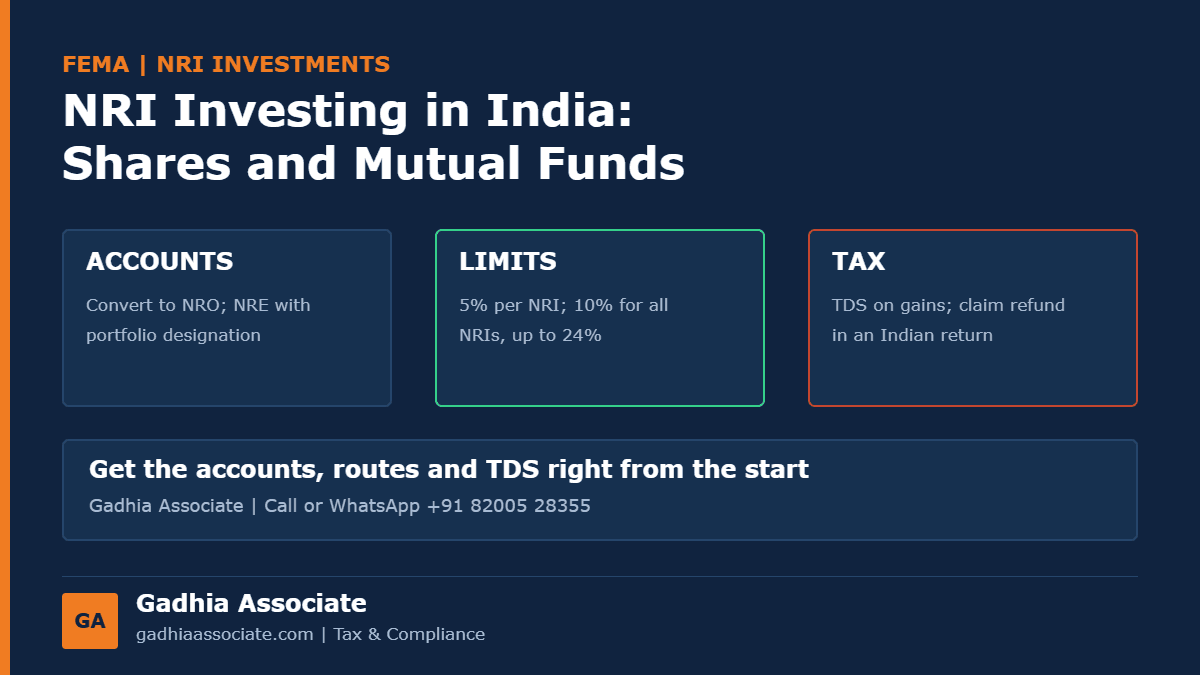
Short Answer: An NRI must convert resident savings and demat accounts to NRO once he or she becomes non-resident. Listed shares can be bought on a repatriable basis through an NRE account linked to a portfolio investment account, or on a non-repatriable basis through NRO. One NRI can hold up to 5% of a listed company, within a 10% overall limit for NRIs that the company can raise to 24%. Indian mutual funds are open to NRIs, though several do not accept investors living in the US or Canada. TDS is deducted on capital gains and dividends at NRI rates, which a treaty can lower. NRE money is freely repatriable, and NRO money up to USD 1 million a year.
Our team handles NRI investment structuring, TDS refunds, returns and repatriation paperwork. Call or WhatsApp +91 82005 28355, or see the details at the end of this guide.
First, change your accounts
- Savings account: convert it to an NRO account as soon as you become non-resident. See NRE, NRO and FCNR accounts.
- Demat and trading accounts: re-designate them as NRI accounts, repatriable or non-repatriable.
- KYC: update your status, overseas address and tax residency with your bank, broker and fund houses.
- Do not continue as resident: using resident accounts after you move abroad is a FEMA contravention.
Shares: repatriable and non-repatriable
- Repatriable: buy through an NRE account designated for portfolio investment with one bank, with an NRE demat account; sale proceeds go back to NRE.
- Non-repatriable: buy through an NRO account and NRO demat; proceeds go to NRO.
- Limits: one NRI can hold up to 5% of the paid-up capital of a listed company; all NRIs together up to 10%, which a company can raise to 24%.
- IPOs: NRIs can apply, on either basis.
Mutual funds
- Open to NRIs: invest through NRE for repatriable or NRO for non-repatriable holdings, including SIPs.
- US and Canada: several fund houses do not accept investors living there, because of their reporting rules; others accept them with extra declarations.
- US taxpayers: Indian funds can be treated as passive foreign investment companies under US tax law, which can be costly, so take US advice too.
Tax and TDS
- Listed shares and equity funds: long-term gains after 12 months are taxed at 12.5% above Rs 1.25 lakh a year, and short-term gains at 20%.
- Debt funds: gains on units bought from April 2023 are taxed at slab rates.
- TDS: the bank, broker or fund house deducts TDS on capital gains for NRIs, which residents do not face.
- Dividends: TDS at 20%, or the lower treaty rate with a tax residency certificate and Form 41. See DTAA for NRIs.
- Return: file an Indian return to claim back excess TDS. See NRI income tax.
- Your new country: it may tax the same gain, with credit for Indian tax under the treaty.
Sending the money abroad
- From NRE: principal and gains are freely repatriable.
- From NRO: up to USD 1 million a financial year, after tax, with Forms 145 and 146. See Form 145 and 146.
- Keep the trail: contract notes, fund statements, bank certificates and tax returns.
Common mistakes
- Continuing SIPs and trades from resident accounts after moving abroad.
- Buying shares from an NRE account without the portfolio investment designation.
- Not claiming refunds of excess TDS in an Indian return.
- Investing in a fund that does not accept investors from your country.
- Not reporting Indian accounts and funds in your country of residence.
Back to Nirav. His savings account becomes an NRO account and his old demat account is re-designated as non-repatriable, so his existing shares and SIPs continue on that basis. For the USD 30,000, he opens an NRE account with a portfolio investment designation and invests through a fund house that accepts US investors, after taking advice on the US tax treatment. His KYC now shows his US address and status, and each year he files an Indian return to claim any excess TDS, keeping the records he needs to send the money back to the US.
How we help
- Account conversion and FEMA compliance for new NRIs
- Choosing repatriable or non-repatriable routes
- TDS refunds and Indian income tax returns for NRIs
- Treaty benefits, tax residency certificates and Form 41
- Repatriation with Forms 145 and 146
- Coordination with your adviser abroad
Gadhia Associate has been in practice since 2007 and has handled work for over 7,000 clients, with a 5.0 Google rating from more than 100 reviews. NRIs with families in Junagadh, Rajkot, Jamnagar, Porbandar and Amreli work with our Junagadh office, and most NRI work is handled online.
Investing in India from abroad? Get the accounts, routes and TDS right from the start. Call or WhatsApp +91 82005 28355, or message us on WhatsApp. The first consultation is free.
Frequently asked questions
Can NRIs invest in Indian shares?
Yes, through an NRE account with a portfolio investment designation on a repatriable basis, or through NRO on a non-repatriable basis.
Can NRIs invest in Indian mutual funds?
Yes, through NRE or NRO accounts, though some fund houses do not accept investors living in the US or Canada.
Can an NRI keep a resident demat account?
No. It must be re-designated as an NRI account after he or she becomes non-resident.
Is TDS deducted on NRI capital gains?
Yes. The bank, broker or fund house deducts it, and excess TDS can be claimed back in a return.
How much can an NRI repatriate from NRO?
Up to USD 1 million a financial year, after tax, with the required forms.
How much of a listed company can an NRI hold?
Up to 5% of its paid-up capital, within a 10% overall limit for NRIs that the company can raise to 24%.
Position as of 26 November 2026, under FEMA and the Non-Debt Instruments Rules, and the income tax law in force. Bank and fund house procedures differ, so check with them before investing.