GST and Income Tax for Architects, Interior Designers and Engineers in 2026: 18% GST, NRI Clients, TDS and the 50% Scheme
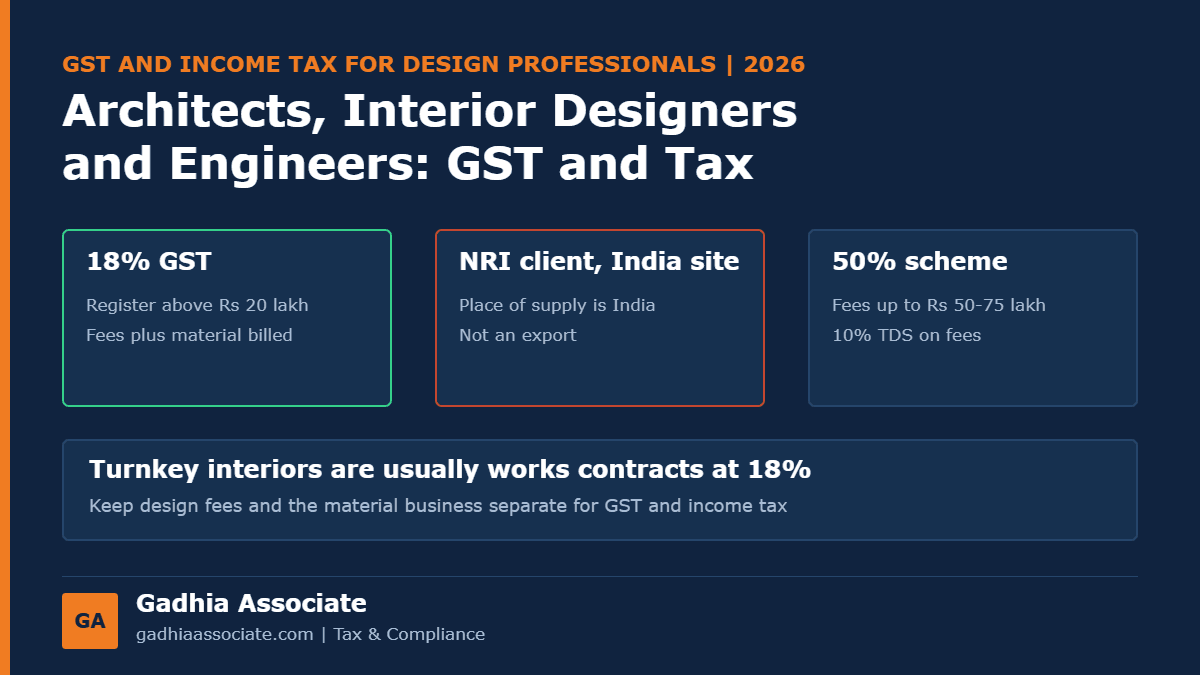
Architects, interior designers and engineers must charge 18% GST once turnover crosses Rs 20 lakh, and can declare 50% of fees as profit for tax.
Riddhi runs an interior design studio in Rajkot. Her design fees came to about Rs 14 lakh last year, and this year she has started buying furniture, laminates and lights for clients in her own name and billing them, which will take her total billing well past Rs 20 lakh. An Ahmedabad builder wants her to design its sample flats and has said it will deduct TDS, and an NRI client in London has asked her to design his new bungalow in Gondal, saying no GST should apply because he pays from abroad. She has never registered for GST.
Design and engineering practices across Saurashtra are busy with new homes, factories, showrooms and NRI bungalows, and many grow past the GST limit without noticing. GST and income tax both treat design fees and material supply differently. Here is how it works in 2026.
Short Answer: Architects, interior designers and engineers must register for GST once aggregate turnover crosses Rs 20 lakh in a year, counting fees and any furniture, material or turnkey work billed in their own name. Their services are taxed at 18%, and a turnkey interior job is usually a works contract at 18%. For work on a building, GST follows the location of the property, so designing a house in India for an NRI is not an export. For income tax, they can declare 50% of fees as profit under the presumptive scheme, with fees up to Rs 50 lakh, or Rs 75 lakh where cash receipts are within 5%. Business clients deduct 10% TDS on professional fees.
Our team handles GST registration, returns and income tax for architects, engineers and interior designers. Call or WhatsApp +91 82005 28355, or see the details at the end of this guide.
When GST registration is needed
- The Rs 20 lakh limit: registration is compulsory once aggregate turnover crosses Rs 20 lakh in a financial year; apply within 30 days. See GST registration limits.
- What counts: your fees plus anything billed in your own name, such as furniture, material and turnkey work.
- Clients in other states: services billed to clients in other states do not force registration below the limit.
- Goods to other states: sending furniture or other goods to a client in another state needs registration whatever your turnover.
- Registering early: builders and companies prefer registered vendors, and registration lets you claim credit for the GST you pay.
GST rates and billing
- Design and consultancy: architecture, interior design and engineering services are taxed at 18%.
- Turnkey interiors: a contract to design, supply and fit out a flat, shop or office is usually a works contract, taxed as a service at 18%, with credit for the GST on material.
- Loose furniture: furniture, lights or fittings sold separately are goods, taxed at the rate for those goods.
- Paying vendors for clients: where the bills are in the client's name and you recover only the actual cost as the client's pure agent, under a written agreement and shown separately on your invoice, that amount is not part of your taxable value.
- Stage-wise fees: raise the invoice when each stage is complete, and pay GST on any advance received before that.
- Small practices: with turnover up to Rs 50 lakh in the previous year and no inter-state work, you can opt to pay 6% of turnover instead, but you cannot charge GST or pass on credit, which builders and companies dislike.
NRI and foreign clients
- Work on a building: for design work on a property, the place of supply is where the property is, wherever the client lives.
- An NRI's house in India: designing a bungalow in Gondal for a client in London is not an export, so GST applies as for any other client.
- Exports: when the client is abroad and the work is for a building abroad, or is not tied to any property, such as product or machine design, payment in foreign currency usually makes it an export.
- LUT: exports can be billed without GST under a letter of undertaking filed online each year. See GST on export of services.
- Proof of payment: keep the bank's FIRC or remittance advice for every export invoice.
Income tax and the 50% scheme
- Specified professions: architecture, engineering, interior decoration and technical consultancy are professions for income tax.
- Presumptive scheme: with fees up to Rs 50 lakh, or Rs 75 lakh where cash receipts are within 5%, you can declare 50% as profit without detailed books. See sections 44AD and 44ADA.
- Material business: profit on furniture, material and turnkey contracts is business income, not professional fees, so keep separate accounts for it.
- Outside the scheme: keep full books, and get a tax audit if fees cross Rs 50 lakh. See tax audit under section 44AB.
- Advance tax: under the scheme, the whole advance tax can be paid by 15 March. See advance tax due dates.
TDS on your fees
- Professional fees: businesses and builders deduct 10% TDS once their payments to you cross Rs 50,000 in a year.
- Technical services: some clients treat engineering work as technical services and deduct 2%.
- Turnkey contracts: clients may deduct TDS as for a contractor, at 1% for individuals and 2% for firms and companies. See GST and income tax for contractors.
- Homeowners: individuals building their own house usually do not deduct TDS, unless their payments to you cross Rs 50 lakh in a year.
- Claim it: check that the TDS appears in your annual statement and claim it in your return. See AIS and Form 26AS.
Common mistakes
- Billing furniture and material in your own name without counting it in turnover.
- Treating projects in India for NRI clients as exports.
- Charging GST on bills before you are registered.
- Putting turnkey contract profit under the 50% professional scheme.
- Not claiming the TDS deducted by builders and companies.
- Forgetting to file a fresh LUT each year for foreign clients.
Back to Riddhi. With her fees and the material she will bill, her turnover will cross Rs 20 lakh this year, so she registers for GST now. Design fees are billed at 18%, the turnkey flat interiors are billed as works contracts at 18% with credit for the GST on material, and clients who prefer to buy their own furniture get bills from her vendors in their own names. The Gondal bungalow is billed with GST, because the property is in India. The builder deducts 10% TDS on her fees, which she claims in her return, and her design fees go under the 50% scheme while the material business has its own accounts.
How we help
- GST registration, returns and LUT for foreign clients
- Structuring fees, material billing and turnkey contracts
- Place of supply and export checks for NRI and foreign clients
- Income tax returns under the 50% scheme or with full books
- TDS reconciliation and advance tax
- Accounts and tax audit for growing practices
Gadhia Associate has been in practice since 2007 and has handled work for over 7,000 clients, with a 5.0 Google rating from more than 100 reviews. Architects, engineers and interior designers from Junagadh, Rajkot, Jamnagar, Morbi and Gondal come to our Junagadh office, where same-day appointments are available. Practices elsewhere in Gujarat are handled online.
Running a design or engineering practice? Set up your GST billing and income tax correctly before the next big project. Call or WhatsApp +91 82005 28355, or message us on WhatsApp. The first consultation is free.
Frequently asked questions
Do architects need GST registration?
Yes, once aggregate turnover crosses Rs 20 lakh in a financial year, or earlier if they send goods to another state.
What is the GST rate for interior designers?
18% on design fees, and usually 18% on turnkey interior contracts as works contracts.
Is GST charged on design work for NRI clients?
Yes, if the property is in India. The place of supply is where the property is, so it is not an export.
Can architects and engineers use the 50% presumptive scheme?
Yes, with fees up to Rs 50 lakh, or Rs 75 lakh where cash receipts are within 5% of the total.
What is the TDS rate on architects' fees?
10% on professional fees above Rs 50,000 a year from one client, or 1% to 2% where the work is paid as a contract.
Is material billed to clients part of GST turnover?
Yes, if it is billed in your name. Amounts paid only as the client's pure agent are not.
Position as of 27 November 2026, under the CGST and IGST Acts and the income tax law, which the Income-tax Act, 2025 carries forward from 2026-27. Rates and limits change, so check your own case before billing.