Income Tax Notice in 2026: Types Explained (143(1), 139(9), 142(1), 143(2), 148 and 245), Reply Timelines and How to Respond on the Portal
Income Tax Notice in 2026: What It Means and What To Do First
An income tax notice is usually a routine communication, not an accusation. Most notices in 2026 are automated intimations asking you to confirm a figure, correct a defect or explain a mismatch with data the department already holds. Read the section number, check the reply window, respond on the e-filing portal with proof, and most cases close without any demand.
At Gadhia Associate in Junagadh, Gujarat we see the same pattern every season: a taxpayer panics, then either ignores the notice or replies in a hurry. This guide explains each type of income tax notice, its purpose, your reply window and where to respond.
Why did I get an income tax notice?
Notices are triggered by data, not suspicion. The department receives your salary, interest, dividend, mutual fund and property data through the Annual Information Statement (AIS) and Form 26AS. When your return does not match, the system flags it.
- Savings or fixed deposit interest not declared
- TDS claimed that does not match Form 26AS
- A deduction claimed without the supporting proof expected
- Property, share or mutual fund sales in AIS but missing from the return
- Arithmetic errors, wrong ITR form, or an unverified return
- Random or risk-based selection for scrutiny
Before drafting any reply, download your AIS and Form 26AS for that year. Our earlier article on AIS vs Form 26AS explains how the two differ and why AIS often contains items 26AS does not.
What is a 143(1) intimation?
A Section 143(1) intimation is the automated summary sent after your return is processed. It places your figures beside the department's and shows the result: refund due, no demand, or tax payable. It is not a scrutiny notice.
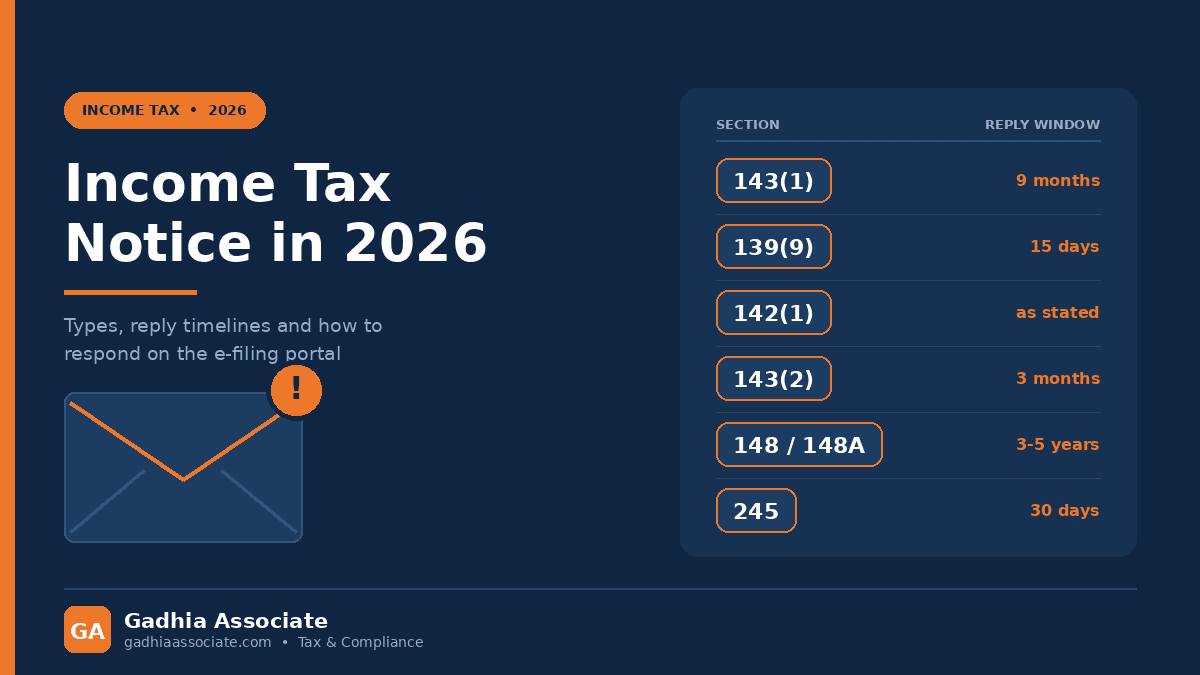
Only limited adjustments are possible: arithmetical errors, internally inconsistent claims, incorrect deductions and mismatches with data already held. The intimation is generally issued within nine months from the end of the financial year in which the return is filed. If you disagree, file a rectification request or a revised return.
An illustrative example
A taxpayer declares income of Rs 9,00,000 and expects a Rs 12,000 refund. The 143(1) intimation shows Rs 9,40,000 and a small demand. Checking AIS, she finds Rs 40,000 of fixed deposit interest from a second bank she forgot to include. Resolution: accept the addition, pay the differential tax with interest, note the FD for next year. Figures are illustrative only.
How many days do I have to reply to a defective return notice?
A Section 139(9) notice says your return is defective - a required schedule is blank, the audit report is missing, or income and tax figures do not tie up. You normally get 15 days from receipt to correct it, and can request an extension through the portal.
This one matters. If the defect is not cured in time, the return can be treated as invalid, as though never filed - bringing late filing consequences, loss of carry-forward of certain losses and delayed refunds. Fix a 139(9) notice first.
What does a 142(1) notice ask for?
Section 142(1) is an inquiry before assessment. The Assessing Officer uses it to ask you to file a missing return, or to produce accounts and specific information. The reply period is stated in the notice, commonly around 15 days. Where no return has been filed there is no fixed outer limit, so an old year can surface here.
What is the difference between 143(1) and 143(2)?
A 143(1) intimation is computer processing: issued for almost every return, no officer involved, nothing asked of you unless you disagree. A 143(2) notice is a scrutiny notice - your case has been selected for detailed examination and an officer will test your claims. It must generally be issued within three months from the end of the financial year in which the return is furnished. Put simply: 143(1) tells you the arithmetic result; 143(2) tells you the department wants evidence. Neither establishes wrongdoing.
Can I get a notice for an old year?
Yes, but only within limits and after a defined procedure. Section 148 deals with income escaping assessment. The Finance (No.2) Act 2024 tightened the reopening window: broadly three years from the end of the relevant assessment year, extended to around five years where the escaped income crosses the Rs 50 lakh threshold. The exact outer date depends on your assessment year.
Critically, a Section 148 notice cannot arrive out of the blue. Section 148A requires the officer to first give you a show-cause opportunity with the information relied upon, consider your reply and pass an order. A well-documented 148A reply frequently ends the matter before reassessment begins.
What are Section 245 and Section 156 notices?
Section 245 intimates that the department proposes to adjust your refund against an outstanding demand from an earlier year. You get an opportunity, typically 30 days, to agree or disagree. Do not let it lapse - many old portal demands are stale or already paid, and can be removed with proof. Section 156 is a demand notice stating the amount payable and the time allowed; if you dispute it, file an appeal within the prescribed period.
A compact rundown of each notice type
- 143(1) - automated processing result; respond only if you disagree
- 139(9) - cure the defect, normally within 15 days
- 142(1) - file the return or produce documents within the stated period
- 143(2) - scrutiny; generally issued within 3 months of the FY end
- 148A - show cause before reopening; reply with full documentation
- 148 - reassessment within the revised statutory window
- 245 - agree or object to refund set-off, usually within 30 days
- 156 - pay within the stated time or file an appeal
How do I respond to an income tax notice on the portal?
Assessment work is now faceless. There is no ward to visit; the exchange happens electronically through e-Proceedings, which is why deadlines are enforced strictly.
- Log in to the income tax e-filing portal with your PAN
- Open Pending Actions and then e-Proceedings to see every live notice
- Note the section, document identification number and response due date
- Download AIS and Form 26AS for that year and reconcile before drafting
- Draft a short factual reply with a clear index of attachments
- Upload legible PDFs - bank statements, contract notes, deduction proofs, challans
- Submit, then save the acknowledgement and transaction ID
- Need more time? Request an adjournment through the portal before the deadline
Keep your registered email and mobile number current - many escalations begin with a notice delivered correctly but never read. Our article on replying to GST notices covers the parallel process on the GST portal, since business taxpayers in Gujarat often face both in the same quarter.
What happens if I ignore an income tax notice?
Ignoring a notice does not make it disappear; it removes your ability to influence the outcome. If you do not respond to a 142(1) or 143(2), the officer can complete a best judgment assessment under Section 144 on the department's own estimates, which are rarely favourable. Penalties can follow for non-compliance and for under-reporting or misreporting, refunds can be withheld, demands recovered through bank attachment, and in serious wilful evasion cases prosecution is possible. That follows from silence, not from a single honest mistake.
Has the new Income-tax Act changed these section numbers?
Yes. The Income-tax Act, 2025 came into force on 1 April 2026 and renumbers provisions taxpayers have known for decades. The concepts - automated intimation, defective return, inquiry, scrutiny, reassessment with a prior show-cause stage, refund adjustment and demand - continue in substance, but the numbers on a notice may not be the familiar 143(1) or 148. Match the description to the process rather than relying on the number, and confirm the new section with your advisor.
Where else can Gadhia Associate support you?
If the notice touches capital gains, our Capital Gain Tax Calculator helps you sanity-check indexation and holding periods before replying. If your present setup no longer fits your scale, our Business Structure Advisor and Company Registration services are the next conversation. Ongoing filing and representation sit under our Income Tax services, and our GST Services cover the indirect tax side.
How Gadhia Associate Can Help
We handle income tax notices end to end for clients across India - reading the notice correctly, reconciling AIS and Form 26AS, drafting and uploading the reply, and representing you through faceless scrutiny, 148A proceedings and appeals. If a notice has landed in your inbox, book a free consultation with us before the deadline runs down.
This article reflects the position as of August 2026. Income tax provisions, section numbering under the Income-tax Act, 2025, and procedural timelines change through CBDT notifications, circulars and Finance Act amendments. Please confirm the position for your specific assessment year with a qualified professional before acting.