
Startup India Registration in 2026: DPIIT Recognition, Section 80-IAC Three-Year Tax Holiday, Angel Tax Abolition and Eligibility
Startup India Registration in 2026: The Short Answer
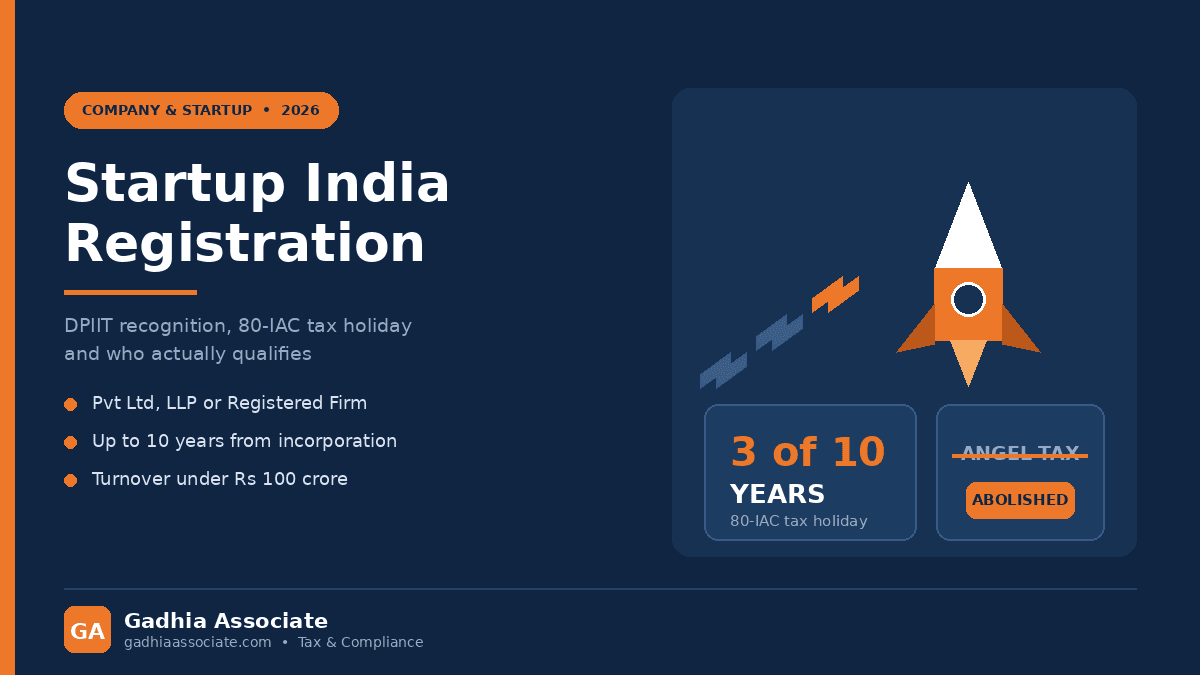
Startup India registration means obtaining DPIIT recognition for your company or LLP through the Startup India portal. It is free, fully online, and usually decided within a few working days. Recognition by itself does not give you a tax holiday - it makes you eligible to apply separately for the Section 80-IAC deduction, which allows 100% of profits to be deducted for three consecutive years out of your first ten.
Two things changed the picture recently. Budget 2025 extended the incorporation cut-off for 80-IAC eligibility to 1 April 2030. And angel tax under Section 56(2)(viib) was abolished with effect from AY 2025-26 by the Finance (No.2) Act 2024, removing the biggest valuation headache in Indian fundraising. This guide explains what Startup India registration gets you in 2026, who qualifies, and how the two approvals fit together.
What is DPIIT recognition?
DPIIT recognition is a certificate issued by the Department for Promotion of Industry and Internal Trade confirming that your entity qualifies as a "startup" under the government's official definition. It carries a recognition number and certificate that you quote when claiming any startup benefit.
It is the gateway document. Without it you cannot apply for the 80-IAC tax holiday, self-certify under the relaxed labour and environment regime, access IPR fast-tracking, or use the relaxed public procurement route. With it you are inside the scheme - but individual benefits still have their own application processes.
Who is eligible for Startup India?
The eligibility conditions are specific and worth checking honestly before you apply. An entity qualifies if it meets all of the following.
- Incorporated as a Private Limited Company, a Registered Partnership Firm, or a Limited Liability Partnership
- Not more than 10 years have passed since the date of incorporation or registration
- Annual turnover has not exceeded Rs 100 crore in any financial year since incorporation
- Working towards innovation, development or improvement of products, processes or services, or having a scalable business model with high potential for employment generation or wealth creation
- Not formed by splitting up or reconstruction of a business already in existence
That last condition catches people out. Carving an existing profitable division into a new company does not work, and neither does re-incorporating an existing trading business with the same customers and activity.
Does an LLP qualify as a startup?
Yes. An LLP is expressly covered by the DPIIT definition, as is a registered partnership firm. A sole proprietorship or an unregistered partnership is not. If you are a proprietor and want recognition, you will need to convert or incorporate first - our Business Structure Advisor and Company Registration services handle exactly this decision, since structure also affects funding, ESOPs and compliance cost for years afterwards.
How do I apply, and how long does DPIIT recognition take?
The application is made online at the Startup India portal. Create a profile, select "Get Recognised", and complete a single form covering entity details, directors or partners, and a short description of what makes your business innovative or scalable.
- Certificate of incorporation or registration certificate
- PAN of the entity
- Details of directors, partners or designated partners
- A brief write-up on the problem you solve and your solution
- Supporting proof - website, pitch deck, IP filings, awards, funding letters
- Authorised signatory details
There is no government fee. Decisions typically come within a few working days to a couple of weeks, though timelines vary with volume. Applications are most often returned because the innovation write-up is vague. Describe the specific problem, the specific solution and why it is different - three tight paragraphs beat three pages of adjectives.
What is the 80-IAC tax holiday, and is it the same as DPIIT recognition?
No, and this is the confusion we correct most often. These are two separate approvals, from two different authorities, with two different application processes.
DPIIT recognition is granted on a largely self-declared basis, is quick, and is open to all eligible entities incorporated within the last ten years. Section 80-IAC approval comes from the Inter-Ministerial Board after substantive scrutiny of your innovation and scalability, is far more selective, and applies only to startups incorporated on or before the cut-off date Budget 2025 extended to 1 April 2030. Many recognised startups never obtain 80-IAC approval; the certificate on your wall does not mean the deduction is yours.
Where 80-IAC is granted, the benefit is a deduction of 100% of profits and gains from the eligible business for three consecutive assessment years, which you may choose out of the first ten years from incorporation, subject to the conditions in the section. You apply for it separately through the Startup India portal after recognition.
An illustrative example of choosing your three years
A Gujarat-based SaaS company incorporated in 2026 loses money for four years, turns a small Rs 20 lakh profit in year five, then earns Rs 2 crore, Rs 5 crore and Rs 8 crore in years six, seven and eight. Claiming in year five would waste the relief. Selecting years six to eight - three consecutive years within the first ten - shelters Rs 15 crore instead. The choice of years is a planning decision, not an automatic one. Figures are illustrative only.
Is angel tax still applicable in 2026?
No. Section 56(2)(viib), commonly called angel tax, taxed a closely held company on the excess of share issue price over fair market value. It caused years of valuation disputes and hit genuine early-stage companies hardest. The Finance (No.2) Act 2024 abolished it with effect from assessment year 2025-26.
Two consequences follow. The abolition applies to all investor classes, so the earlier exemption route specific to DPIIT-recognised startups no longer decides a funding round. And valuation discipline still matters - FEMA pricing guidelines, Companies Act valuation requirements and transfer pricing all continue to apply. Angel tax is gone; valuation reports are not.
What other benefits come with DPIIT recognition?
- Self-certification of compliance under specified labour and environment laws, with relief from routine inspections for an initial period
- IPR support - fast-tracked patent examination, facilitator assistance, and a substantial rebate on patent filing fees
- Public procurement relaxations - exemption from prior turnover and experience criteria in many government tenders, plus GeM access
- Easier winding up under the fast-track insolvency route for eligible startups
- Fund of Funds for Startups - indirect access to capital through SEBI-registered alternative investment funds
- Carry-forward of losses under Section 79 - relaxed shareholding continuity conditions for eligible startups, so a funding round that changes the shareholder base does not automatically kill accumulated losses
- Access to state-level startup schemes, incubators and mentorship networks
The Section 79 relaxation deserves more attention than it gets. In an ordinary closely held company, losses lapse if more than a specified proportion of shareholding changes hands. For eligible startups the condition is relaxed within the prescribed period - exactly what founders need when successive rounds dilute the original holders.
Does location matter, and what about Gujarat?
DPIIT recognition is a national scheme, so where you are registered makes no difference to eligibility - but it changes what you can stack on top. Gujarat runs its own startup policy with seed support administered through recognised nodal institutions, and GIFT City in Gandhinagar has become a serious option for fintech, fund management and businesses with a genuine international dimension under the IFSCA regime. We advise founders from Junagadh and across Gujarat choosing between a straightforward domestic private limited structure and something built around GIFT City; the answer depends on where your customers and investors actually are.
A practical sequence for 2026
- Choose the right structure and incorporate - our Company Registration service handles this end to end
- Complete PAN, TAN, bank account and, where applicable, registration under our GST Services
- Apply for DPIIT recognition with a sharp innovation write-up
- Apply separately to the Inter-Ministerial Board for 80-IAC once recognition is granted
- Keep annual filings, ROC compliance and Income Tax services current - benefits depend on continued eligibility
- Plan founder and investor exits early; our Capital Gain Tax Calculator is useful when secondary sales come up
How Gadhia Associate Can Help
We provide complete startup registration support - advising on the right entity, incorporating the company or LLP, filing the DPIIT recognition application, drafting the innovation narrative, and taking the separate 80-IAC application to the Inter-Ministerial Board. We also handle ongoing ROC, GST and income tax compliance so your recognition stays valid. Book a free consultation with our team in Junagadh and we will tell you honestly whether your business fits the definition before you spend time applying.
This article reflects the position as of August 2026. Startup India eligibility, Section 80-IAC conditions and cut-off dates change through DPIIT and CBDT notifications and Finance Act amendments. Please confirm the current position with a qualified professional before acting.