GST for Influencers and Content Creators in India 2026: Registration Threshold, 18% on Brand Deals, Export of Services and LUT for Foreign Income
GST for influencers and content creators in India: the short answer
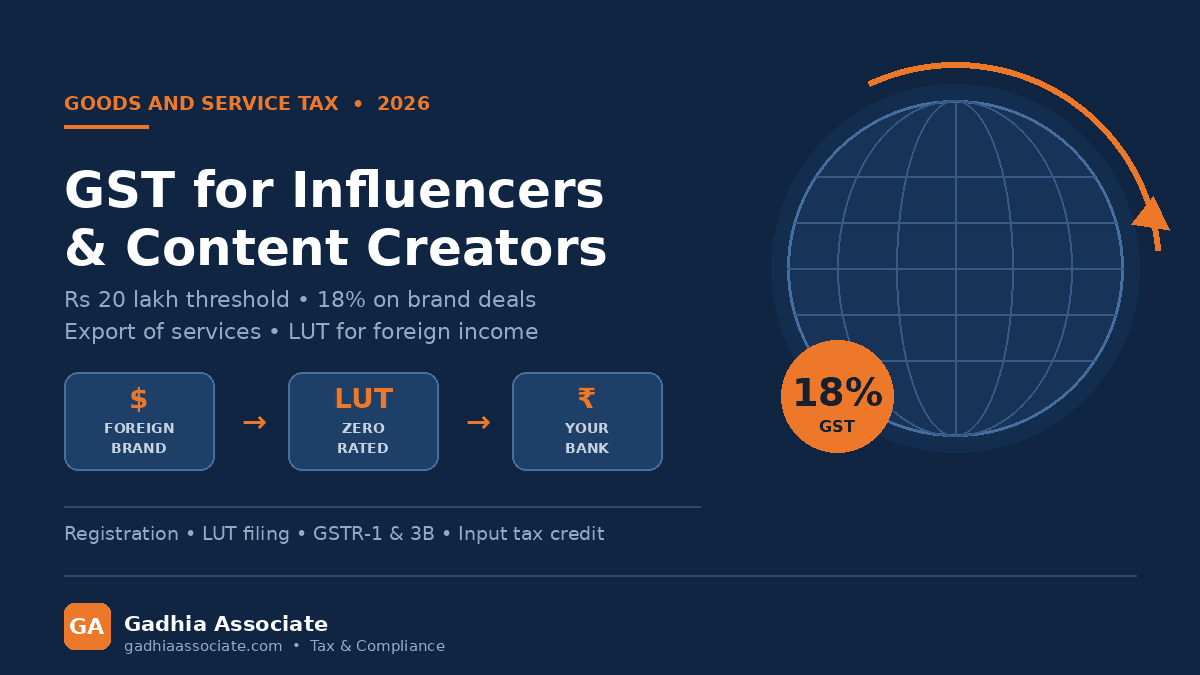
GST for influencers and content creators in India applies because promotion, advertising and content services are taxable supplies. Once your aggregate turnover crosses Rs 20 lakh in a financial year, or Rs 10 lakh in special category states, you must register and charge 18% GST on brand deals to Indian clients. Money you earn from foreign brands and from platforms like Google AdSense is generally treated as an export of services, which is zero-rated, and you can supply it without paying IGST by filing a Letter of Undertaking, or LUT.
That is the whole framework in one paragraph. The details below are where creators actually lose money: barter deals, place of supply, foreign exchange proof and input tax credit.
Do influencers need GST registration?
Registration is mandatory once your aggregate turnover exceeds the threshold. Aggregate turnover is computed on an all-India PAN basis and includes taxable supplies, exempt supplies, exports and inter-state supplies. Creators routinely underestimate it because they count only brand deal invoices and forget AdSense, affiliate income and the value of barter.
There are also situations where registration is required or advisable even below the threshold. If you make an inter-state supply of services, if you are liable under reverse charge, if a brand or agency insists on a GSTIN before onboarding you as a vendor, or if you want to claim input tax credit and issue export invoices under an LUT, registration becomes necessary or commercially unavoidable. Many creators register voluntarily well before Rs 20 lakh simply because larger brands will not raise a purchase order for an unregistered vendor.
Signs you should register now
- Your combined brand, ad, affiliate and barter revenue is approaching Rs 20 lakh
- Brands or agencies are asking for a GSTIN on your invoices
- You earn from foreign clients and want to export without blocking cash in IGST
- You are buying serious equipment and want to recover the tax on it
- You are liable to pay tax under reverse charge on any inward supply
What is the GST rate on brand promotion?
Influencer marketing, brand promotion, advertising space, sponsored content and content licensing are services taxed at 18%. If you quote a brand Rs 1,00,000 for a reel, your tax invoice reads Rs 1,00,000 plus Rs 18,000 GST, split as CGST and SGST for a client in Gujarat and charged as IGST for a client in Maharashtra or Karnataka. The GST is not your income; you collect it and remit it. Use our GST Calculator to get the inclusive and exclusive figures right before you send a quote, because agreeing to an all-inclusive fee without checking is how creators end up funding the tax themselves.
Is GST applicable on barter deals?
Yes, and this is the most commonly missed liability in the creator economy. Under GST, a supply made for a consideration that is not wholly in money is still a supply. When a brand sends you a product, a stay or an experience in exchange for content, you have supplied a promotional service and the product is your consideration. That supply has to be valued, typically at the open market value of what you received, and reported.
Practically that means recording the fair value of every gifted item you promote, treating it as turnover for threshold purposes, and issuing a tax invoice for it once you are registered. Keep the brand email, the product listing price and the deliverable brief on file. A folder of screenshots is much cheaper than an assessment two years later.
Do I pay GST on income from foreign brands?
Export of services is zero-rated. So no, you generally do not charge 18% to a foreign brand or on AdSense revenue, provided the transaction genuinely qualifies as an export of services. The conditions broadly require that the supplier is located in India, the recipient is located outside India, the place of supply is outside India, payment is received in convertible foreign exchange, and the supplier and recipient are not merely establishments of the same person.
For most creator services supplied to a foreign business recipient, the place of supply follows the recipient location, which puts it outside India. But there are exceptions in the place of supply rules, and if a foreign brand Indian subsidiary contracts with you and pays in rupees, that is a domestic supply attracting 18%, not an export. Read the contracting entity name on the purchase order, not the logo on the campaign deck.
Documentation carries the claim. Retain the foreign invoice, the SWIFT or remittance advice, and the FIRC or bank realisation certificate evidencing receipt in foreign currency. Without proof of foreign exchange receipt, the zero-rating can be denied.
What is an LUT and do I need one?
An LUT is a Letter of Undertaking filed on the GST portal in which you undertake to fulfil the export conditions. With a valid LUT in force you export services without paying IGST. Without one, you must pay IGST on the export invoice and then apply for a refund.
LUT route versus refund route: under the LUT route no tax leaves your bank account, your invoice shows zero tax, and you still claim refund of unutilised input tax credit if you have accumulated credit. Under the refund route you pay IGST on every export invoice out of your own working capital and wait for a refund that can take weeks or months of follow-up. For a creator with recurring AdSense credits and overseas brand deals, the LUT is clearly better. It is filed for a financial year and must be renewed, so put a reminder in your calendar each April.
Domestic brand deal versus export of service: the comparison
Consider the same Rs 2,00,000 campaign. If the client is an Indian company, you raise a tax invoice for Rs 2,00,000 plus Rs 36,000 GST, collect Rs 2,36,000, and pay the Rs 36,000 to the government after adjusting input tax credit. If the client is a Singapore company paying in US dollars and you hold a valid LUT, you raise a zero-rated invoice for the equivalent of Rs 2,00,000 with no GST, mark it as an export under LUT, and receive the full amount, while the input tax credit on your camera and software still accumulates and can be claimed as a refund. Same work, very different cash flow, entirely driven by who the recipient is and whether your paperwork is in order.
GST for influencers: invoicing and return filing obligations
Once registered you must issue proper tax invoices carrying your GSTIN, the client GSTIN, invoice number and date, description of service, HSN or SAC code, taxable value and tax split. Export invoices should be endorsed as a supply meant for export under LUT without payment of integrated tax.
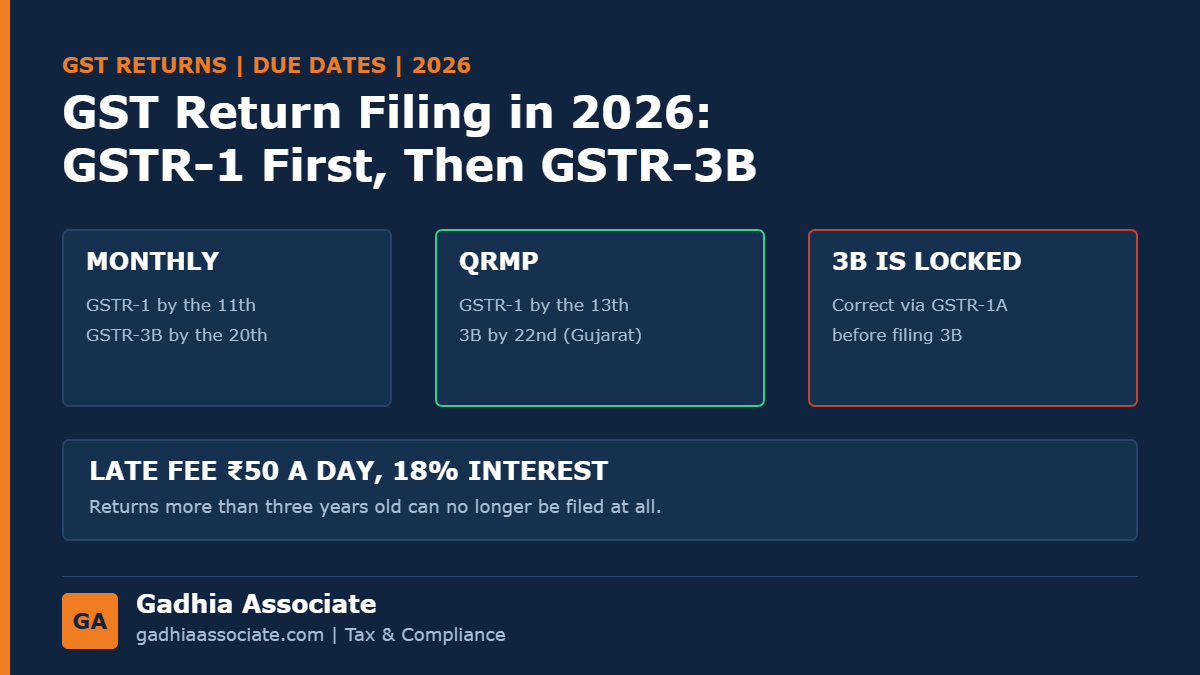
- File GSTR-1 with outward supply details for each period, monthly or quarterly under QRMP
- File GSTR-3B summary return and pay the net tax
- File the annual return where applicable to your turnover
- Reconcile input tax credit against GSTR-2B every period
- Renew your LUT at the start of each financial year
- File nil returns even in months with no income
Late filing attracts late fees and interest, and a lapsed return history blocks other portal functions, so consistency matters more than volume.
Can creators claim input tax credit?
Yes. Registered creators can claim ITC on GST paid on genuine business inputs: cameras, lenses, lighting, computers, editing software subscriptions, cloud storage, internet and mobile bills in the business name, studio rent, agency and professional fees, and paid advertising. The invoice must carry your GSTIN, the supplier must have reported it so it appears in your GSTR-2B, and the item must be used for business. Personal purchases and blocked credits do not qualify. For an exporter with mostly zero-rated output, this accumulated credit is refundable, which turns a compliance chore into real money back.
A worked example, illustrative numbers only
A creator based in Junagadh earns Rs 14,00,000 from Indian brand deals, Rs 9,00,000 from AdSense and foreign sponsorships, and receives barter products valued at Rs 2,00,000. Aggregate turnover is about Rs 25,00,000, so registration is required. GST at 18% is charged on the Rs 14,00,000 domestic revenue and on the Rs 2,00,000 barter value, roughly Rs 2,88,000 of output tax. The Rs 9,00,000 foreign revenue is invoiced at zero tax under an LUT. Input tax credit on equipment and software purchased during the year reduces the cash payable. Figures are illustrative and simplified; your actual liability depends on your invoices, place of supply and eligible credits.
How Gadhia Associate can help
Gadhia Associate works with creators, YouTubers and freelancers across Gujarat and India from our base in Junagadh. Our GST Services cover registration, LUT filing and renewal, export invoicing, barter valuation, monthly and quarterly returns, ITC reconciliation and refund claims for zero-rated supplies. We also handle Income Tax services for creators, and our GST Calculator and Business Structure Advisor tools help you price your work and decide when to move from proprietorship to a company. Creators get a free first consultation. Send us your last twelve months of invoices and payouts and we will tell you exactly where you stand.
This article reflects the position as of August 2026. GST rules, rates and procedures change through CBIC notifications and circulars. Please confirm your specific position with a qualified professional before acting.