Crypto Tax in India 2026: 30% Tax on VDA Gains, 1% TDS under Section 194S, Loss Set-Off Rules and Schedule VDA in Your ITR
Crypto Tax in India 2026: The Short Answer
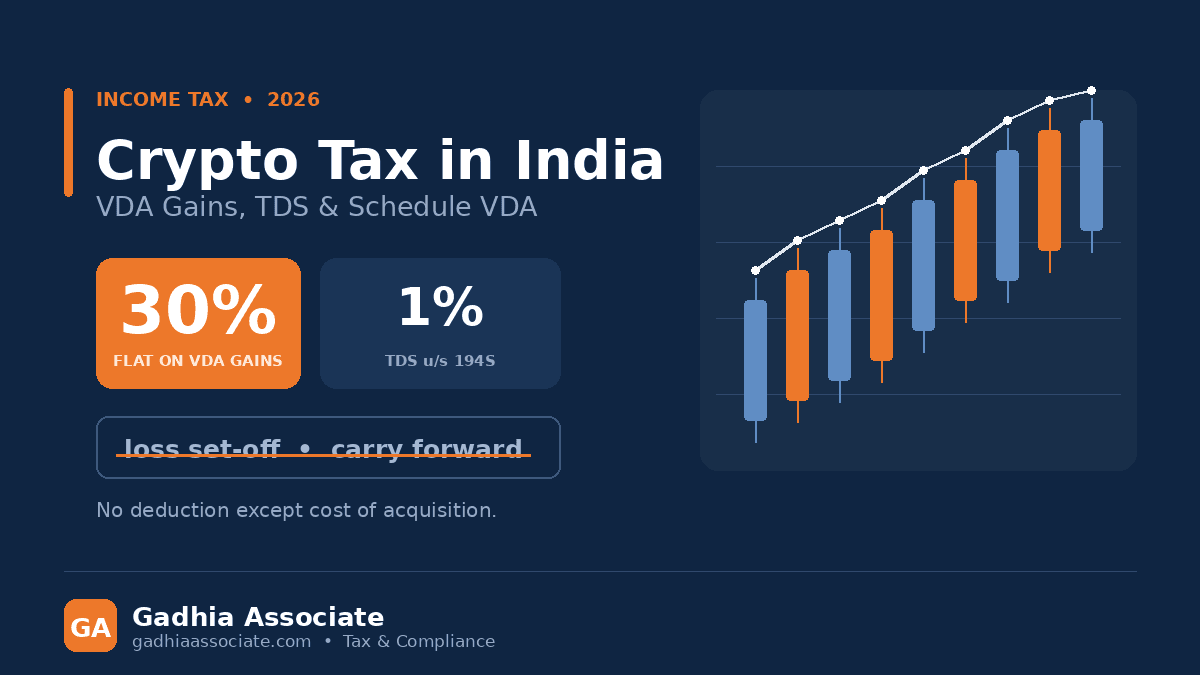
Crypto tax in India is simple to state and painful to plan around: gains on the transfer of a Virtual Digital Asset (VDA) are taxed at a flat 30% plus applicable surcharge and 4% cess, the only deduction allowed is the cost of acquisition, and losses from one coin cannot be set off against gains from another or against any other income. On top of that, a 1% TDS under Section 194S is deducted when you transfer a VDA, and every transaction has to be reported line by line in Schedule VDA of your ITR.
That regime came in through Section 115BBH of the Income-tax Act, 1961. With the Income-tax Act, 2025 in force from 1 April 2026, the same provisions continue under renumbered sections of the new Act — the rate, the no set-off rule, TDS and Schedule VDA reporting are all unchanged in substance. We use the familiar 115BBH and 194S labels below, with the corresponding provisions of the 2025 Act now applying.
How much tax do I pay on crypto in India?
Thirty percent of your net gain on each transfer, plus surcharge if applicable and 4% health and education cess. It does not matter whether you held the coin for three days or three years, and it does not matter what your slab is. A person with total income below the basic exemption limit still pays 30% on a VDA gain, because the special rate overrides the slab.
The taxable amount is sale consideration minus cost of acquisition. Nothing else comes off — exchange fees, brokerage, gas fees, charting subscriptions, interest on borrowed money. That is deliberate, and it is the biggest reason real crypto tax bills come out higher than traders expect.
Crypto tax in India versus normal capital gains: what actually differs
Sell listed shares or property and you can deduct transfer expenses, claim exemptions by reinvesting under the capital gains exemption provisions, and set off a loss against other capital gains with the balance carried forward for several years. Holding period matters, and the rate varies with it.
Under the VDA regime none of that exists: no holding period distinction, no indexation, no reinvestment exemption, no expense deduction beyond cost, no set-off, no carry-forward. Two investors with identical economics — one in shares, one in tokens — end up with very different outcomes on the same rupee of profit. Our Capital Gain Tax Calculator helps on the equity and property side; for VDA the arithmetic is deliberately blunt, and our Income Tax services team runs the reconciliation for clients across Junagadh and Gujarat every season.
Can I set off crypto losses against crypto gains?
No. This is the rule people most often get wrong. Loss from the transfer of one VDA cannot be set off against gain from the transfer of another VDA, cannot be set off against salary, business income, house property or any other head, and cannot be carried forward to a later year. Each profitable transfer is taxed on its own.
Illustrative example. Suppose in a year you sell Coin A for Rs 6,00,000 having bought it for Rs 4,00,000, giving a gain of Rs 2,00,000. In the same year you sell Coin B for Rs 1,00,000 having bought it for Rs 3,00,000, giving a loss of Rs 2,00,000. Economically you are flat. For tax, the Rs 2,00,000 gain on Coin A is taxed at 30% — roughly Rs 60,000 plus cess — and the Rs 2,00,000 loss on Coin B is simply ignored and dies in that year. Round numbers, illustrative only, but that is exactly how the regime works.
What is Section 194S TDS and who deducts it?
Section 194S requires 1% TDS on consideration paid for the transfer of a VDA. On an Indian exchange, the exchange itself normally deducts and deposits it, and you see it reflected in your Form 26AS and AIS. In a peer-to-peer or off-exchange transfer, the buyer is responsible for deducting and depositing, generally through the prescribed challan-cum-statement route.
The thresholds are Rs 50,000 in a financial year for a "specified person" — broadly an individual or HUF without business turnover above the audit-linked limits — and Rs 10,000 in a financial year for everyone else. Once you cross the threshold, TDS applies to the transfers, not merely to the excess. TDS is not the final tax. It is only 1%, while your liability is 30%, so it is a credit you claim in the return, and if your overall position leaves excess TDS you claim a refund. Crucially, TDS is deducted on the consideration, not on the profit — so a loss-making trade still suffers TDS.
Do I have to report crypto if I made a loss?
Yes. Reporting is not optional and does not depend on whether you profited. Schedule VDA in ITR-2 and ITR-3 asks for transaction-level detail: date of acquisition, date of transfer, cost of acquisition, consideration received and the resulting income. Loss transactions are disclosed even though the loss gives you no relief. Because exchanges report to the department and TDS entries land in your AIS, a return that omits crypto activity while the AIS shows Section 194S deductions is an easy mismatch for the system to flag.
The department has steadily tightened this. Exchange reporting, 194S TDS trails and matching against filed returns have made undisclosed crypto income far more visible, and taxpayers have received notices asking them to reconcile AIS crypto entries with their returns. If you traded and did not disclose, fix it before a notice arrives.
Is crypto received as a gift taxable?
Yes, in the recipient's hands. A VDA received without consideration, or for inadequate consideration, is taxed as income from other sources under the ordinary gift provisions, with the usual relief for gifts from specified relatives and on occasions such as marriage. The value taken is the fair market value on the date of receipt. That value then becomes your cost of acquisition when you later sell the coin, and the sale itself is taxed at 30% under the VDA regime. Airdrops received free of cost are treated on the same logic.
What about mining, staking and airdrop rewards?
Where rewards are received in the form of tokens, the accepted position is that the fair market value on the date of receipt is offered as income from other sources at slab rates, and that value becomes the cost of acquisition for the eventual sale, which is then taxed at 30%. For self-mined coins, no cost of acquisition is allowed and infrastructure or electricity costs are not deductible. All of this only holds up if the documentation holds up — wallet-level records, dated receipt values and a consistent valuation source.
Are crypto gains business income or capital gains for frequent traders?
For the 30% rate the distinction matters less than people assume, since the special rate applies to income from transfer of VDAs either way. It matters for surrounding compliance: a person treating crypto activity as a business may attract books of account and audit obligations and files ITR-3 rather than ITR-2. Frequency, borrowed funds and scale push towards a business characterisation. If you are considering trading through a firm, LLP or company, our Business Structure Advisor discussion is worth having before the year starts.
Crypto compliance checklist for the year
- Download full trade statements from every exchange and wallet you used, including closed accounts.
- Build a transaction-wise register: date acquired, date transferred, cost, consideration, gain or loss.
- Reconcile Section 194S TDS in Form 26AS and AIS against your own records, exchange by exchange.
- Value every airdrop, staking reward and mined coin in rupees on the date of receipt and keep the source of that value.
- Identify gifts received and check whether the relative or occasion exemption applies.
- Report every transfer in Schedule VDA — including loss-making ones.
- Do not set off crypto losses anywhere; do not attempt to carry them forward.
- Retain records for the full statutory period; crypto reconciliation notices often arrive years later.
How Gadhia Associate Can Help
We handle crypto and VDA reporting for investors, active traders and NRIs from our office in Junagadh, Gujarat, and remotely across India. We rebuild transaction registers from raw exchange data, reconcile 194S TDS against AIS, prepare Schedule VDA correctly, respond to mismatch notices and advise on structure if trading has grown into a business. Our GST Services and Income Tax services teams work together so nothing falls between the two. Book a free consultation with Gadhia Associate.
This article reflects the position as of August 2026. Tax law, rates, thresholds and reporting formats change through CBDT notifications, circulars and finance legislation, and the Income-tax Act, 2025 has renumbered several provisions. Please confirm your specific position with a qualified professional before acting.