GST Composition Scheme in 2026: Turnover Limits, 1% and 5% Rates, CMP-08 and GSTR-4 Filing, and When You Should Not Opt In
What is the GST composition scheme?
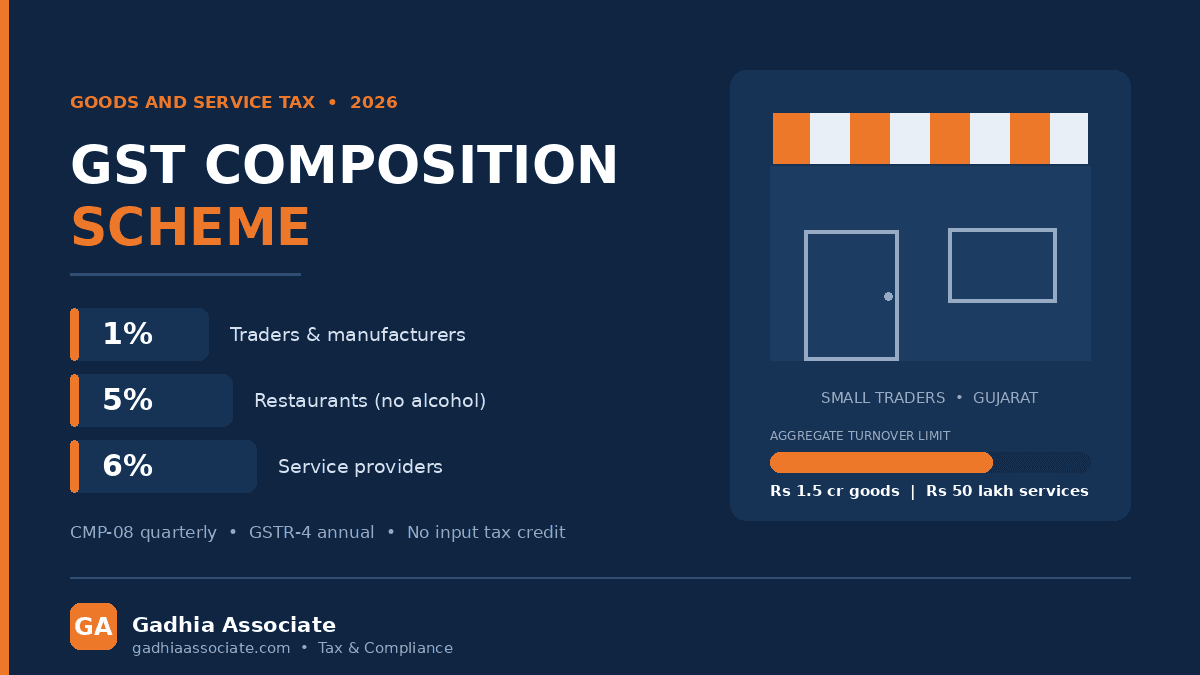
The GST composition scheme is a simplified route for small businesses: instead of charging GST on every invoice and tracking input tax credit, you pay a flat percentage of your turnover, file one short quarterly statement and one annual return. Traders and manufacturers pay 1%, restaurants not serving alcohol pay 5%, and a separate option for service providers is taxed at 6%. The trade-off is that you cannot collect GST from customers, cannot claim input tax credit, and cannot sell outside your state.
For a kirana shop in Junagadh, a cloth trader in Rajkot or a small restaurant anywhere in Gujarat, that trade-off is usually worth it. For a wholesaler selling to GST-registered buyers, it usually is not. This article explains exactly where the line falls.
Who can opt for the GST composition scheme in 2026?
Eligibility runs on aggregate turnover in the preceding financial year, computed PAN-India across all your GSTINs.
- Goods - traders and manufacturers: aggregate turnover up to Rs 1.5 crore
- Special category states (including several North-Eastern states and Himachal Pradesh): Rs 75 lakh
- Restaurant service (not serving alcohol): treated with the goods limit of Rs 1.5 crore
- Service providers and mixed suppliers, under the separate composition option for services: Rs 50 lakh
Gujarat is not a special category state, so businesses in Junagadh work with the Rs 1.5 crore limit for goods and Rs 50 lakh for the services option.
Who cannot opt in?
The exclusions matter more than the limits, because crossing one of them invalidates the whole option:
- Manufacturers of certain notified goods, including ice cream and other edible ice, pan masala and tobacco products
- Anyone making inter-state outward supplies of goods or services
- Anyone supplying through an e-commerce operator required to collect tax at source
- Casual taxable persons and non-resident taxable persons
- Suppliers of goods or services not leviable to tax under GST
One more rule catches people out: the option is PAN-linked. If you hold several registrations on the same PAN, all of them must be under composition, or none can be.
What is the GST rate under the composition scheme?
Three rates cover almost every case. Manufacturers and traders pay 1% of turnover in the state or union territory - in practice split as 0.5% CGST and 0.5% SGST. Restaurants and similar food service that do not serve alcohol pay 5%, split 2.5% and 2.5%. Service providers and mixed suppliers under the separate services option pay 6%, split 3% and 3%.
Read those percentages carefully: they are on turnover, not on margin and not on profit. A trader with a 4% gross margin who pays 1% of turnover is handing over a quarter of the margin. That is why the scheme suits businesses with healthy margins and retail customers, and punishes thin-margin, high-volume operations. Our GST Calculator is useful for running your own numbers before you commit.
Can a composition dealer claim input tax credit?
No. A composition dealer cannot claim input tax credit on purchases, and equally cannot collect GST from customers. The tax you pay under CMP-08 comes out of your own pocket, treated as a cost of doing business rather than something passed down the chain.
The knock-on effect is on documentation. A composition dealer issues a bill of supply, not a tax invoice, and must state on it, and on every notice and signboard at the place of business, that they are a composition taxable person not eligible to collect tax on supplies. This is checked during inspections and the omission is an easy penalty.
Composition versus regular scheme: how do they actually compare?
Under the regular scheme, you charge GST on each invoice at the applicable rate, claim credit on your purchases, file GSTR-1 and GSTR-3B monthly or quarterly, and pay only the net difference. Your compliance load is heavy but your customers get credit, so GST-registered buyers happily deal with you, and you can sell across state borders and on e-commerce platforms without restriction.
Under composition, you charge nothing extra, absorb 1%, 5% or 6% of turnover yourself, claim no credit, issue a bill of supply, file CMP-08 quarterly and GSTR-4 annually, and stay inside your own state. Your compliance load is light and your accounting is simple, but a registered buyer gets no credit from you, which makes you roughly 18% more expensive to them than a regular supplier at the same price.
The decision therefore has almost nothing to do with turnover and almost everything to do with who your customers are. Sell to end consumers - a kirana store, a tailor, a small restaurant, a hardware retailer - and composition is efficient. Sell B2B and composition costs you business.
How do I opt in? Form CMP-02 and its timing
An existing regular taxpayer switches by filing Form GST CMP-02 on the portal before the beginning of the financial year for which the option is to take effect - in practice, by 31 March for the year starting 1 April. The option then runs for the whole year; you cannot dip in and out mid-year. A dealer opting in from a regular registration also has to reverse credit on stock held, generally through Form ITC-03, within the prescribed time.
A new applicant can choose composition at the time of registration itself in Form GST REG-01, which is the cleaner route if you know from day one that you are a retail business.
What is CMP-08 and when is GSTR-4 due?
Form GST CMP-08 is a quarterly statement-cum-challan in which you declare your turnover for the quarter and pay the tax. It is due by the 18th of the month following the quarter - so 18 July, 18 October, 18 January and 18 April. It is short: a handful of figures, no invoice-level detail.
Form GSTR-4 is the annual return, due by 30 April following the end of the financial year. All four CMP-08 statements for the year must be filed before GSTR-4 can be submitted. Late filing of either attracts late fee and interest, so the quarterly discipline matters.
Does reverse charge still apply under composition?
Yes, and this catches many small dealers. Composition does not switch off reverse charge. Where you receive notified supplies - for example goods transport agency services, legal services from an advocate, or supplies from certain unregistered persons where notified - you pay GST at the normal applicable rate under reverse charge, in addition to your 1%, 5% or 6%. And, being a composition dealer, you cannot claim credit of that reverse charge tax either. Budget for it.
A worked example (illustrative only)
Consider a hardware trader in Junagadh registered under composition. Quarterly turnover for the July to September quarter is Rs 20,00,000. Tax at 1% is Rs 20,000, split as Rs 10,000 CGST and Rs 10,000 SGST, paid through CMP-08 by 18 October. No GST is charged on any bill of supply issued to customers, and no credit is claimed on purchases from suppliers. Across four similar quarters the annual tax is roughly Rs 80,000 on Rs 80,00,000 of turnover, reported in GSTR-4 by 30 April. Figures are illustrative and rounded.
What happens if I cross the turnover limit?
The option ends from the day turnover exceeds the limit - not from the next quarter and not from the next year. You must file Form GST CMP-04 to intimate withdrawal within the prescribed period, and from that day you are a regular taxpayer: charging GST on invoices, issuing tax invoices, and filing GSTR-1 and GSTR-3B.
The compensating benefit is that you can claim input tax credit on inputs, semi-finished and finished goods held in stock on the date of transition by filing Form GST ITC-01 within the prescribed time. Miss that window and the credit is simply lost. If your turnover is anywhere near Rs 1.5 crore, track it monthly rather than discovering the breach at year end.
When should you not opt in?
- Your customers are GST-registered businesses who need input tax credit
- You sell, or plan to sell, outside Gujarat
- You sell on Amazon, Flipkart, Zomato or any e-commerce platform collecting TCS
- Your margins are thin and 1% of turnover is a large share of profit
- You buy heavily taxed inputs and would benefit from credit
- Your growth will take you past the limit mid-year anyway
How Gadhia Associate can help
We advise small traders, restaurants and service providers across Junagadh and Gujarat on whether composition genuinely saves money in their situation, and then run the compliance - CMP-02 filing, quarterly CMP-08, annual GSTR-4, CMP-04 and ITC-01 on transition, and clean bill-of-supply formats. Our GST Services cover this end to end, our GST Calculator helps you model the choice, and if you are still deciding on proprietorship, LLP or a private limited setup, our Business Structure Advisor and Income Tax services tie the whole picture together. Book a free consultation and bring last year's turnover figure.
Position as of August 2026. GST rates, turnover limits, forms and due dates change through CBIC notifications and GST Council decisions. Please confirm the current position with a qualified professional before acting on this article.