HUF in 2026: How to Create a Hindu Undivided Family, PAN and Deed, Tax Benefits, Clubbing Traps and Partition Rules
HUF in 2026: The Short Answer
A Hindu Undivided Family (HUF) is a separate assessee under Indian income tax law with its own PAN, its own basic exemption limit and its own slab rates. It comes into existence automatically when a Hindu, Sikh, Jain or Buddhist man marries and a family exists; a written deed and an opening corpus are used in practice to evidence it, not to magically create it. Used correctly, an HUF gives a family a second tax file. Used carelessly, the clubbing provisions wipe out the entire benefit.
This guide explains how to create an HUF in 2026, how to get its PAN and deed in place, what tax benefits are genuinely available, the clubbing trap that catches most first-timers, and how partition works when the family decides to wind it up.
What exactly is an HUF and who can form one?
An HUF is not a company and not a partnership. It is a status recognised by Hindu personal law and separately recognised by the Income-tax Act as a distinct "person". A family governed by Hindu law can have an HUF; the Act extends the same treatment to Sikh, Jain and Buddhist families. A single unmarried person cannot form one, because there is no "family" yet.
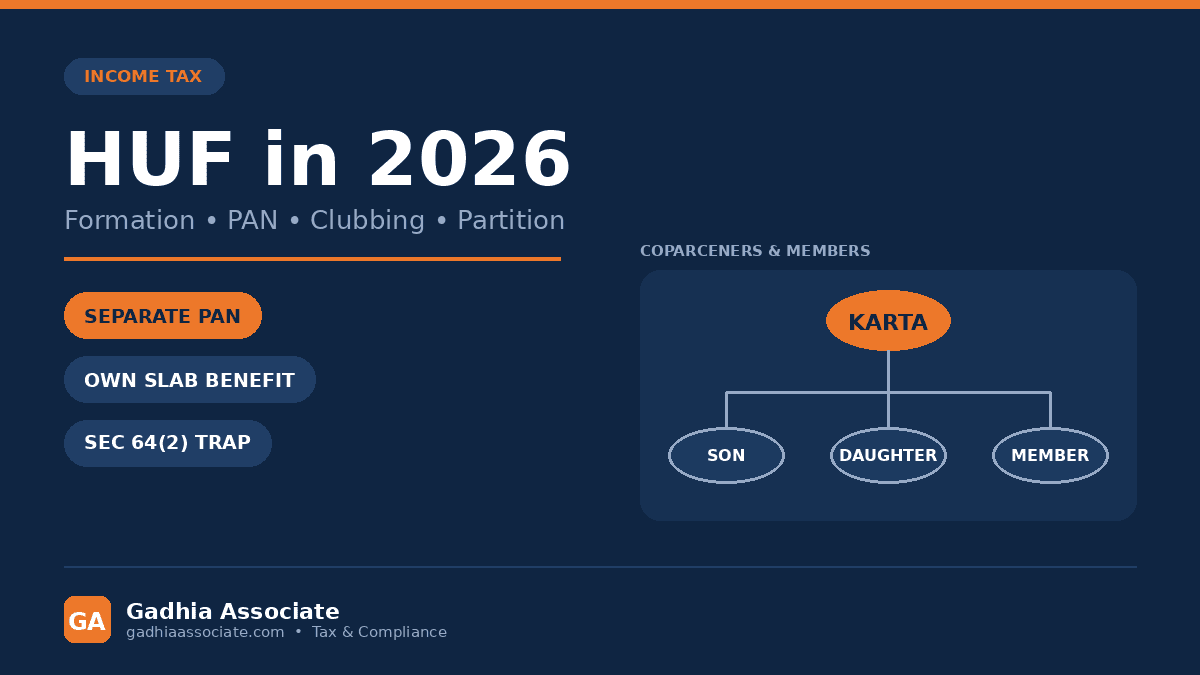
Inside an HUF there are three roles worth understanding:
- Karta — the manager who runs the affairs of the family, signs returns, operates the bank account and represents the HUF.
- Coparceners — those who acquire an interest by birth and can demand a partition. Since the Hindu Succession (Amendment) Act, 2005, daughters are coparceners by birth on the same footing as sons.
- Members — a wider circle including, for example, wives of coparceners, who are members and share in maintenance but are not coparceners.
Can a daughter be a karta?
Yes, in principle. The karta must be a coparcener, and since 2005 a daughter is a coparcener. Where a daughter is the senior-most living coparcener, courts have recognised that she can act as karta. Note that she remains a coparcener in her father's HUF even after marriage, while also becoming a member of her husband's HUF.
How do I create an HUF and register it in 2026?
The practical steps are short, but every one of them matters if you want the HUF to survive scrutiny:
- Execute an HUF deed on stamp paper declaring the name of the HUF (usually "Karta's name HUF"), the date of existence, the karta, the coparceners and members, and the initial corpus.
- Apply for a separate PAN in the name of the HUF, signed by the karta.
- Open a separate bank account in the HUF's name. Never mix HUF money with individual money.
- Bring in a corpus from an acceptable source — ancestral property, assets received on partition of a larger HUF, a gift from a non-member, or property received under a will that specifically favours the HUF.
- Maintain books, investment records and a simple asset register in the HUF's name.
- File the HUF's own return every year — ITR-2 where there is no business income, ITR-3 where the HUF carries on a business or profession, with tax audit if the turnover thresholds are crossed.
Does an HUF need a separate PAN?
Yes. Because the HUF is a separate assessee, it must hold its own PAN and file its own return. Using the karta's individual PAN for HUF income defeats the whole structure and invites the department to treat the income as the karta's.
What are the tax benefits of an HUF?
The core benefit is simple: an additional tax file in the family. The HUF gets its own basic exemption limit and travels up its own slab ladder instead of stacking on top of the karta's income. On top of that, the HUF can claim its own Chapter VI-A deductions in its own right — for instance life insurance premium and eligible investments in the nature of 80C, health insurance premium in the nature of 80D for its members, and savings interest deduction in the nature of 80TTA where applicable. An HUF can also own a house property in its own name, which is useful where a family already holds property in individual names.
An HUF can run a business, hold shares and mutual funds, earn rent, and pay reasonable remuneration to the karta for managing a genuine HUF business. This is a familiar structure across family businesses in Gujarat, where a trading or commission business has often been carried on in the family name for decades. If you are deciding between an HUF, a proprietorship, an LLP and a private limited company, our Business Structure Advisor is a quick way to compare the options before you commit.
HUF versus individual taxation — what actually changes?
An individual is taxed on everything he earns, and every additional rupee of family income sits on top of his existing income, often at the highest slab that applies to him. An HUF, by contrast, starts from zero. Income that genuinely belongs to the family — rent from ancestral property, profits of an ancestral business, returns on the HUF corpus — is taxed in the HUF's hands from the bottom of the slab table upwards. The saving is real, but it depends entirely on the income being the HUF's income in substance, not just in name. Under the Income-tax Act, 2025, in force from 1 April 2026, these provisions have been reorganised and renumbered; the substance described here is unchanged, but the section numbers you see in notices and software may differ from the older numbering. Where we cite section numbers below, they are the familiar ones practitioners still use in conversation.
Can I transfer my own money to my HUF?
You can, but it usually will not save tax. This is the single biggest trap. Under Section 64(2), where a member converts his self-acquired property into HUF property, or transfers it to the HUF without adequate consideration, the income arising from that property is clubbed back and taxed in the member's own hands. So if the karta gifts Rs 20 lakh of his own savings to the HUF and the HUF earns interest on it, that interest is taxed as the karta's income, not the HUF's.
There is a second, related point that people confuse. Under Section 56(2)(x), a gift received by an HUF from its own member is not taxed as income in the HUF's hands, because the member is treated as a "relative" of the HUF. That is a receipt-side exemption only. It does not switch off clubbing. The gift is tax-free on receipt; the income it later produces is still clubbed back to the member.
So how should an HUF be funded?
Safe sources of HUF funds are:
- Ancestral property and assets already held by the family.
- Assets received on the partition of a larger HUF.
- Gifts from persons who are not members of the HUF, kept within the exemption limits so they are not taxed as income.
- Property received under a will that clearly names the HUF as the beneficiary.
- Income reinvested by the HUF out of its own past income.
A common and defensible route is a will or a gift from a relative outside the family unit specifically in favour of the HUF, documented at the time it is made, not reconstructed later.
A worked example (illustrative only)
Assume a family owns an ancestral shop that has always been treated as family property and yields Rs 6,00,000 of net rental income a year. The karta separately earns Rs 15,00,000 from his profession.
If the rent is declared in the karta's individual return, that Rs 6,00,000 sits on top of Rs 15,00,000 and is taxed at the highest slab rate applicable to him. If the same rent is correctly assessed in the HUF's hands, the HUF starts fresh: the first slice falls within the HUF's own basic exemption and the balance moves up the lower slabs, so a meaningful part of the Rs 6,00,000 is taxed at a materially lower effective rate, and the HUF can additionally claim its own deductions. The exact rupee saving depends on the regime chosen and the slabs for the year, so treat this purely as an illustration of the mechanism. If the same Rs 6,00,000 had come from a property the karta gifted to the HUF out of his own funds, Section 64(2) would club it straight back and the saving would be zero. For property sales inside an HUF, our Capital Gain Tax Calculator is a useful first check before you plan the transaction.
How is an HUF dissolved or partitioned?
An HUF ends by partition. For income tax purposes, partition is governed by Section 171, and the rule that surprises people is this: only a full partition is recognised. A partial partition — dividing some assets, or dividing among some members only — effected after 31 December 1978 is not recognised for tax. The department will continue to assess the family as an undivided HUF and tax the whole income in the HUF's hands, even though the family may have divided the assets under Hindu law.
The comparison is therefore stark. In a full partition, the assets are divided among all coparceners by metes and bounds, an application is made and the Assessing Officer records the partition after enquiry; the HUF ceases to be assessed and each coparcener is taxed on his or her share thereafter. In a partial partition, the family may believe it has split, but for tax the HUF continues in existence, continues to file returns, and the members remain jointly and severally liable for the HUF's tax. If you plan to wind up an HUF, plan a clean, complete, well-documented partition.
Compliance checklist for HUF owners
- HUF deed executed and retained, with the corpus source documented.
- Separate PAN and separate bank account, with no mixing of funds.
- Gift deeds on file for every inflow, clearly identifying the donor and the recipient HUF.
- Annual return filed in ITR-2 or ITR-3, with audit where turnover thresholds apply.
- TDS obligations, advance tax and, if the HUF runs a business, GST registration checked. Our GST Calculator and GST Services pages help with that side.
- Investments, property and demat accounts held in the HUF's name, not the karta's.
- A written note of who the coparceners and members are, updated on births, marriages and deaths.
How Gadhia Associate Can Help
We set up HUFs end to end for families in Junagadh and across Gujarat — deed drafting, PAN application, bank account documentation, corpus planning that survives Section 64(2), annual return filing and, when the time comes, a properly recorded full partition. If you already have an HUF that has been running loosely, we review it and fix the gaps before the department finds them. Explore our Income Tax services or book a free consultation with our team to discuss your family's position.
Position as of August 2026. Income tax law changes regularly through CBDT notifications, circulars and amendments, and the Income-tax Act, 2025 has renumbered several provisions. Please confirm the current position with a qualified professional before acting on this article.