ITR Refund Not Received for AY 2026-27? Here Is Exactly Why It Is Stuck and How to Get It Released
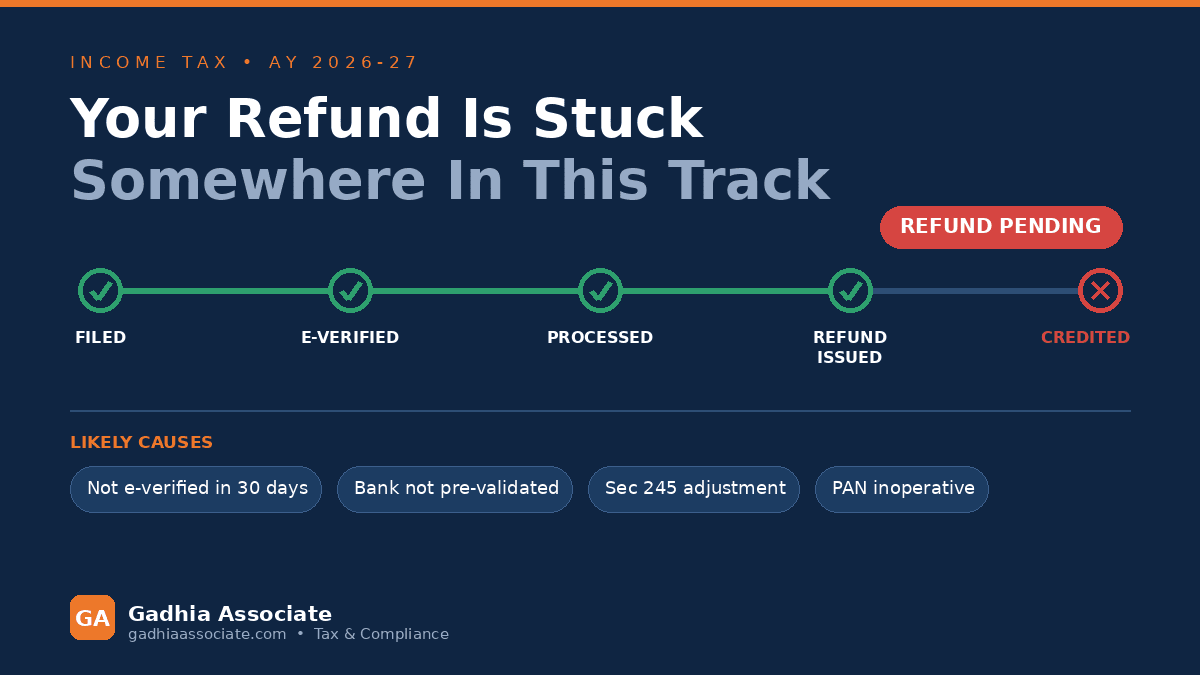
Your ITR refund for AY 2026-27 has not arrived. You filed well before the due date, the acknowledgement is sitting in your inbox, friends who filed after you have already been paid, and your bank account is silent. Every time you open the e-filing portal it says something slightly different, and nobody at the helpline explains why the money is stuck. Refund delays are almost never random. In practice there are seven or eight specific causes, each with its own fix, and this article walks you through diagnosing yours in the order that catches most cases fastest.
First, check this in two minutes
Before you assume the department has lost your file, log in to the income tax e-filing portal and look at two screens.
- e-File > Income Tax Returns > View Filed Returns for AY 2026-27. Read the exact status line: "Successfully e-Verified", "Under Processing", "Processed with refund due", "Processed with no demand no refund", "Processed with demand due", or worst of all "Return not verified / Invalid".
- Services > Refund Reissue. If a failed refund exists, it will be listed here waiting for you to raise a fresh request.
Also check the NSDL/TIN refund tracker with your PAN and assessment year. It shows the bank-side story: "Refund paid", "ECS failed", "Account closed", "Adjusted against outstanding demand". Those two minutes usually tell you which of the sections below is your problem.
Why is my ITR refund delayed? The likely causes, in order
Cause 1: Your return was never e-verified, so it is treated as invalid
This is the single most common reason for a refund that "never came" — the return was never legally completed. You have 30 days from the date of filing to e-verify. Miss it and the return can be treated as invalid, or the later verification date is taken as the filing date, dragging late-filing consequences with it.
How to confirm: View Filed Returns shows no verification date, or a status like "Return uploaded, pending for e-Verification".
The fix: e-Verify immediately using Aadhaar OTP, net-banking, or EVC from a pre-validated bank account. If the 30 days are gone, file a condonation of delay request under e-File > Income Tax Returns > e-Verify Return / Condonation Request, explaining the reason. If condonation is refused, you may need to file a belated or updated return depending on where the calendar stands. Timeline: once verified, processing typically takes about 4-5 weeks, sometimes faster.
How long does a refund take after e-verification?
Realistically, four to five weeks from e-verification to credit for a clean, small, salaried return. Returns with large TDS claims, capital gains, foreign income or business income routinely take longer. If you are past eight weeks with no intimation, stop waiting and start diagnosing.
Cause 2: Your bank account is not pre-validated, or is not linked to your PAN
CPC releases refunds only to a pre-validated bank account where the PAN matches the bank's records. A name mismatch (your bank has an initial, your PAN has the full name), a wrong IFSC after a bank merger, a closed or dormant account, or an account whose branch code changed will all bounce the credit even after the portal proudly says "refund issued".
How to confirm: Profile > My Bank Account. Look for validation status "Validated and EVC enabled". Anything showing "Validation in progress", "Validation failed" or "Restricted refund" is your culprit.
The fix: Add or revalidate the correct account, ensure the name and PAN with the bank match your PAN database exactly, and mark it as nominated for refund. Then go to Services > Refund Reissue > Create Refund Reissue Request, select AY 2026-27, choose the validated account and e-verify the request.
How do I raise a refund reissue request?
Login > Services > Refund Reissue > Create Refund Reissue Request > select the assessment year and the failed refund > select a pre-validated, EVC-enabled bank account > proceed and e-verify with Aadhaar OTP or EVC. You can track it under the same menu. Credit usually follows within a few weeks of a successful reissue. If it fails a second time, the bank details are still wrong — fix them before re-requesting, not after.
Cause 3: Your refund was adjusted against an old outstanding demand (Section 245)
The department can set off your current refund against demand outstanding for an earlier year. It must give you prior intimation and a window to respond before adjusting. Most taxpayers miss this email, the window lapses, silence is treated as agreement, and the refund vanishes into a demand from six years ago that may itself be wrong.
How to confirm: Pending Actions > Response to Outstanding Demand. Also read your intimation and the NSDL tracker line "Adjusted against outstanding demand".
The fix: Open the demand, and if it is not correct, choose Disagree with demand (fully or partly) with reasons — demand already paid (attach challan details), rectification already filed, demand raised on a return you never filed, or TDS credit not given. If the demand is genuinely yours, pay it and the balance refund is released. Old, stale demands frequently survive on the system because nobody ever responded to them.
Cause 4: The Section 143(1) intimation reduced or wiped out your refund
You claimed a refund; CPC processed the return and computed a smaller one, or none. This happens when there is a mismatch with AIS or Form 26AS, when TDS is claimed against income not offered, when a deduction (80C, 80D, HRA, 80G) is disallowed for want of a schedule entry, or when a challan is entered with the wrong assessment year.
How to confirm: Download the intimation under e-File > Income Tax Returns > View Filed Returns > Download Intimation, and place the "as provided by taxpayer" column next to "as computed under 143(1)". The differing row is your answer. Our earlier articles on AIS vs Form 26AS and on how to respond to income tax notices explain how to read those mismatches line by line.
The fix: If CPC made the error, file a rectification under Section 154 (Services > Rectification), choosing the correct request type — reprocess the return, tax credit mismatch, or return data correction. If you made the error, a revised return is the correct route, not a rectification. Getting this choice wrong costs months.
Cause 5: Your PAN is inoperative because it is not linked with Aadhaar
An unlinked PAN becomes inoperative. While it stays inoperative, your refund is withheld and no interest is paid for that period. Higher TDS can also apply, quietly making the problem bigger.
How to confirm: Profile > PAN details, or the Link Aadhaar Status page. It will say "inoperative" plainly.
The fix: Complete PAN-Aadhaar linking with the prescribed fee, wait for the status to flip to operative, then raise a refund reissue request. Fix the underlying name or date-of-birth mismatch first if linking fails.
Cause 6: The refund is withheld because assessment or scrutiny is pending
Where a notice has been issued and assessment is pending, the department can withhold a refund with approval, historically under Section 241A and now dealt with under the Section 245 framework. You will usually see a communication saying the refund is withheld pending assessment.
The fix: There is no shortcut. Respond to the scrutiny notice properly and on time — the refund follows the assessment. This is the point at which DIY stops being sensible.
Cause 7: It is genuinely just slow — claim your interest
Where the delay is not attributable to you, Section 244A provides interest on the delayed refund. It is computed automatically at processing; if it is missing or short, raise it in the rectification. Note also that the Income-tax Act, 2025, in force from 1 April 2026, has renumbered many of these provisions. The remedies are the same; only the section numbers in your notice may read differently, so match the description in the notice rather than the number you remember.
An illustrative example
Illustrative only. A Junagadh shopkeeper files for AY 2026-27 claiming a refund of Rs 40,000. The intimation shows a refund of Rs 12,000 instead. The reason: Rs 28,000 of TDS deducted by a buyer appeared in AIS under a different PAN-linked entry and was not picked up. A rectification for tax credit mismatch, with the AIS extract and the deductor's certificate, restores the balance — no revised return needed.
What makes it worse — and what not to do
- Do not file a fresh original return when a rectification or revised return is the right remedy. It creates duplicate records and a fresh delay.
- Do not ignore the Section 245 intimation. Silence is read as agreement.
- Do not raise a refund reissue request before fixing the bank validation — it will simply fail again.
- Do not add a bank account whose name does not match your PAN and hope it clears.
- Do not file repeated grievances on the same issue; use e-Nivaran / Grievances tagged to CPC-ITR once, with document references.
- Do not "disagree" with a demand without evidence — challan numbers, dates and amounts are what move it.
When you should stop DIY and get help
Call a professional when: the refund is adjusted against a demand you believe is wrong and involves several assessment years; you have received a scrutiny or reassessment notice with a short deadline; your rectification has been rejected or reprocessed with the same result; the AIS/26AS mismatch involves capital gains, property transactions or multiple deductors; the refund is large enough that a mistake in the route costs you real money; or you simply cannot tell whether you need a rectification, a revised return or a demand response. Each of those has a wrong path that wastes three to six months.
How Gadhia Associate Can Help
We handle stuck refunds every week. We read your Section 143(1) intimation line by line against your return, AIS and Form 26AS and tell you exactly what CPC changed and why. We file the correct remedy — rectification under Section 154, revised return, or a documented response to an outstanding demand under Section 245 — instead of guessing. We fix bank pre-validation and PAN linkage issues, raise and follow up the refund reissue request until the credit lands, compute and chase interest under Section 244A where it is due, and escalate through e-Nivaran and the jurisdictional office when the portal goes quiet. Where a scrutiny notice is behind the withheld refund, we handle the full reply and representation.
The first consultation is free. We are based in Junagadh and work with clients across Gujarat and the rest of India entirely digitally — documents over WhatsApp, no office visit needed. Call or WhatsApp +91 82005 28355 with your PAN, assessment year and a screenshot of your refund status, and you will get a straight answer about what is holding your money and how long the fix will take.
This article reflects the position as of August 2026. Income tax rules, section numbering under the Income-tax Act, 2025, portal procedures and timelines change through CBDT notifications and circulars, and outcomes depend on the facts of each individual case. Please obtain professional advice before acting.