GST Input Tax Credit Blocked Under Rule 86A? Why Your Electronic Credit Ledger Is Frozen and How to Get It Unblocked
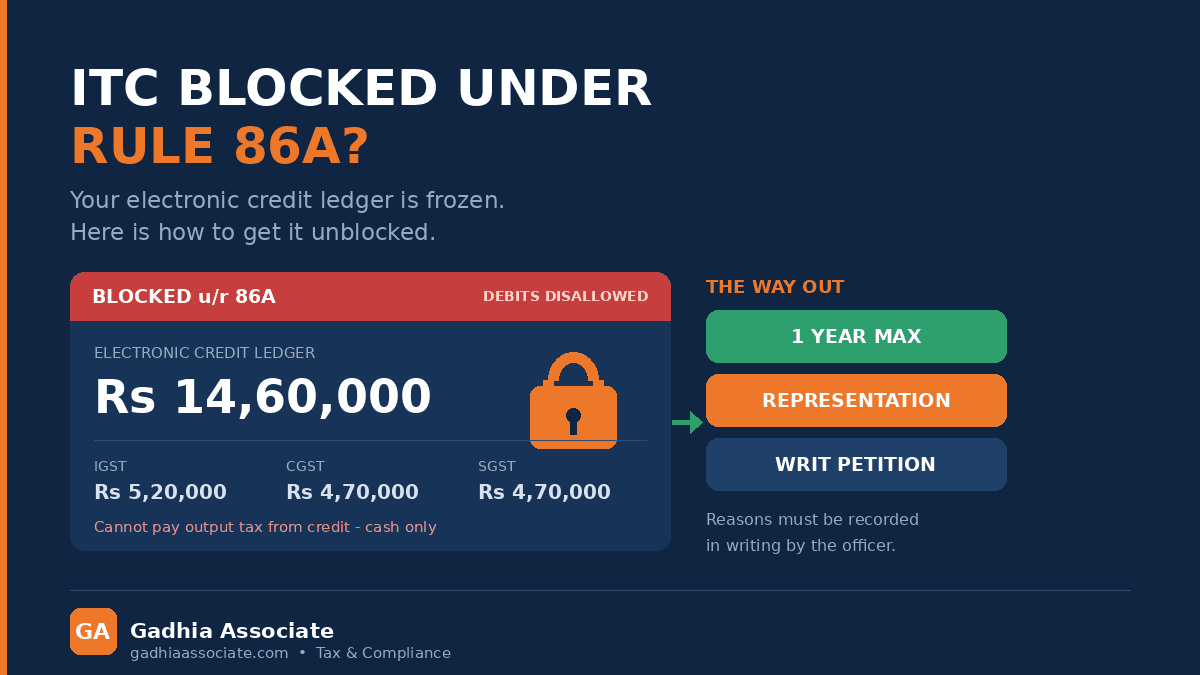
You go to file GSTR-3B, and the portal will not let you use your credit balance. The money is sitting right there in your electronic credit ledger, but every time you try to offset output tax against it, the system refuses. Your input tax credit is blocked under Rule 86A, and nobody told you in advance. No notice arrived, no officer called. You found out because the return would not submit.
This is not a system error and it will not fix itself before your due date. But it is temporary by law, and there is a defined route out.
Why is my ITC blocked under Rule 86A?
Rule 86A of the CGST Rules lets the Commissioner, or an officer authorised by him not below the rank of Assistant Commissioner, disallow debits from your electronic credit ledger where he has reason to believe that credit was fraudulently availed or is ineligible. The rule requires him to record those reasons in writing before doing it.
The listed grounds are narrow. Credit taken on invoices from a supplier found to be non-existent or not conducting business from his registered place. Credit taken without actually receiving the goods or services. Credit where the tax was never paid to the government. Credit where you do not hold the invoice or debit note at all. In practice, the overwhelming majority of blockings in Gujarat trace back to the first and third grounds — one of your suppliers turned out to be non-genuine, or simply never paid.
Check this in two minutes
Log in to the GST portal and go to Services > Ledgers > Electronic Credit Ledger. On that screen you will see a Blocked Credit Balance option. It shows the amount blocked, split across IGST, CGST and SGST, the date of blocking, and the details of the authority that placed the block. Print or screenshot this — it is the starting point of everything that follows, and it tells you which jurisdiction you are dealing with.
Then check Services > User Services > View Additional Notices and Orders. Sometimes the recorded reasons or an intimation are sitting there unread.
What each cause looks like and how to fix it
Cause 1: Your supplier has been found non-existent
The department verified a supplier's registered premises and found nobody there, or the registration was cancelled retrospectively as bogus. Every recipient who claimed credit on that GSTIN gets blocked.
How to confirm: search the supplier's GSTIN on the portal and look at the status and cancellation date. If it shows cancelled with a date before your purchase, this is your cause.
The fix: prove your transaction was genuine even if the supplier was not. Assemble the tax invoice, the e-way bill, transport documents such as the lorry receipt and weighbridge slip, goods inward and stock records, and bank statements showing payment made through banking channels. File a written representation to the jurisdictional Commissioner attaching all of it. Timeline: allow two to six weeks for a decision, longer if the investigation is still open.
Cause 2: The supplier did not pay the tax or did not file returns
Your supplier issued the invoice, reported it in GSTR-1 so it appeared in your GSTR-2B, but never filed GSTR-3B or never actually deposited the tax. The credit was availed but not backed by payment to the government.
How to confirm: use the portal's return-filing status search for the supplier's GSTIN and see which GSTR-3B periods are missing.
The fix: this is often the fastest resolution because it is curable. Get the supplier to file the pending returns and pay the tax with interest. Once the tax is in the government's hands, the foundation of the blocking disappears and a representation attaching proof of the supplier's filing usually succeeds. Timeline: days to weeks, entirely dependent on how cooperative your supplier is.
Cause 3: Alleged credit without receipt of goods, or missing documents
The department alleges you took credit on paper transactions where nothing moved, or that you cannot produce the invoice. This is the most serious category because it edges into fraud allegations.
The fix: documentation, and quickly. If the goods genuinely moved, the movement trail settles it. If your invoice filing is disorganised, reconstruct it from the supplier and from your GSTR-2B before you respond to anything.
How do I get my electronic credit ledger unblocked?
There is no button on the portal for this. The route is a written representation to the Commissioner or the authority that blocked the ledger, delivered to the jurisdictional office, asking for the restriction to be lifted and specifically asking for a copy of the reasons recorded in writing if they were never communicated to you.
Gather these before you draft:
- Screenshot of the blocked credit balance showing amount, date and blocking authority
- Tax invoices and debit notes for every disputed purchase
- E-way bills, lorry receipts, transport and weighbridge documents
- Bank statements proving payment to the supplier through banking channels
- Goods inward register, stock records and, where relevant, the onward sales invoices
- GSTR-2B extracts showing the credit was auto-populated
- Supplier's GSTIN status, GSTR-1 and GSTR-3B filing history
- Any earlier notices, DRC-01A or orders on the same issue
If the representation is ignored, or the block continues without any reasons ever being recorded, the remedy is a writ petition before the High Court. Courts have consistently held that Rule 86A is a drastic, preventive power that must be exercised on tangible material and with recorded reasons, and they have not hesitated to set aside blockings that fail those tests. That route needs legal representation, but it works where representations do not.
How long can ITC be blocked under Rule 86A?
One year. Rule 86A(3) provides that the restriction ceases to have effect after the expiry of one year from the date it was imposed. It lapses by operation of law — no fresh order is needed. High Courts have ordered unblocking where the department kept a ledger frozen past that date.
Note the date of blocking from your ledger screen and diarise the anniversary. If the balance is still blocked a day after, write to the officer immediately citing sub-rule (3). What you must watch for is a fresh blocking order issued on the same facts as the old one expires — that is challengeable, and you should not let it pass unnoticed.
Can the officer block more credit than my balance?
This is the negative blocking controversy. Where the department believes you wrongly availed Rs 30 lakh but only Rs 5 lakh remains in your ledger, some officers have blocked the full Rs 30 lakh, driving the ledger to an effective negative and catching credit you have not even earned yet.
The judicial trend has run strongly against this. Courts have taken the view that Rule 86A permits disallowing debits from credit available in the ledger, not the creation of a negative balance, because the rule is preventive and not a recovery mechanism. If your blocked amount exceeds the balance that was in the ledger on the date of the order, say so explicitly in your representation — it is one of the strongest points you can make. Our article on landmark GST judgments discusses how courts have approached ITC disputes generally.
An illustrative example
A Junagadh trader has Rs 8,00,000 in his credit ledger. A supplier is found non-existent, and Rs 6,50,000 is blocked. His next GSTR-3B carries Rs 4,00,000 of output tax, which he now has to pay entirely in cash. He gathers invoices, e-way bills and bank proof, files a representation, and the ledger is released in about five weeks. Figures are illustrative only.
What makes it worse, and what not to do
Do not stop filing. A blocked ledger does not excuse a late return — you still owe late fee and interest, and unfiled returns can lead to further restrictions and even suspension of registration. Pay the output tax in cash if you must, keep filing, and fight the blocking separately.
Do not keep buying from the same supplier. Every further invoice from a non-compliant GSTIN adds to the exposure and destroys the argument that you were an innocent recipient exercising due diligence.
Do not send an emotional one-page letter. A representation that simply says the blocking is unfair, without documents, gets filed away. Our articles on replying to GST notices and on GST ITC eligibility rules cover the drafting discipline this needs.
When to stop DIY and get help
Call a professional when the blocked amount is large enough to affect your working capital, when your representation has gone unanswered for weeks, when the block exceeds the balance you had, when the reasons recorded have never been shared with you, when a summons or DRC-01 arrives alongside the blocking, or when the one-year period is close to expiring and nothing has moved.
How Gadhia Associate Can Help
We handle Rule 86A blockings regularly. We pull the blocked credit details from your ledger, identify exactly which supplier and which period triggered it, and obtain the recorded reasons where they were never served. We draft the representation to the Commissioner with a properly indexed document set — invoices, e-way bills, transport records and bank proof — rather than a bare letter. We coordinate directly with your supplier to get pending GSTR-3B returns filed and tax paid, which is often the quickest release. Where the blocking is arbitrary, unreasoned, exceeds your available balance or has run past one year, we advise on the writ route and work with counsel.
We are based in Junagadh, Gujarat, and serve clients across Gujarat and India digitally. The first consultation is free. Call or WhatsApp +91 82005 28355 with your GSTIN and the blocked amount, and we will tell you which of the four grounds you are facing and what it takes to get your ledger released.
This article reflects the position as of August 2026. Rule 86A and GST procedures change through CBIC notifications and circulars, and judicial views continue to develop. Outcomes depend entirely on the facts of each case and on the documentation available. Writ matters before the High Court require legal representation. This is general information and not a substitute for professional advice on your own matter.